
%20(1).svg)
Month-End Close Checklist: Step-by-Step Guide
By Anran Xie |
Last Updated: October 13, 2026
The month-end close does not end when accounting posts the last journal entry. Finance still needs to confirm that the numbers are complete, reconcile material accounts, explain significant variances, and make sure actuals are ready for management reporting and forecasting.
A clear close checklist keeps these tasks from becoming a last-minute scramble. It also gives accounting, FP&A, and finance leadership a shared view of what needs to happen, who owns each task, and what must be completed before reporting can move forward.
This month-end close checklist covers the accounting work required to close the books, followed by the FP&A work needed to turn finalized actuals into useful analysis and updated forecasts.
A month-end close works best as a defined sequence rather than a list of disconnected accounting tasks. Each step builds on the previous one, from preparing the close and completing transactions to reconciling accounts, validating results, and preparing them for FP&A and management reporting. Use the following process as a starting point and adapt the timing, owners, and controls to your finance team's close cycle.
Start by confirming the close calendar, deadlines, and responsibilities before transaction processing begins. This gives each team a clear cutoff and makes it easier to identify tasks that could delay reporting.
Before the close, confirm
A recurring close calendar can also help finance identify tasks that need to happen before the books can be finalized.
The accounting team needs to make sure transactions for the period have been captured before reviewing the resulting balances. Missing activity at this stage can create reconciliation issues or distort the financial statements.
Complete the required processing for:
Review cutoff issues carefully. Transactions that belong to the period but are posted later may require an accrual or other adjustment.
Once routine transactions are processed, record the adjustments needed to reflect the period accurately. The specific entries depend on the company's accounting policies and the activity during the month.
Common adjustments include:
Document the basis for significant or unusual entries so reviewers can understand why the adjustment was recorded.
Reconciliations help confirm that the balances in the general ledger agree with the relevant supporting records. Prioritize accounts that are material or have a history of reconciliation issues.
Review:
Track unreconciled differences separately. A reconciliation that cannot be completed should have an identified owner, explanation, and follow-up action.
After reconciliations are complete, review the general ledger for unusual activity or balances that need further investigation.
Look for:
This review can catch issues that individual account reconciliations may not reveal.
With the underlying accounts reviewed, examine the financial statements before distributing management reports.
Review the
Once actuals are sufficiently finalized, FP&A can begin analyzing what changed during the period. This is where the close moves from accounting completion to financial performance analysis.
Compare actual results with
Investigate material variances and identify the underlying business drivers. A revenue variance, for example, may be related to changes in volume, pricing, customer mix, or timing. An expense variance may result from headcount, vendor costs, timing, or one-time activity.
FP&A should also confirm that departmental, entity, and other reporting dimensions are complete before using the results for management reporting.
The latest actuals may change assumptions used in the forecast. Review whether the close reveals changes that should flow into future periods.
Consider whether there are changes to
Not every monthly variance requires a forecast change. Separate timing differences from changes that indicate the underlying business assumption has shifted.
Once the results and major variances have been reviewed, prepare the reporting package for finance and business leadership.
Management reporting may include
The commentary should explain the material movements rather than simply repeat the numbers. Leadership should be able to see what changed, why it changed, and whether the change affects future periods.
Before considering the monthly close complete, confirm that outstanding issues have been reviewed and that required approvals have been obtained.
Complete the final checks for
Document recurring issues while they are still fresh. These notes can help finance improve the next close rather than repeatedly solving the same problems.
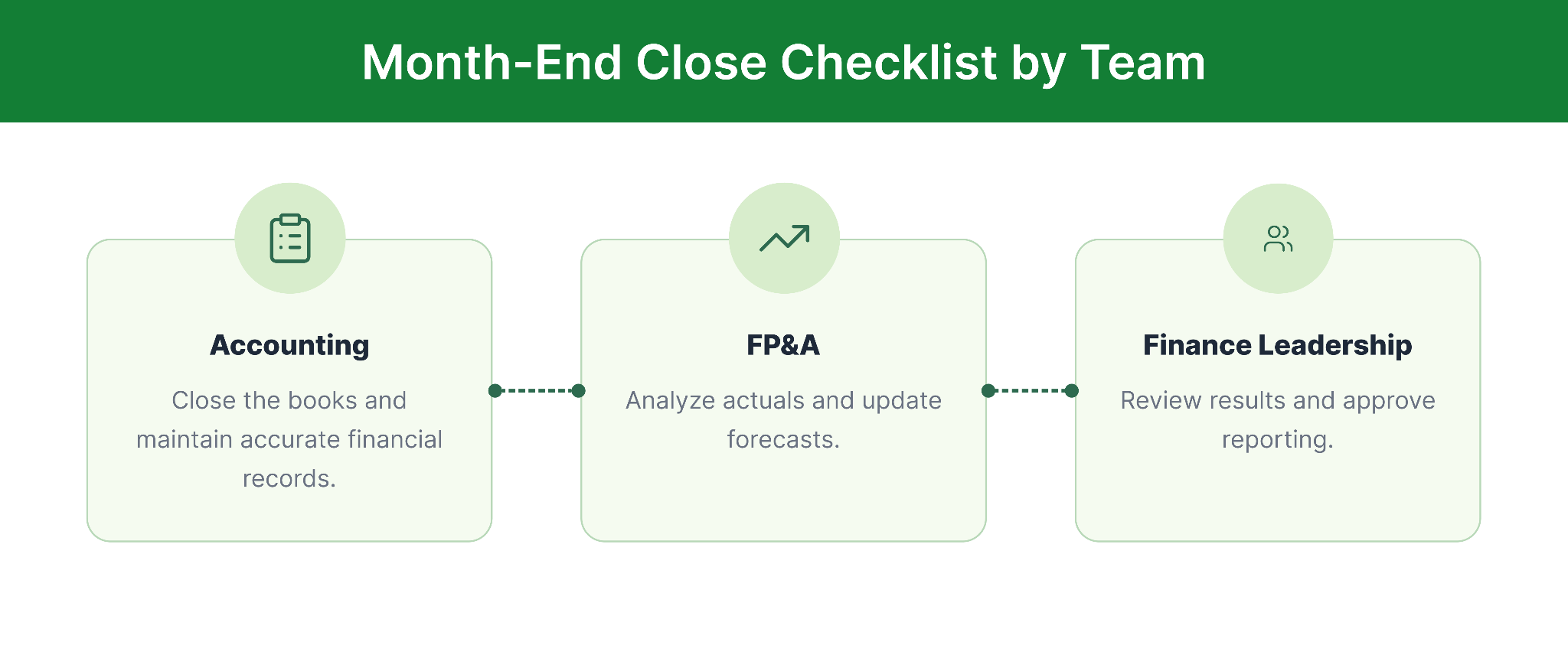
The close works better when accounting, FP&A, and finance leadership know where their responsibilities begin and end. The following breakdown can help separate the work:
Accounting owns the activities required to establish complete and accurate financial records for the period.
FP&A uses the finalized or sufficiently stable actuals to explain performance and assess what the results mean for the forecast.
Finance leadership reviews the results and ensures that significant issues are resolved before the numbers are communicated.
A traditional accounting close checklist can stop once the books are closed. FP&A has additional work to do because finalized actuals become inputs for forecasting, variance analysis, and management decisions.
A faster close is not simply about completing every task sooner. The process also needs clear ownership, fewer manual handoffs, and reliable data moving from accounting into reporting and planning.
Focus on these improvements
The biggest efficiency gains often come from removing repeated manual work between accounting, reporting, and FP&A rather than simply shortening individual accounting tasks.
Finance teams can adapt this template to their own close calendar.
|
Task |
Owner |
Deadline |
Status |
Dependency |
Notes |
|
Confirm close calendar |
Finance |
||||
|
Complete transaction processing |
Accounting |
||||
|
Post adjusting entries |
Accounting |
||||
|
Complete account reconciliations |
Accounting |
||||
|
Review general ledger |
Accounting |
||||
|
Validate financial statements |
Accounting / Finance |
||||
|
Validate actuals for FP&A |
FP&A |
||||
|
Review budget and forecast variances |
FP&A |
||||
|
Update forecast assumptions |
FP&A |
||||
|
Prepare management reporting |
FP&A / Finance |
||||
|
Review and approve reporting |
Finance leadership |
||||
|
Document outstanding items |
Accounting / FP&A |
The checklist can be expanded with task-specific dependencies, approval requirements, and recurring deadlines.
Closing the books gives finance a finalized set of actual results. The next step is turning those results into information that can support decisions.
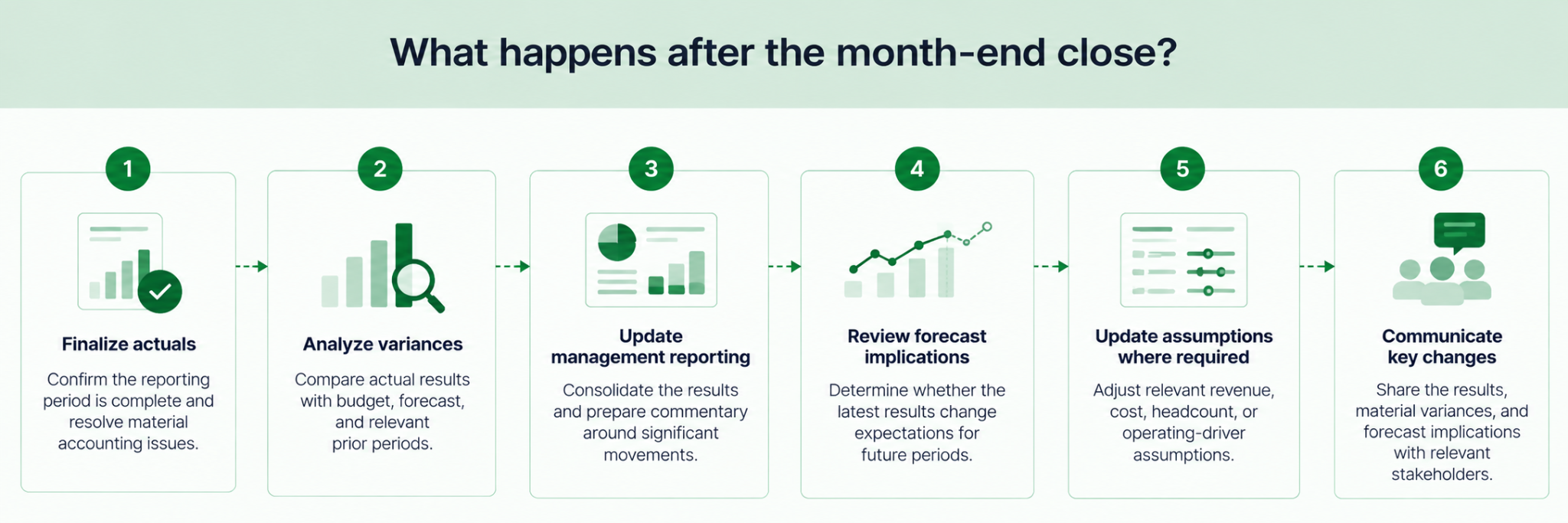
The post-close process typically includes
This creates a continuous cycle from close to actuals to analysis to forecast rather than treating each activity as a separate finance process.
The month-end close produces the actuals that FP&A needs for analysis and forecasting. When those actuals, budgets, forecasts, and business drivers are maintained in disconnected spreadsheets and systems, finance can spend significant effort moving and reconciling the same information each month.
Limelight connects actuals, budgets, forecasts, and business drivers in one financial model. This gives finance teams a connected structure for moving from finalized results to variance analysis, reporting, and forecasting.
See how Limelight can connect your actuals, budgets, forecasts, and reporting in one financial model.
A soft close uses preliminary financial information to provide an earlier view of performance, while a hard close is completed after the required accounting procedures and reviews are finished. A finance team may use a soft close for internal reporting while continuing to complete the remaining work required for the formal period close.
Finance teams can track measures such as the number of days required to close, the number of unresolved reconciliations, late journal entries, post-close adjustments, and recurring exceptions. Tracking these measures over time can show where the close process is creating delays or rework.
A close policy can define the required close activities, deadlines, responsibilities, approval requirements, supporting documentation, reconciliation standards, exception handling, and period-lock procedures. It gives the checklist a consistent set of controls to follow each month.
Common process issues include late transaction submissions, unresolved reconciliations, intercompany differences, missing supporting information, manual data transfers, and unclear ownership of close tasks. Reviewing these issues after each close can help finance identify recurring sources of delay.
Finance should follow its established post-close policy for material transactions rather than reopening the period automatically. The appropriate treatment depends on the organization's accounting policies, materiality, reporting requirements, and whether the transaction requires an adjustment to a previously reported period.
Before locking a period, finance should confirm that required reconciliations, journal-entry approvals, financial statement reviews, and material issue resolutions are complete. The specific controls should reflect the organization's accounting policies and reporting requirements.
Subscribe to our newsletter