
Finance-Owned Modeling
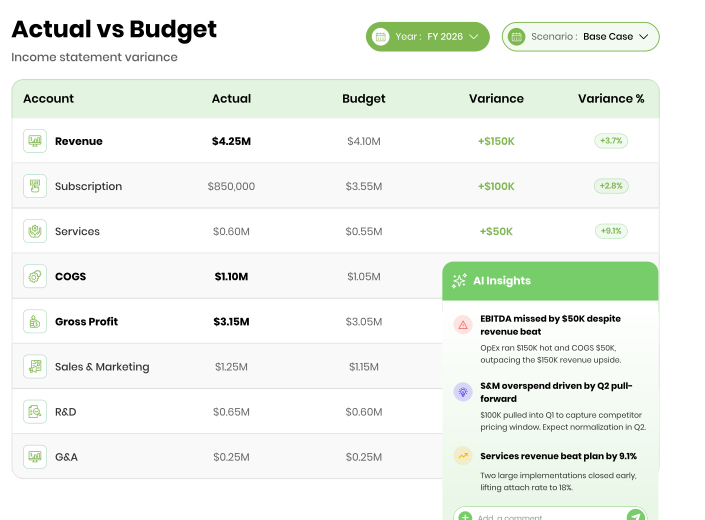
Designed for Finance, Built for Power. Limelight's intuitive, no-code platform puts financial modeling in your hands. Create custom hierarchies, define business rules, and unlock data-driven insights.
Your Financial Picture, Unified and Dynamic
Limelight consolidates your financial data into a single, interactive model. Uncover insights, run what-if scenarios, and confidently forecast the future of your business.
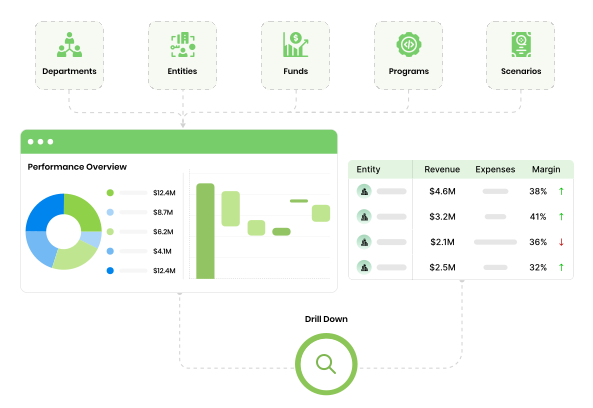
Structure Your Data
Organize your financial information into meaningful hierarchies and dimensions, creating a clear and comprehensive view of your business.
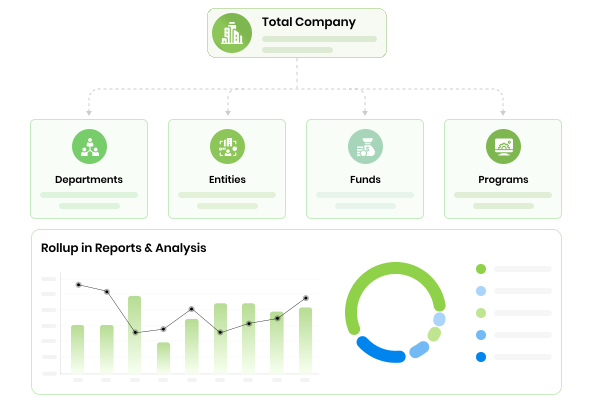
Automate Roll-Ups
Effortlessly aggregate financial data across various levels (e.g., departments, regions, time periods) for insightful reporting and analysis.
Set Business Rules
Apply business rules to automate calculations, allocations, and consolidations.
The Secret Weapon Behind Successful FP&A
Discover the modeling engine that's transforming the way finance teams work.
Effortless Automation
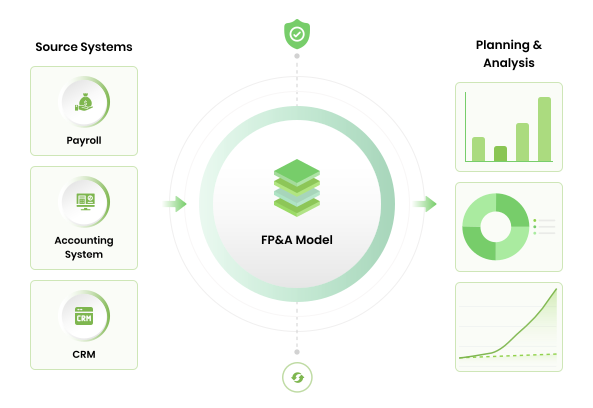
Connect all your data sources and let Limelight do the heavy lifting – calculations, rollups, consolidations, you name it! No more complex formulas, just real-time accuracy
Drives Accuracy and Consistency
Centralize your data, say goodbye to version control chaos, and always work with the most up-to-date information.
Enables Agility
What-if scenarios? New product launches? Departmental changes? No problem! Limelight's dynamic modeling adapts to your business in a flash.
How to Build a Financial Model in 3-Minutes
Limelight powers some of North America’s fastest growing companies
Frequently Asked Questions
Financial modeling software is a system that centralizes financial data, structures it into organized hierarchies, and applies business rules and calculations across the entire model.
Unlike spreadsheets, where formulas live in individual cells, financial modeling software groups accounts, departments, entities, and dimensions into a structured framework. Business logic is layered on top of that structure, creating a controlled financial environment that behaves like finance’s own database. This allows finance teams to build scalable, accurate financial models that update automatically as data changes.
Financial modeling software works by centralizing data from ERP and accounting systems into a structured data model. Accounts are grouped logically, hierarchies are defined, and standardized calculations are applied consistently across the organization.
Instead of embedding formulas in multiple spreadsheets, calculations are managed centrally. When revenue assumptions, headcount, or cost drivers change, the entire model updates automatically. This structured approach improves accuracy, consistency, and scalability in financial planning and analysis.
Centralized financial modeling improves control, transparency, and accuracy. Because data and calculations are layered in one structured system, finance teams eliminate version control issues and reduce formula errors.
This approach supports real-time forecasting, scenario planning, and consolidated reporting without manual reconciliation. As organizations grow in complexity, centralized financial modeling ensures that financial planning remains scalable and reliable.
Limelight centralizes all financial data and automates calculations across models. This removes version control issues, reduces manual errors, and ensures models always reflect the most up-to-date data.
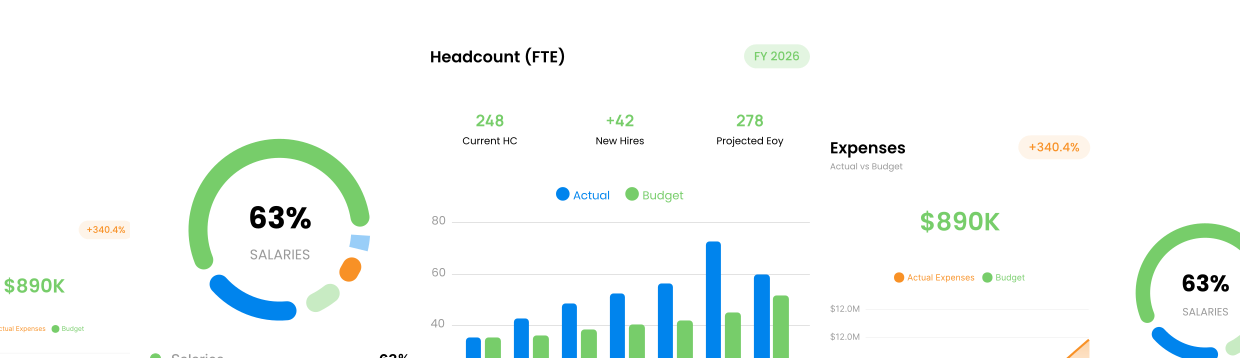
Yes. Limelight enables finance teams to run what-if scenarios by adjusting assumptions such as revenue growth, headcount, or costs to quickly understand their impact on financial outcomes.
Financial modeling software is used by FP&A teams, financial analysts, controllers, and CFOs who need reliable forecasting, deeper financial insights, and scalable modeling without spreadsheet complexity.
Limelight integrates with ERP and accounting systems to pull real-time financial data directly into models, eliminating manual data imports and ensuring a single source of truth.
Unlike spreadsheets, financial modeling software provides real-time collaboration, automated calculations, structured data models, and scalability — allowing finance teams to focus on insights instead of maintenance.
Get ahead with faster insights
We'll show you what automated FP&A looks like and how easily you can build reports.