
%20(1).svg)

By Jade Cole |
Last Updated: August 24, 2026

• Match the tool to reporting complexity. Accounting suites handle core statements, dedicated FP&A platforms add planning and consolidation, and enterprise systems cover more complex close, compliance, and reporting requirements
• Check ERP fit before feature count. Native connections, dimensional reporting, and transaction-level drill-down determine how much spreadsheet work actually disappears
• Compare pricing models, not one headline range. Small-business tools publish monthly list prices, while most FP&A and enterprise vendors use custom quotes
• Treat consolidation as an upgrade trigger. Multiple entities, intercompany eliminations, currency translation, and governed group reporting often push teams beyond basic accounting-suite reports
• Limelight fits mid-market teams that want reporting and planning together. Its current platform combines ERP-connected reporting, planning, workforce modeling, scenario analysis, and AI-assisted finance workflows
Financial reporting software ranges from low-cost accounting suites that produce core statements to FP&A and enterprise platforms that consolidate entities, connect to ERPs, and link reporting with planning.
The right choice depends less on the longest feature list than on your entity structure, source systems, reporting depth, and how much of the process finance can own without IT.
Finance teams are evaluating these tools while technology priorities are rising faster than reporting maturity. EY’s 2025 Tax and Finance Operations Survey, based on 1,600 tax and finance executives across 30 jurisdictions and 22 industries, found that 86% rank data, AI, and technology as a top priority. The 2026 FP&A Trends Survey, based on 475 respondents, found that 47% of FP&A time is still spent on data collection and validation, while only 11% of organizations have real-time access to data.
That gap matters when comparing software. A credible shortlist should solve current reporting problems first, including consolidation, data connectivity, controls, drill-down, and report ownership, while leaving room for forecasting and AI-assisted analysis as finance processes mature.
This guide compares 19 tools on reporting, consolidation, integrations, audit controls, usability, and pricing, then maps those options to company size and reporting complexity.
Disclosure: Limelight publishes this guide and appears in the list. Every tool is assessed against the same evaluation criteria described below.
Coverage varies by product tier, but most tools in this guide generate some combination of the following outputs:
• Income statement or profit and loss statement
• Balance sheet
• Cash flow statement
• Management and variance reports
• Board packs and executive dashboards
• Consolidated group financials
• Department or cost-center P&L reports
• Rolling forecast reports
The deeper distinction is how much control finance has over consolidation, dimensions, drill-down, and report design. Those capabilities separate basic accounting reports from dedicated FP&A and enterprise reporting platforms.
A useful comparison needs the same standard for every vendor. We assessed each tool against eight criteria that matter to corporate finance teams:
• Statement generation and accounting-standard support: Can the platform produce income statements, balance sheets, cash flow statements, and management reports without repeated manual rework?
• Multi-entity consolidation: Can it roll up subsidiaries, handle intercompany eliminations, and support currency translation where those capabilities are part of the product?
• ERP and GL connectivity: Does it connect to common source systems without relying on recurring file exports?
• Dimensional reporting: Can finance analyze results by department, cost center, project, entity, or another business dimension?
• Report control by finance: Can finance users build and change reports without depending on IT for routine updates?
• Drill-down: Can a user move from a summary number to the journal entry or transaction behind it?
• Audit trail and access controls: Does the platform maintain version history, role-based permissions, and a clear record of changes?
• Pricing transparency: Is pricing public, or does the vendor clearly direct buyers to a custom quote?
Feature and pricing information was checked against current vendor documentation and pricing pages on August 11, 2026. G2 ratings were also checked on August 11, 2026, and linked in both the comparison table and each tool subsection. Review scores can change, so treat them as a current snapshot rather than a permanent ranking.
The list spans accounting suites, dedicated FP&A platforms, ERP reporting tools, and enterprise performance-management software. Use the table to narrow the field, then use the vendor entries for fit, capability, and pricing context.
|
No. |
Platform |
Best for |
Pricing |
G2 rating |
|
1 |
Limelight |
Mid-market finance teams that want reporting, planning, workforce modeling, and ERP-connected FP&A in one platform |
From $1,400/month in Limelight’s 2026 pricing guide. Starter supports up to five users. |
|
|
2 |
Prophix |
Mid-market teams combining FP&A, financial close, consolidation, and reporting |
No public standard list price. Contact Prophix. |
|
|
3 |
Cube |
Spreadsheet-centric finance teams that want planning and reporting in Excel and Google Sheets |
Custom quote across Bronze, Silver, and Gold plans. |
|
|
4 |
Oracle NetSuite |
Organizations that want ERP, accounting, and multi-subsidiary reporting in NetSuite OneWorld |
No public standard list price. Contact an account representative. |
|
|
5 |
QuickBooks Online |
Small businesses needing core accounting statements and management reporting |
The current US list prices are Simple Start at $38/month, Essentials at $75/month, Plus at $115/month, and Advanced at $275/month before temporary promotions. |
|
|
6 |
FreshBooks |
Freelancers and small service businesses needing accounting and invoicing with financial reports |
Pricing varies by region, customer type, plan, client limits, and promotion. |
|
|
7 |
Sage Intacct |
Scaling and mid-market organizations needing multi-entity accounting and dimensional reporting |
Tailored quote based on modules and organization needs. |
|
|
8 |
insightsoftware Spreadsheet Server |
ERP-centric finance teams that want live, drillable reporting in Excel |
Custom quote based on region, business goals, and technology requirements. |
|
|
9 |
Workday Adaptive Planning |
Enterprises and high-growth organizations standardizing planning, reporting, and optional close and consolidation |
Pricing varies. Request a quote. |
|
|
10 |
Board |
Enterprises combining planning with financial consolidation and reporting |
Customized quote. |
|
|
11 |
Vena Solutions |
Excel-centric FP&A teams adding a governed database, workflows, reporting, and planning |
Professional and Complete plans. Custom pricing. |
|
|
12 |
Planful |
Mid-market and enterprise teams centralizing planning, reporting, close, and consolidation |
Custom quote through Planful sales. |
|
|
13 |
Datarails |
Excel-centric teams centralizing reporting, dashboards, and planning |
Professional, Premium, and Expert plans. All require a custom quote. |
|
|
14 |
Jirav |
Small and growing finance teams that need planning, reporting, and connected three-statement projections |
Starter $10,000/year, Pro $15,000/year, Enterprise custom quote. |
|
|
15 |
SAP S/4HANA Finance for group reporting |
Global SAP-centered organizations with complex group consolidation and reporting |
Price upon request. |
|
|
16 |
Synoptix |
Teams extending ERP reporting with real-time data, drill-down, scheduling, and dashboards |
Contact Synoptix for a quote. |
|
|
17 |
Workiva |
Public and regulated organizations managing SEC, disclosure, and compliance reporting |
Customized, solution-based subscription pricing. |
|
|
18 |
Jedox |
Mid-market and enterprise teams needing integrated planning and reporting with flexible packaging |
Custom quote by package, users, add-ons, and deployment needs. |
|
|
19 |
Zoho Books |
Small businesses needing standard statements and accounting-suite reporting |
Free plan available. Standard $20/month, Professional $50/month, Premium $70/month. Annual billing lowers those tiers to $15, $40, and $60 per organization per month. |
Table: The comparison combines reporting fit, pricing, and current G2 ratings, with SAP’s 4.4/5 score referring to SAP Cloud ERP because G2 does not list group reporting separately.
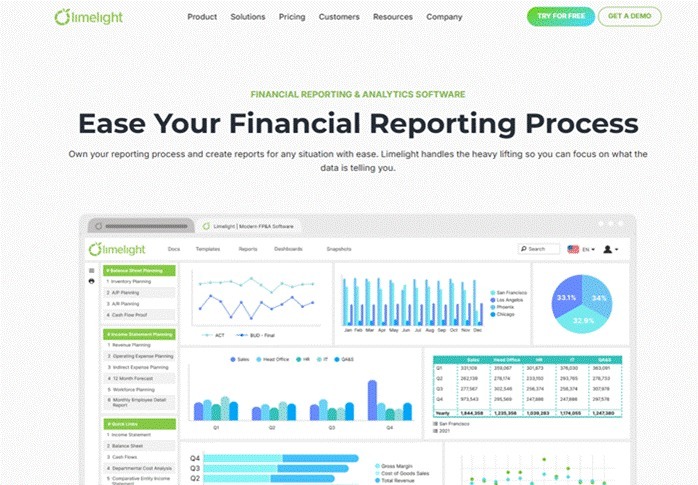
Limelight is a cloud FP&A platform for finance teams that want reporting, planning, forecasting, workforce modeling, and AI-assisted analysis in one environment. Its reporting platform supports financial statements, actual-versus-budget and actual-versus-forecast views, variance analysis, management reporting, drill-down, drill-through, comments, and report books.
• ERP-connected reporting: Limelight connects with systems including NetSuite, Sage Intacct, Microsoft Dynamics, QuickBooks, and other finance systems, reducing recurring manual exports
• Planning and scenario modeling: Budgeting, forecasting, driver-based models, and scenario analysis sit alongside reporting
• Multi-entity reporting: Limelight supports multi-entity and multi-currency reporting for finance teams that need consolidated views across companies or locations
• Workforce modeling: Finance can model headcount, salaries, bonuses, benefits, and hiring scenarios
• AI-assisted analysis: Limelight AI explains variances, highlights trends, flags anomalies, and can generate forecasts and what-if scenarios
Limelight is best suited to mid-market finance teams that want finance-owned reporting and planning without maintaining separate spreadsheet processes for actuals, budgets, forecasts, and management reporting.
A dedicated FP&A platform is a larger commitment than an accounting-suite reporting tool. Buyers should validate source-system mappings, multi-entity requirements, implementation scope, and the performance of their largest recurring reports during the evaluation.
Limelight’s 2026 FP&A software pricing guide lists a starting point of $1,400 per month. Its current pricing page states that Starter supports up to five users and that core planning, reporting, workforce planning, scenario planning, narrative reporting, and AI capabilities are included with the subscription.

Prophix One combines FP&A with financial close and consolidation. Its current financial close documentation covers automated data imports, account reconciliation, intercompany eliminations, currency translation, journal entries, reporting, and audit trails.
• Automated consolidation and close workflows across multiple entities
• Intercompany eliminations, currency translation, journal entries, and report assembly
• Data integration across accounting and operational systems
• Audit trails and customizable audit reports
Prophix fits mid-market organizations that want planning, reporting, close, and consolidation within a broader corporate performance-management environment.
The breadth of the platform means implementation scope matters. Teams should test source-system mapping, close workflows, ownership structures, eliminations, and report maintenance using their own data structure.
For a direct comparison with Limelight, see Limelight vs. Prophix.
Prophix does not publish a standard list price on the financial-close page reviewed for this guide. Contact Prophix for current pricing.
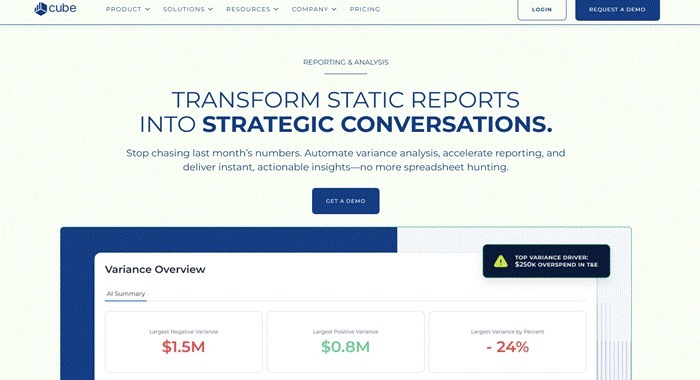
Cube is a spreadsheet-centric FP&A platform that works with Excel and Google Sheets while adding governed data, planning, reporting, dashboards, workflow, and AI-assisted finance capabilities.
• Excel and Google Sheets workflows for finance users who want to keep familiar spreadsheet interfaces
• Unlimited dimensions, users, and dashboards across current pricing tiers
• Reconciliation, audit trails, drill-down to GL transactions, forecasting, and scenario modeling
• Workflow, collaboration, and presentation integrations on higher tiers
Cube fits finance teams that want to modernize FP&A while keeping Excel or Google Sheets central to day-to-day modeling and reporting.
Buyers should confirm which integrations, workflow features, support levels, API access, and additional modules are included in the tier they are evaluating.
For a direct comparison with Limelight, see Limelight vs. Cube.
Cube’s official pricing page lists Bronze, Silver, and Gold plans, but each requires a custom quote. The canonical pricing page does not publish a standard monthly starting price.
Oracle NetSuite OneWorld is an ERP environment for global and multi-subsidiary organizations. OneWorld rolls subsidiary data into consolidated reporting, supports multiple currencies, and uses elimination subsidiaries to balance intercompany activity at the consolidated level.
• Multi-subsidiary accounting and consolidated reporting within one NetSuite account
• Currency translation through consolidated exchange rates
• Intercompany transaction handling and elimination journal entries
• ERP, accounting, operational, and reporting data inside one suite
NetSuite is strongest when the organization already wants NetSuite to be the core ERP and financial system, rather than adding reporting as a separate layer across several ERPs.
OneWorld is an ERP platform first. Organizations that want deeper cross-system FP&A, finance-owned planning, or specialized management reporting should test whether native NetSuite capabilities cover those workflows or whether an FP&A layer is still needed.
Oracle does not publish a standard list price in the OneWorld documentation used for this comparison and directs interested buyers to contact their account representative. Pricing depends on the NetSuite configuration and implementation scope.
For teams using NetSuite as the system of record, Limelight’s NetSuite FP&A software guide compares planning, forecasting, and reporting options that sit on top of the ERP.

QuickBooks Online is an accounting platform for small and growing businesses. All plans cover core accounting, while higher tiers add deeper reporting, budgeting, forecasting, KPI tracking, and dashboard features.
• Core accounting statements and business reports
• Enhanced reports on Essentials and higher tiers
• Budgeting and deeper reporting features on higher plans
• Advanced dashboards, KPI tracking, management reports, forecasting, and Excel data sync on Advanced
QuickBooks Online fits smaller organizations that need accounting-led reporting without the consolidation, modeling, and governance depth of a dedicated FP&A platform.
Capabilities vary materially by plan. Buyers should map required reporting, budgeting, classes, locations, users, and forecasting features to the exact tier rather than comparing QuickBooks Online as one undifferentiated product.
The current US list prices are Simple Start at $38/month, Essentials at $75/month, Plus at $115/month, and Advanced at $275/month before temporary promotions.
If native QBO reporting is becoming restrictive, see Limelight’s guide to budgeting software for QuickBooks Online.
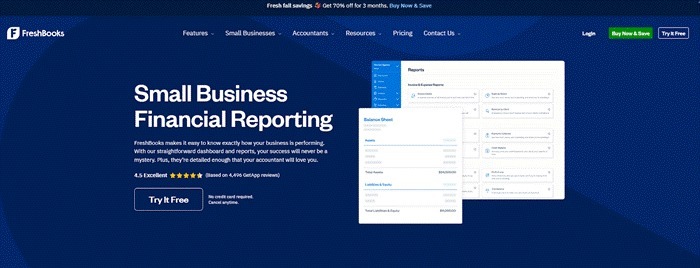
FreshBooks is an accounting and invoicing platform for freelancers, service businesses, and small teams. FreshBooks’ official pricing guidance states that accounting reports such as the Chart of Accounts, General Ledger, and Trial Balance are available on Plus, Premium, and Select, while Project Profitability is available on Premium and Select.
• Invoicing, expenses, time tracking, and small-business accounting
• Accounting reports on Plus, Premium, and Select
• Accounts payable on Premium and Select
• Project profitability analysis on Premium and Select
FreshBooks fits freelancers and service businesses that need invoicing and accounting reports in one small-business platform.
FreshBooks is not positioned as a dedicated FP&A or enterprise consolidation system. Finance teams that need complex entity roll-ups, dimensional planning, or ERP-scale reporting should compare a different product category.
FreshBooks pricing varies by region, customer type, plan, client limits, and promotion. The US pricing paths reviewed on August 11, 2026 displayed different list prices, so buyers should use the amount shown for their account rather than treat one headline figure as a universal rate.
Sage Intacct is a cloud financial-management platform for scaling and mid-market organizations. Its current product documentation highlights real-time dashboards, multi-dimensional reporting, drill-down, multi-entity management, and extended planning capabilities.
• Real-time dashboards and multi-dimensional reporting
• Multi-entity management with consolidated views across entities
• Dimensions for locations, departments, projects, customers, vendors, employees, items, classes, and custom structures
• Extended planning and analytics capabilities alongside core accounting
Sage Intacct fits scaling organizations and nonprofits that need multi-entity accounting, dimensional reporting, and financial-management controls within the accounting system.
Sage Intacct can extend into planning, but buyers should separate native accounting and reporting requirements from any additional planning modules or external FP&A tools they may need.
Sage Intacct pricing is tailored to organization size and the modules selected. Sage directs buyers to request customized pricing.
For finance teams extending Sage Intacct into broader planning and analysis, compare the top Sage Intacct FP&A software tools.
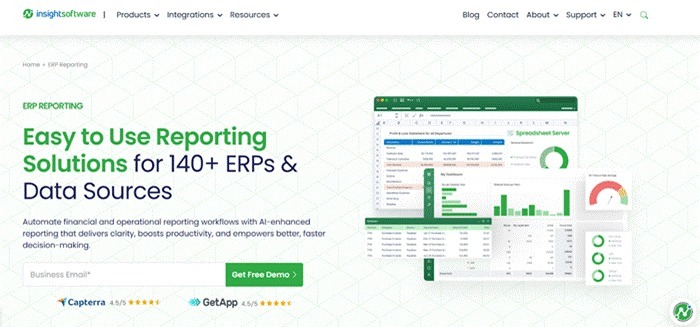
insightsoftware sells a broad portfolio, so this entry focuses specifically on Spreadsheet Server for a like-for-like financial-reporting comparison. Spreadsheet Server connects Excel to live ERP data and supports direct reporting across more than 140 ERP and data-source connections.
• Real-time ERP data inside Excel without repeated static exports
• Connections to 140+ ERPs and data sources
• Drill-down from summary figures to transaction detail
• Scheduled distribution and refreshable reports
• Multi-source reporting in a single Excel-based workflow
Spreadsheet Server fits ERP-centric finance teams that want to keep Excel as the reporting interface while replacing manual data exports and static report refreshes.
This entry does not represent every insightsoftware product. Buyers comparing disclosure management, consolidation, planning, or other insightsoftware products should evaluate those products separately rather than assuming Spreadsheet Server covers the entire portfolio.
insightsoftware pricing is custom. The company states that pricing reflects region, business goals, and technology requirements.
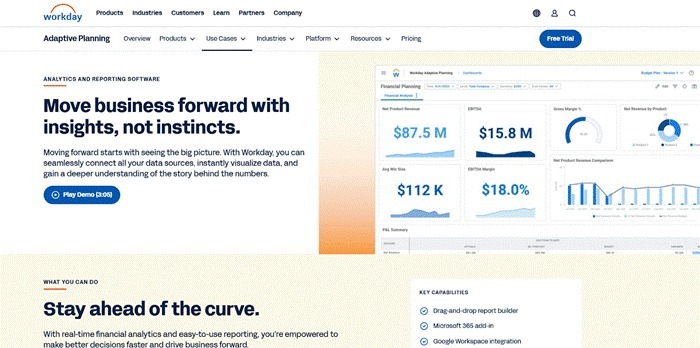
Workday Adaptive Planning is an enterprise planning and reporting platform that connects with any ERP or GL. Current packaging includes dashboards, unlimited versions, unlimited what-if scenarios, transaction reporting and analysis, and an unlimited audit trail. Workday also offers a Close & Consolidation package.
• Planning and modeling across business units and data sources
• Active dashboards and transaction reporting
• Unlimited versions and what-if scenarios
• Integration with ERP and GL systems
• Close and consolidation available in a unified package
Workday Adaptive Planning fits larger or fast-growing organizations that need enterprise-scale planning and reporting across multiple business units and source systems.
Close and consolidation are packaged separately from the core Adaptive Planning offer. Buyers should confirm the exact package, integrations, environments, and implementation scope required for their use case.
For a direct comparison with Limelight, see Limelight vs. Workday Adaptive Planning.
Workday lists pricing as variable and directs buyers to request a quote for Adaptive Planning and for Adaptive Planning Close & Consolidation.
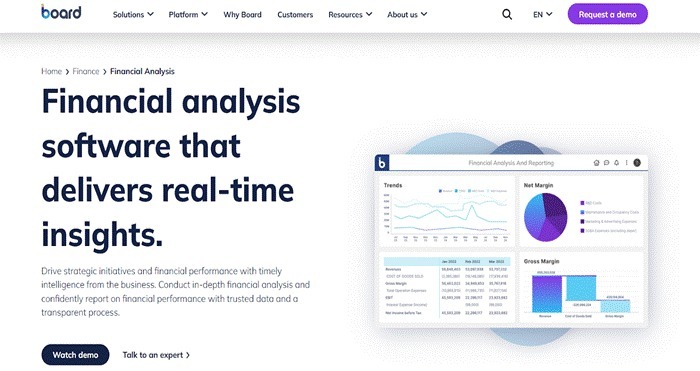
Board Financial Consolidation and Reporting sits within Board’s enterprise planning platform. Board’s current materials cover entity consolidation, multi-currency eliminations, automated workflows, audit trails, and reporting from a governed platform.
• Entity consolidation and multi-currency eliminations
• Financial reporting tied to consolidation workflows
• Audit trails and governed finance processes
• Planning and analysis within a broader enterprise-planning platform
Board fits enterprises that want planning, consolidation, and reporting within one broad performance-management environment.
A broad enterprise platform can involve more configuration than a reporting-only tool. Teams should validate consolidation logic, planning use cases, user roles, integrations, and implementation ownership together.
Board pricing is customized. The company asks buyers to discuss specific requirements and request a quote.
Vena is an Excel-centric FP&A platform that adds a central database, integrations, workflow, security, modeling, reporting, and analytics around familiar Microsoft workflows.
• Full Microsoft Excel integration
• Central database, integrations, workflow, security, and permissions
• Modeling, reporting, and analytics
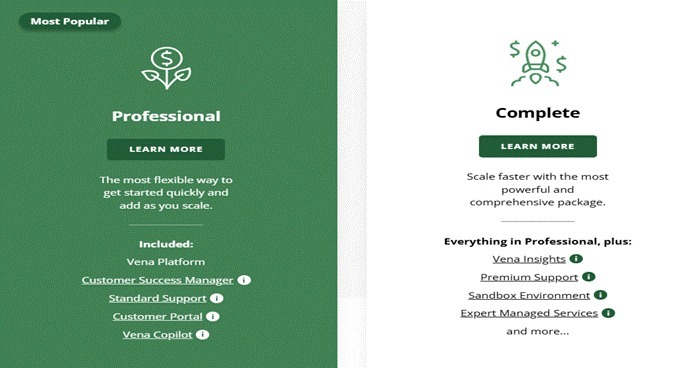
• Additional Vena Insights, sandbox, premium support, and managed services in the Complete package
Vena fits finance teams that want to keep Excel central while adding governance, centralized data, workflow, and broader planning capabilities.
The Professional and Complete packages include different support and platform components. Buyers should confirm which add-ons, APIs, services, and Vena Insights capabilities are included in their quote.
For a direct comparison with Limelight, see Limelight vs. Vena.
Vena offers Professional and Complete plans with customized pricing rather than a public standard dollar amount.
Considering a switch? Review the top Vena alternatives and competitors before finalizing the shortlist.
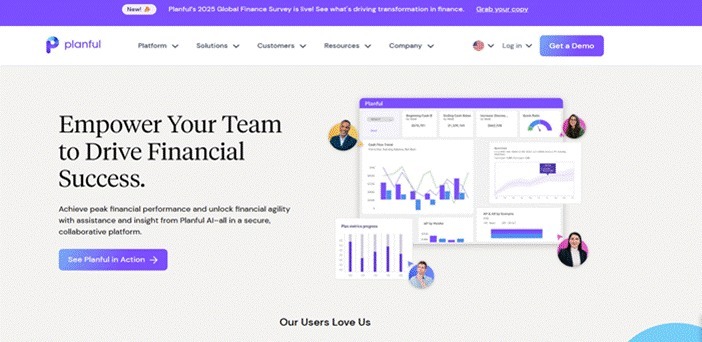
Planful is a financial performance-management platform for planning, reporting, and close. Its current product information covers financial close and consolidation, real-time reporting and analysis, workforce planning, and connected financial and operational data.
• Planning, budgeting, forecasting, and reporting
• Financial close and consolidation
• Support for multiple ERPs or GLs, multiple currencies, subsidiaries, and regulatory reporting use cases
• Dynamic dashboards, self-service analysis, and drill-down
Planful fits mid-market and enterprise finance teams that want planning, reporting, and close processes in one financial performance-management environment.
Consolidation can involve currency, entity hierarchy, elimination, ownership, and close-process configuration. Buyers should test those requirements using their actual legal-entity structure rather than a generic demo model.
Planful does not publish a standard list price on the product information reviewed for this guide. Its sales contact page directs buyers to contact the sales team for solution and licensing inquiries.
Datarails combines an Excel add-in with a web application for FP&A. Current packages include unlimited dashboards, reporting and planning, plus different user and integration allowances by tier.
• Excel-based FP&A workflows with cloud-based data storage and collaboration
• Unlimited dashboards, reporting, and planning across current FP&A packages
• Real-time updates and drill-down from reports and dashboards
• Professional, Premium, and Expert packages with different user, integration, and support allowances
Datarails fits finance teams that want to keep existing Excel models while centralizing data, reporting, dashboards, and planning around them.
The number of users, integrations, support level, and additional finance products varies by tier, so buyers should compare package limits against their implementation scope.
For a direct comparison with Limelight, see Limelight vs. Datarails.
Datarails requires a custom quote. The company states that pricing is tailored to use cases, users, and integrations.
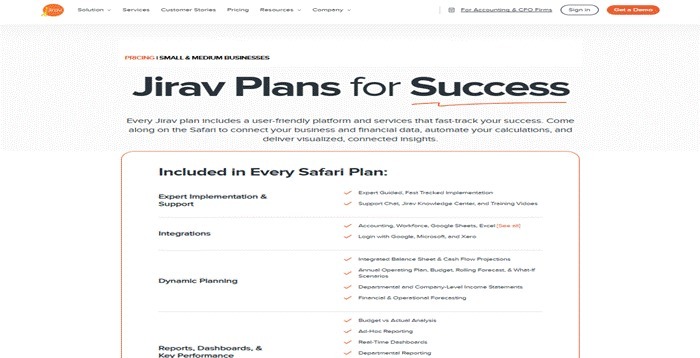
Jirav is an FP&A platform for small and medium businesses. Every current business plan includes integrated balance-sheet and cash-flow projections, budgets, rolling forecasts, what-if scenarios, reports, dashboards, and budget-versus-actual analysis.
• Integrated balance-sheet and cash-flow projections
• Annual plans, budgets, rolling forecasts, and what-if scenarios
• Reports, dashboards, KPIs, and budget-versus-actual analysis
• Departmental planning and longer-range capabilities on higher tiers
Jirav fits smaller and growing finance teams that want connected planning and reporting without moving immediately to a larger enterprise platform.
Planning horizon, departmental planning, integrations, and other limits vary by plan. Compare those tier boundaries with the organization’s expected growth rather than evaluating the entry price alone.
Jirav’s current business pricing is Starter at $10,000/year, Pro at $15,000/year, and Enterprise by custom quote.
SAP S/4HANA Finance for group reporting connects entity and group reporting with financial consolidation and close. SAP’s current product materials cover planned and actual consolidation, inter- and intra-segment eliminations, validation rules, journal-level drill-down, and data collection from systems outside SAP S/4HANA.
• Unified entity and group reporting
• Real-time planned and actual consolidation
• Inter- and intra-segment eliminations
• Validation rules and drill-down to underlying journals
• Data collection from non-SAP and non-finance sources
SAP S/4HANA Finance for group reporting fits global organizations that already operate in the SAP ecosystem and need complex group consolidation and reporting.
Deployment model, SAP architecture, entity structure, data collection, consolidation design, and implementation scope can materially affect the project. Buyers should validate the specific SAP edition and group-reporting configuration they require.
SAP lists group-reporting pricing as price upon request. Contract structure and metering depend on the selected group-reporting offering.
4.4/5 for SAP Cloud ERP (SAP S/4HANA Cloud). G2 does not list the group-reporting component as a separate product profile.
For teams evaluating a move beyond SAP BPC, Limelight’s SAP BPC alternatives guide covers FP&A options, pricing context, and fit.
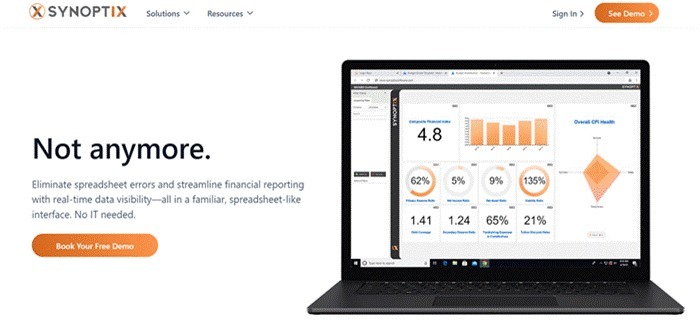
Synoptix is a financial-reporting tool that connects directly to ERP and other source data, using a spreadsheet-like interface for real-time reporting and analysis.
• Direct ERP and source-system connections
• Custom reports without relying on IT for routine report creation
• Drill-down from high-level reports to transaction detail
• Scheduled report generation and delivery
• Dashboards, consolidation and eliminations, version control, and multi-currency support listed on the current product page
Synoptix fits teams that primarily want to extend ERP reporting with real-time, finance-owned reports rather than adopt a full enterprise FP&A suite.
Connector coverage and product scope should be validated against the exact ERP version and reporting workflow. Teams that need extensive planning, workforce modeling, or enterprise performance management should compare those requirements separately.
Synoptix does not list a standard price on the financial reporting page reviewed for this guide. Contact Synoptix for a quote.
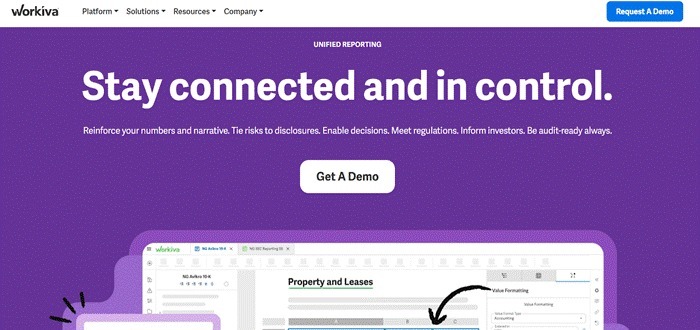
Workiva is a connected reporting and compliance platform with particular depth in SEC reporting, internal controls, audit trails, version control, permissions, XBRL and iXBRL, and filing workflows.
• SEC filings, annual reports, 10-Ks, 10-Qs, 8-Ks, proxy statements, and related reporting workflows
• Clear audit trails, version control, and granular permissions
• Linked data across reports and documents
• XBRL and iXBRL tagging and filing support
• Collaboration across reporting, audit, risk, legal, and other stakeholders
Workiva fits public and regulated organizations where disclosure, auditability, governance, and filing workflows matter as much as the financial report itself.
The Workiva page reviewed for this guide focuses on SEC and disclosure reporting rather than budgeting and forecasting. Teams looking for operational FP&A should evaluate planning and modeling requirements separately.
Workiva does not publish a standard list price. In its 2025 annual report, the company describes annual and multi-year SaaS subscriptions with solution-based pricing tied to expected use, plus additional fees for services such as document setup and XBRL tagging.
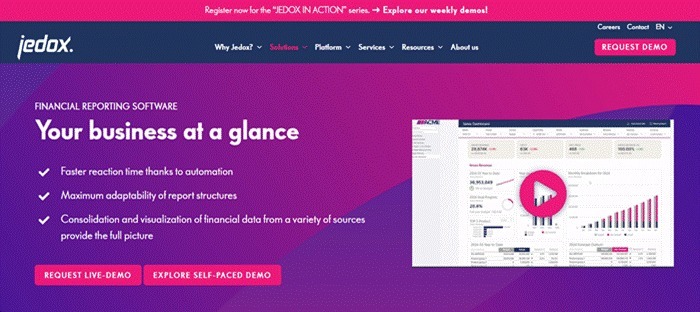
Jedox is an integrated planning and reporting platform with packages ranging from small departmental use cases to large enterprise deployments. Its current pricing page describes Essential, Business, Professional, and Professional Plus packages, with solution bundles for use cases such as integrated financial planning and financial consolidation.
• Planning, reporting, and collaboration across package levels
• ERP, CRM, and BI connectors available in higher packages
• Enterprise add-ons, security options, AI-assisted planning and forecasting, and performance upgrades on higher tiers
• Solution bundles for integrated financial planning and financial consolidation
Jedox fits mid-market and enterprise teams that want configurable planning and reporting with packaging that can expand as user count and model complexity grow.
User types, add-ons, connectors, support options, and performance requirements affect packaging. Buyers should model the required package and add-ons before comparing Jedox with a simpler reporting tool.
Jedox uses custom pricing based on user roles, modules, deployment needs, add-ons, and organization complexity. The vendor directs buyers to request a quote.
Zoho Books is a cloud accounting platform for small and growing businesses. Its US plans include profit and loss, balance sheet, and other financial reports, with custom reports on Standard and higher tiers, multi-currency transactions on Professional and higher tiers, and budgets and cash-flow forecasting on Premium and higher tiers.
• Profit and loss, balance sheet, and 50+ reports on the Free plan
• Custom reports and transaction-period locking from Standard
• Multi-currency transactions from Professional
• Budgets and cash-flow forecasting from Premium
• Advanced analytics and KPI tracking on Ultimate
Zoho Books fits small businesses that need accounting-suite reporting and want a lower-cost path from basic statements into custom reports, budgets, and analytics.
Zoho Books remains an accounting suite rather than a dedicated enterprise FP&A platform. Teams that need complex legal-entity consolidation, intercompany eliminations, or deep cross-system planning should compare a different category.
Current US monthly pricing is Free $0, Standard $20, Professional $50, Premium $70, Elite $150, and Ultimate $275 per organization. Annual billing lowers the paid tiers to $15, $40, $60, $120, and $240 per organization per month, respectively. Prices exclude local taxes.
The feature list should follow the reporting problems you need to solve. For a mid-market team, the following capabilities usually matter more than a long catalog of secondary features.
• Standards-aligned statements: Produce income statements, balance sheets, and cash flow statements without manual formatting every period
• Multi-entity consolidation: Combine separate legal entities, apply intercompany eliminations, and translate currencies where required
• Direct ERP and GL connectivity: Pull actuals from NetSuite, Sage Intacct, Microsoft Dynamics, SAP, or another source system without a recurring export process
• Dimensional reporting: Analyze results by department, cost center, project, entity, or another business dimension without rebuilding the underlying report
• Transaction-level drill-down: Move from a summary number to the journal entry or transaction behind it while the question is still being discussed
• Audit trails and access controls: Maintain a record of who changed what and when, with permissions that limit who can alter reports, assumptions, and mappings
The two features teams often underweight are consolidation and drill-down. They may feel secondary during a demo, but they determine how much manual reconciliation survives after implementation.
Pricing depends on product category and deployment scope. Small-business accounting tools usually publish list prices, while most FP&A and enterprise platforms require a quote based on users, entities, integrations, and implementation needs.
|
Category |
Current pricing pattern |
Examples |
|
Small-business accounting-suite reporting |
Paid monthly list prices in this guide include Zoho Books Standard at $20 per organization and QuickBooks Online plans from $38 to $275 before add-ons or temporary promotions. Zoho Books Standard is $15 per organization per month when billed annually, while FreshBooks pricing varies by region, customer type, plan, client limits, and promotion. |
QuickBooks Online, Zoho Books, FreshBooks |
|
Mid-market FP&A platforms |
Mostly custom-quoted. Public business pricing in this guide includes Jirav at $10,000/year for Starter and Limelight at a published $1,400/month starting point. |
Limelight, Cube, Datarails, Jirav |
|
Enterprise and ERP-linked platforms |
Usually customized by deployment, user count, modules, region, or data scope. |
SAP S/4HANA Finance for group reporting, Oracle NetSuite, Workiva, Workday Adaptive Planning, Board, insightsoftware Spreadsheet Server |
Table: Pricing becomes less standardized as reporting complexity grows, so buyers should compare subscription, implementation, integrations, and user or entity limits together.
Subscription price is only part of the total cost of ownership. Data mapping, implementation, training, consulting, integrations, and support can materially change first-year spend. Where a vendor publishes a standard list price, this guide uses that price rather than a temporary promotion.
Limelight’s 2026 FP&A software pricing guide provides additional context for mid-market FP&A pricing.
Start with the constraints in your current reporting process. Feature breadth matters only after the platform fits your systems, reporting structure, and level of finance-team ownership.
1. Map company and entity complexity. A single-entity business and a group with 12 subsidiaries do not need the same reporting architecture.
2. Confirm ERP and source-system fit. Validate the connector for your GL or ERP before evaluating secondary features.
3. Separate accounting reports from FP&A needs. Standard statements may be enough for a small business. Consolidation, dimensions, forecasting, and management reporting usually require a different class of tool.
4. Test finance-team independence. Ask a finance user to change a report, add a dimension, and trace a variance without vendor or IT assistance.
5. Decide whether planning belongs in the same platform. Keeping actuals, budgets, and forecasts together can remove another reconciliation layer.
6. Model total cost of ownership. Include implementation, integrations, training, consulting, and ongoing support rather than comparing subscription fees alone.
Company size is a useful first filter, but entity count and reporting complexity often matter more. A growing group with several legal entities can need deeper consolidation than a much larger single-entity company.
|
Organization profile |
Typical reporting needs |
Best-fit category |
Example tools |
|
Small business or simpler single-entity reporting |
Standard statements, invoicing, tax reporting, basic dashboards |
Accounting-suite reporting |
QuickBooks Online, Zoho Books, FreshBooks |
|
Growing or mid-market multi-entity reporting |
Multi-entity reporting, dimensional analysis, planning integration, drill-down |
Dedicated FP&A or advanced financial-management platform |
Limelight, Cube, Datarails, Jirav, Sage Intacct |
|
Enterprise, global, or regulated reporting |
Complex consolidation, high-volume reporting, statutory or regulatory controls, disclosure workflows |
Enterprise, ERP-linked, or specialist reporting platform |
SAP S/4HANA Finance for group reporting, Oracle NetSuite, Workday Adaptive Planning, Board, Workiva |
Table: Company size narrows the category, but entity count, ERP fit, regulatory needs, and reporting complexity should decide the final shortlist.
The 19 platforms above are a curated comparison rather than an exhaustive market map. Finance teams may also encounter OneStream, Anaplan, Solver, Abacum, Phocas, CCH Tagetik, and Coefficient in adjacent FP&A, corporate performance-management, BI, and spreadsheet-data workflows. They are outside the 19-tool comparison above, so this guide does not assign them pricing or capability rankings.
Limelight is aimed at mid-market finance teams that have outgrown spreadsheet-based reporting but do not need the implementation weight of a large enterprise EPM suite. It combines reporting, planning, forecasting, and multi-entity finance workflows in one cloud FP&A platform.
For teams running NetSuite, Sage Intacct, Microsoft Dynamics, or similar ERPs, three capabilities are especially relevant:
• ERP-connected reporting: The real-time reporting platform brings source-system data into management reports and supports drill-down and drill-through when finance needs to explain a number
• Planning beyond the report: Budgeting, driver-based planning, scenario modeling, and workforce planning sit alongside actuals so reporting and planning do not require separate reconciliation processes
• AI-assisted analysis: Limelight AI can analyze variances, surface anomalies and trends, and generate forecasts and what-if scenarios from governed financial data
The vendor-specific comparison links above cover where Limelight differs from Prophix, Cube, Workday Adaptive Planning, Vena, and Datarails.
See Limelight in action: Request a personalized demo to review how the platform would connect to your reporting and planning workflow.
The questions below focus on distinctions that are easy to miss when comparing categories of financial software.
Possibly. An ERP can generate core financial statements, but a separate reporting or FP&A platform becomes useful when finance needs cross-system consolidation, management-report design without IT, planning integration, or deeper dimensional analysis than the ERP provides.
Financial reporting software produces and analyzes statements and management reports. Consolidation software combines multiple entities into group results, including intercompany eliminations and currency translation. Many mid-market FP&A platforms do both, which is why the categories overlap.
Financial reporting software is designed around governed finance outputs such as statements, consolidation, dimensions, and audit trails. BI software is broader and can visualize data across the business, but it may not include accounting logic such as eliminations, consolidation rules, or statutory statement structures.
Excel can produce financial reports, but it is a spreadsheet rather than a governed reporting system. At scale, teams have to create their own controls for version history, mappings, permissions, source-system updates, and auditability.
Use your own reporting workflow as the test. Ask the vendor to connect or simulate your ERP structure, build a management report, add a dimension, consolidate entities, trace a variance to source detail, and change a report without technical assistance. That reveals fit more reliably than a generic feature tour.
Subscribe to our newsletter