

Financial Services
Cash Flow Forecasting Guide: Methods, Best Practices & Tools
By Anran Xie |
Last Updated: September 25, 2026
By Anran Xie |
Last Updated: September 25, 2026
The Q2 2026 OnDeck and Ocrolus Small Business Cash Flow Trend Report found that cash flow remained a top concern for 30% of 805 surveyed OnDeck customers. Thirty-eight percent also cited increasing cash flow as a reason for seeking additional capital.
A good cash flow forecast gives finance time to respond. It can reveal when collections need attention, when spending should move, when financing may be required, or when an investment can be funded without pushing cash below an acceptable threshold.
This guide covers cash flow forecasting methods, the 13-week forecast, formulas, practical steps, best practices, and four tools finance teams can evaluate.
Cash flow forecasting estimates when cash will enter and leave a business over a defined period and projects the resulting cash balance.
Unlike a budget, which establishes planned revenue and expenses, a cash flow forecast focuses on timing. A sale recorded this month may produce cash next month, while an expense recognized over several periods may require an immediate payment.
For the concise definition and basic forecast types, see the cash flow forecasting glossary. This guide focuses on how finance teams build, maintain, and use cash flow forecasts.
A cash flow forecast gives finance time to respond before expected cash movements become actual liquidity problems.
Cash flow forecasting helps businesses determine whether expected cash will cover upcoming obligations.
Consider a seasonal retailer with strong December sales but 30- to 45-day collection terms for a portion of its business. Revenue can look healthy while cash receipts arrive after February payroll, rent, inventory, and supplier payments become due.
The cash flow forecast makes the timing mismatch visible early enough to respond. Finance might accelerate collections, change purchasing timing, negotiate supplier terms, use an existing credit facility, or defer discretionary spending.
Profitability alone cannot answer that liquidity question. The company needs to know when cash becomes available.
Forecasting also shows when the business can fund growth without creating a liquidity problem elsewhere.
A manufacturer planning a major equipment purchase, for example, needs to assess more than the purchase price. Finance should model the payment schedule alongside expected collections, payroll, taxes, debt service, working-capital requirements, and minimum cash thresholds.
The same logic applies to hiring, acquisitions, market expansion, product launches, and other commitments that consume cash before they generate returns.
Limelight’s scenario planning process lets finance compare different assumptions about collections, costs, demand, financing, or investment timing before capital is committed.
Forecasts expose cash risks that are difficult to see from the income statement.
Suppose a software company expects two large customer payments in the same week that quarterly taxes and a debt payment are due. The base forecast may show enough liquidity, but a delayed customer payment could push cash below the company's operating threshold.
Finance can use that information to create a downside case, prepare a credit option, change payment timing where appropriate, or accelerate collections before the risk becomes urgent.
Direct and indirect cash flow forecasting start from different data and usually serve different planning horizons. Oracle's financial-planning documentation describes the direct method around sources and uses of cash, while the indirect method connects cash flow with the income statement and balance sheet.
|
Comparison area |
Direct cash flow forecasting |
Indirect cash flow forecasting |
|
Starting point |
Individual cash receipts and payments |
Projected net income and other financial-statement forecasts |
|
Typical inputs |
Customer collections, supplier payments, payroll, taxes, debt service, interest, capital expenditures, financing proceeds, and intercompany cash movements |
Depreciation and other non-cash charges, accounts receivable changes, accounts payable changes, inventory changes, other working-capital movements, capital expenditures, and financing activity |
|
Primary purpose |
Track when cash is expected to enter and leave the business |
Translate projected financial performance into expected cash flow |
|
Typical planning horizon |
Short-term liquidity forecasting, often focused on days or weeks |
Monthly, quarterly, and longer-range financial planning |
|
Level of detail |
High. The forecast follows transaction-level or schedule-level cash timing |
Lower near-term transaction detail because the model is built from financial-statement assumptions |
|
Useful questions |
Will cash cover next week's payroll? What happens if a major customer pays two weeks late? Which week contains the lowest projected cash balance? When will borrowing be required? Can a supplier payment move without creating operational risk? |
How will the annual operating plan affect cash? What happens to liquidity if revenue growth slows? How will working-capital assumptions affect future cash? Can the company fund planned investment without additional borrowing? |
|
Main advantage |
Gives finance a detailed view of near-term cash timing and liquidity requirements |
Keeps cash forecasting connected with the forecasted income statement, balance sheet, and wider financial model |
|
Main trade-off |
Requires current transaction-level or schedule-level data and frequent updates |
Provides less visibility into the exact timing of individual near-term receipts and payments |
Choose the method based on whether finance needs near-term visibility into cash timing or a longer-range view of how the financial plan affects cash.
Use the direct method when finance needs detailed visibility into when specific cash receipts and payments will occur.
Use the indirect method when finance needs to understand how projected financial performance will affect cash over a longer horizon.
Many finance teams use both methods, with direct forecasting supporting near-term liquidity management and indirect forecasting connecting cash with the longer-range financial plan.
A 13-week cash flow forecast is a rolling weekly forecast of cash receipts, payments, and ending balances for approximately one quarter.
J.P. Morgan describes 13 weeks as a standard horizon that balances detailed cash visibility with a useful planning range. KPMG's 2026 liquidity guidance similarly recommends a rolling 13-week short-term cash flow forecast for immediate cash management.
The 13-week cash flow forecast model usually follows the direct method.
A typical 13-week forecast includes:
Each week, actual cash replaces the forecast for the completed period and a new week is added to the end. The horizon therefore remains 13 weeks rather than shrinking toward a fixed end date.
A shorter forecast can provide more transactional detail but may not expose a funding requirement far enough in advance. A much longer weekly forecast introduces more uncertainty and can create false precision.
Thirteen weeks gives finance roughly one quarter to identify cash lows, challenge collection assumptions, plan borrowing, review covenant exposure, and discuss corrective actions while the data remains detailed enough to use operationally.
Limelight’s cash flow forecast template provides the basic structure, but the value comes from maintaining current assumptions rather than simply extending formulas across 13 columns.
Forecast type refers to the planning horizon and refresh process. It is related to forecasting method, but the terms are not interchangeable.
Short-term forecasting focuses on immediate liquidity, usually over days or weeks. It often uses the direct method because finance needs visibility into specific receipts and payments.
Common uses include:
The 13-week forecast is one of the most common short-term formats.
Long-term forecasting extends across several months, quarters, or years.
It supports decisions such as:
Long-range forecasts often use the indirect method or a driver-based planning model because expected cash depends on forecast revenue, margins, working capital, capital spending, and financing assumptions.
A hospital planning a major facility expansion, for example, may model several years of operating cash, capital spending, financing, and minimum liquidity requirements before approving the project.
A rolling forecast maintains a consistent forward-looking horizon.
When one period closes, another is added. A 13-week model can therefore be a rolling forecast, as can a 12-month or 18-month monthly model.
The process allows finance to:
For a deeper explanation of the process, see rolling forecasts.
A reliable forecast starts with opening cash, expected inflows, expected outflows, and defensible timing assumptions.
The underlying information normally comes from bank balances, accounts receivable (AR), accounts payable (AP), payroll, taxes, debt schedules, capital plans, and recent actuals.
The basic formula is:
Opening cash balance + forecasted cash inflows - forecasted cash outflows = projected ending cash balance
Net cash flow can be calculated separately:
Forecasted cash inflows - forecasted cash outflows = net cash flow
Then:
Opening cash balance + net cash flow = projected ending cash balance
A corporate cash flow forecast commonly includes:
Relevant data can come from ERP systems, banks, AR and AP subledgers, payroll systems, tax calendars, debt schedules, procurement plans, sales pipelines, and historical actuals.
The forecast should also document the assumptions behind timing. A number without its collection, payment, or due-date assumption is difficult to challenge and harder to improve.
Start by listing the sources that produce actual cash receipts.
These may include:
The forecast should reflect expected collection timing rather than automatically treating booked revenue as cash.
A restaurant group, for example, may receive dining revenue immediately while catering invoices, event deposits, and third-party delivery settlements follow different payment cycles.
A software company may need separate assumptions for subscriptions, professional services, usage fees, and renewals.
Finance should distinguish recurring, one-time, contract-based, and timing-sensitive receipts so changes can be traced to the correct driver.
Next, identify cash payments and the periods in which they are expected to occur.
Common cash outflow categories include:
Historical actuals provide a starting point, but the forecast should also incorporate current commitments and approved operating plans.
Irregular items deserve particular attention. A forecast built from monthly averages can miss a large annual insurance payment, quarterly tax installment, debt repayment, or equipment purchase that creates a temporary cash low.
Once inflows and outflows are entered, calculate the net movement and ending cash position.
Suppose a company begins the week with $100,000, expects $50,000 in cash receipts, and expects $40,000 in payments.
Net cash flow = $50,000 - $40,000 = $10,000
Projected ending cash = $100,000 + $10,000 = $110,000
The ending balance is often more insightful than net cash flow because it shows whether the company remains above its required liquidity threshold.
Cash flow should also be separated from profit. Revenue can be recognized before a customer pays, and expenses can be recognized before or after cash leaves the business. AR and AP timing can therefore change liquidity without changing the underlying profitability of the period.
Forecast timing should reflect how the business actually operates.
Finance can:
A beach hotel, for example, may receive stronger summer cash inflows while also carrying higher seasonal payroll and operating costs.
A tax advisory firm may receive a disproportionate share of annual collections between January and April.
Driver-based forecasting makes those relationships explicit rather than relying on flat percentage increases.
The forecast should improve as finance learns where its assumptions were wrong.
A regular review should:
Budget variance analysis applies the same discipline more broadly across financial performance. In cash forecasting, the key question is often whether a variance changed the amount of cash, the timing of cash, or both.
Short-term forecasts may require weekly review. Longer-range forecasts may be refreshed monthly or quarterly.
The cadence should increase when liquidity is tight, collections become volatile, financing conditions change, or management needs more frequent cash visibility.
The following cash flow forecasting best practices can help improve forecasting accuracy and consistency:
Small and midsize businesses (SMBs) often need visibility quickly with limited finance resources. Enterprises are more likely to struggle with data volume, entity complexity, multiple systems, currencies, and organizational ownership.
For smaller businesses, liquidity pressure can become immediate. An SMB may need to focus first on:
The process may begin in a spreadsheet, especially when transaction volume and entity complexity remain manageable.
The risk appears when the forecast depends on repeated exports, manual updates, inconsistent assumptions, or one employee who understands how the file works.
In larger organizations, cash is often spread across legal entities, currencies, bank accounts, business units, ERP instances, and geographic regions. Receivables, payables, payroll, financing, and treasury data may update on different schedules.
KPMG's 2026 cash-forecasting guidance notes that many organizations still lack timely and reliable liquidity visibility because workflows and systems remain disconnected.
Enterprise forecasting therefore needs more structure around:
Automation can reduce data preparation, but it does not remove the need for judgment.
Finance still needs to challenge collection assumptions, explain forecast variances, assess downside scenarios, and decide which risks require action.
The four platforms below support cash forecasting as part of broader financial planning and analysis (FP&A) and connected-planning workflows.
The right choice depends on company size, existing systems, forecast horizon, spreadsheet preferences, and how much broader FP&A functionality the finance team needs.
|
Feature |
Limelight |
Anaplan |
Cube |
Planful |
|
Best for |
Mid-market finance teams needing ERP-connected FP&A and cash forecasting |
Large enterprises with complex connected-planning requirements |
Finance teams wanting live cash forecasting with spreadsheet workflows |
Finance teams needing structured FP&A and 13-week cash forecasting |
|
Core approach |
Balance-sheet, driver-based, rolling, and scenario planning |
Connected three-statement and enterprise scenario planning |
Direct 13-week and rolling indirect forecasting |
Weekly cash forecasting within financial performance management |
|
Integrations |
ERP and finance integrations including Sage Intacct, NetSuite, and Microsoft Dynamics |
Enterprise finance and operational systems |
GL, AR, AP, billing, banking, ERP, Excel, and Google Sheets |
ERP, AR, AP, payroll, and other financial inputs |
|
Scenario support |
What-if scenarios and rolling forecasts |
Enterprise-wide scenario modeling |
Cash scenarios and rolling forecasts |
Scenario analysis and configurable forecast horizons |
|
Workflow fit |
Finance-owned cloud FP&A |
Enterprise connected planning |
Spreadsheet-connected FP&A |
Structured financial planning and reporting |
Best for: Mid-market finance teams that want cash forecasting connected with broader FP&A.
Limelight supports cash flow forecasting within the same environment used for budgets, forecasts, scenarios, balance-sheet planning, and reporting.
Its current cash flow forecasting approach uses financial and non-financial data and can model cash through balance-sheet forecasting, historical trends, financial ratios, and management adjustments.
Limelight also connects with ERP and accounting systems through its integration library, including Sage Intacct, Oracle NetSuite, and Microsoft Dynamics.
Best for: Large enterprises that need cash planning inside complex connected-planning models.
Anaplan supports three-statement planning by connecting projected income statements, balance sheets, and cash flow in one model.
Its broader connected-planning architecture can also support scenarios across finance and other business functions.
Anaplan is most relevant when cash flow forecasting is part of a larger enterprise-planning architecture with complex models, organizational dimensions, and multiple contributors.
The flexibility can also increase implementation and administration requirements, so buyers should assess model ownership and internal planning resources.
Best for: Finance teams that want governed cash forecasting while continuing to work in spreadsheets.
Cube's cash flow forecasting product supports a 13-week direct view and a rolling indirect forecast using a shared financial model.
The platform can combine general ledger, AR, AP, billing, and banking data and deliver the resulting forecasts through Excel, Google Sheets, and other interfaces.
Best for: Finance teams that need structured weekly cash forecasting inside a broader financial performance platform.
Planful's 13-week cash flow solution brings AP, AR, payroll, expenses, receipts, and disbursements into a weekly cash forecast.
Teams can track opening balances, weekly movements, and closing cash and can extend the forecast beyond 13 weeks or move to daily detail when cash timing requires it.
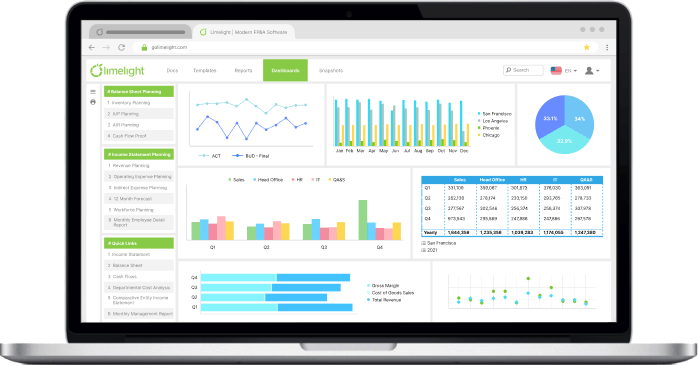
Limelight brings cash flow forecasting into the same FP&A environment as financial planning, scenarios, actuals, and reporting.
Limelight supports cash flow forecasting through its broader planning and forecasting environment.
Finance teams can use profit and loss (P&L), balance sheet, and other planning data as inputs to the cash model rather than rebuilding the forecast from a separate set of disconnected spreadsheets.
This is particularly useful for indirect and driver-based forecasts, where changes to revenue, expenses, working capital, or capital spending need to flow through the wider financial model.
Limelight's ERP integrations include systems such as Sage Intacct, Oracle NetSuite, and Microsoft Dynamics.
Connected actuals reduce the need to export and remap financial information each time finance refreshes the cash forecast.
The integration layer can also provide a more consistent basis for forecast-to-actual analysis because the planning model and reporting process use the same underlying financial data.
Cash forecasting rarely has one reliable outcome.
A collection delay, hiring change, cost increase, capital purchase, or financing decision can alter the cash position even when the approved budget has not changed.
Limelight supports what-if scenarios, driver-based planning, and rolling forecasts so finance teams can test those changes without maintaining a separate spreadsheet for every case.
For example, finance can model:
The value is the connection between the changed assumption and the rest of the financial plan.
Forecasting becomes more useful when management can see where the numbers changed and why.
Limelight's reporting tools support financial reporting, drill-down analysis, dashboards, and variance explanations.
Finance can use that reporting layer to compare actual results with the current plan, investigate deviations, and update future assumptions without rebuilding the reporting package manually.
Cash forecasting then becomes part of the broader financial planning and analysis process rather than a standalone exercise performed only when liquidity becomes tight.
Effective cash flow forecasting gives finance time to act before a shortfall becomes a crisis. Limelight supports that process by connecting financial data, forecasts, scenarios, and reporting in one finance-owned planning environment.
Book a demo to see how Limelight can support connected cash flow forecasting.
Cash flow forecasting estimates when cash will enter and leave a business over a defined period and projects the resulting cash position.
Finance teams use it to assess liquidity, funding requirements, payment timing, financial risk, and whether expected cash will cover upcoming commitments.
Cash flow forecasting gives finance time to respond before liquidity pressure becomes urgent.
It can identify future cash shortages, expose collection or payment-timing risks, support investment decisions, guide financing requirements, and help management maintain required cash reserves.
Start with the opening cash balance, add expected cash receipts, subtract expected cash payments, and calculate the projected ending cash balance.
Build the assumptions from current sources such as bank balances, AR aging, AP schedules, payroll, taxes, debt service, capital spending, and recent actuals. Then compare the forecast with actual cash movements and update future periods regularly.
The basic formula is:
Opening cash balance + forecasted cash inflows - forecasted cash outflows = projected ending cash balance
Net cash flow is forecasted inflows minus forecasted outflows. Projected ending cash is the more complete liquidity measure because it applies that movement to the opening balance.
Direct cash flow forecasting projects specific cash receipts and payments, making it well suited to short-term liquidity management and 13-week forecasts.
Indirect forecasting starts with projected financial performance and adjusts for non-cash items and working-capital movements. It is generally more useful for monthly, quarterly, and longer-range financial planning.
Finance teams may use both because the methods answer different questions.
The best software depends on the forecast horizon, company size, finance stack, and whether the team needs broader FP&A or specialist treasury functionality.
Limelight, Anaplan, Cube, and Planful are four FP&A-oriented options covered in this guide. Limelight fits ERP-connected mid-market FP&A, Anaplan fits complex enterprise connected planning, Cube supports spreadsheet-centered cash workflows, and Planful provides structured weekly cash forecasting inside a broader financial performance platform.
Subscribe to our newsletter