
%20(1).svg)
What Is Workforce Planning? A CFO's Guide to Aligning Headcount and Strategy
By Laks Satchi |
Last Updated: August 17, 2026
Most CFOs can tell you exactly what next year's headcount cost will be. Far fewer can tell you whether the workforce producing those costs has the shape and capabilities to deliver the three-year strategy. The gap between knowing what people cost and knowing what they can do is what workforce planning addresses. It is also the gap most finance functions live with year after year.
This guide is written for CFOs and finance leaders forming a foundational view of workforce planning as a finance discipline. It covers the definition, the difference from headcount budgeting, the three horizons that structure good workforce planning practice, a practical framework for translating strategy into headcount, and the mistakes most organizations make. Aimed at finance leaders building shared vocabulary with HR partners, not yet evaluating tools.
Workforce planning is the discipline of aligning the size, shape, and capabilities of the workforce with the organization's strategy across multiple time horizons. It answers a question different from "how much will people cost next year": it answers "do we have the right workforce to deliver the plan."
The workforce planning definition that holds up across most rigorous practitioners includes three elements: the strategic component (what capabilities does the business need?), the structural component (what roles, levels, and locations make up the workforce?), and the financial component (what does it cost, and what is the ramp?). Strong workforce planning carries all three. Weak workforce planning collapses to one and misses the other two.
These two terms get used interchangeably inside many finance organizations. They are different exercises with different outputs, owned by different people, on different cadences. The confusion is the single most common reason workforce planning underdelivers.
|
Dimension |
Headcount budgeting |
Workforce planning |
|---|---|---|
|
Primary question |
How much will people cost next year? |
Do we have the right workforce to deliver our strategy? |
|
Time horizon |
Annual |
Multi-year (strategic), with annual and quarterly layers |
|
Output |
Headcount cost in the P&L |
Capability gaps, role design, headcount math, hiring sequence |
|
Owners |
Finance, with HR input |
Joint Finance and HR ownership |
|
Connection to strategy |
Cost-side reflection of decisions already made |
Strategic input that shapes operating decisions |
The relationship between the two is one-directional. Workforce planning produces the capability and role decisions that headcount budgeting then prices. When the order reverses, when budget targets get set first and then drive role decisions, the organization is no longer doing workforce planning. It is doing cost management with a workforce planning label on it.
|
QUICK TAKE Headcount budgeting answers how much people will cost. Workforce planning answers whether the workforce can deliver the strategy. The first feeds the P&L; the second feeds the strategic plan. |
Compensation and benefits are typically the largest single line item in operating expenses for service businesses. The largest line item in the P&L should be the line item the CFO knows the most about, not the least. In practice, that is rarely how it works. HR owns the workforce plan because HR owns the hiring, the compensation philosophy, and the org design. Finance owns the budget because Finance owns the dollars. The workforce plan and the budget end up in different rooms, in different files, with different owners, and the strategy suffers.
The case for joint ownership is straightforward. Workforce planning has a financial output (cost, ramp, productivity) and a people output (capabilities, roles, retention). Neither function can run the discipline alone. The CFOs who get this right operate workforce planning as a Finance-HR joint accountability, not a handoff.
|
DID YOU KNOW? According to data from the U.S. Bureau of Labor Statistics, compensation costs continue to grow faster than inflation in service industries, which means the largest opex line is also the line item moving fastest. Workforce planning rigor is increasingly the difference between a strategy that delivers and one that gets repriced halfway through the year. |
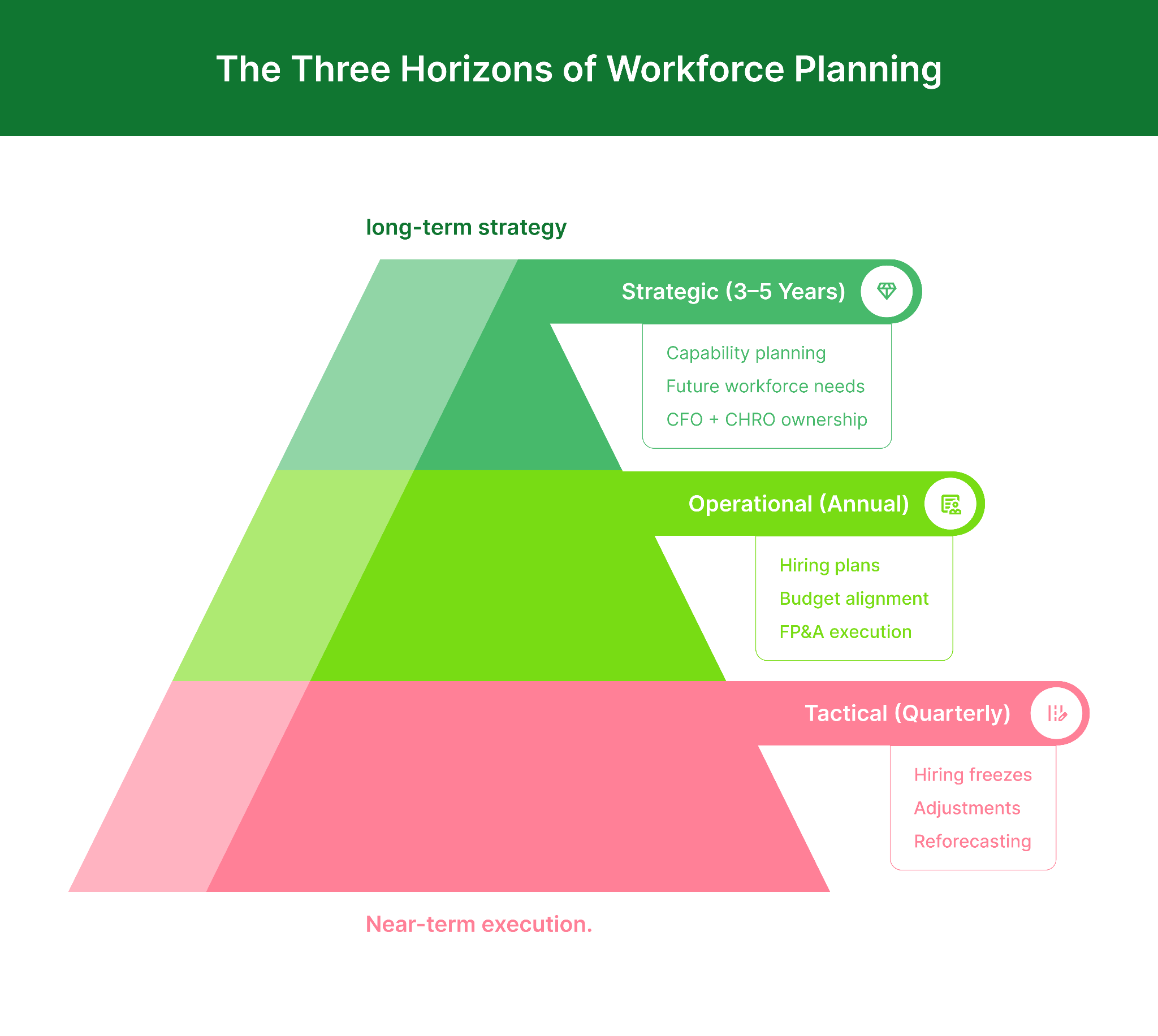
With the definition clear, the discipline operates across three time horizons. They serve different purposes, involve different people, and run on different cadences. Most organizations do one of them well and assume the others will fall out naturally. They will not.
|
Horizon |
Time scale |
Owners |
Primary question |
|---|---|---|---|
|
Strategic |
3 to 5 years |
CFO + CHRO, with exec team |
What capabilities will we need to deliver our strategy? |
|
Operational |
Annual, aligned to budget |
Finance + HR, FP&A leads |
What does the next budget year actually look like? |
|
Tactical |
Quarterly or as-needed |
Finance, with HR involvement |
Do we adjust based on what is actually happening? |
Strategic workforce planning takes the multi-year strategy and works backward to the workforce that will deliver it. The output is a view of which capabilities the organization needs to grow, which to sustain, and which to shrink. It is owned jointly by the CFO and CHRO, with the rest of the executive team contributing the strategic input that drives capability decisions.
The cadence is annual at most. Most organizations refresh the strategic workforce plan when the corporate strategy refreshes, which is typically every two to three years. Strategic workforce planning is the horizon where most organizations underinvest. Few finance functions formally produce a five-year capability view, and the gap shows up later as missed strategic execution.
Operational workforce planning is the annual exercise that turns the strategic view into a workable plan for the next budget year. The output is an annual workforce plan that includes hiring sequence, role design changes, and the connection to the headcount budget. It is owned jointly by Finance and HR, with FP&A typically running the model.
This is where most organizations live. Operational workforce planning is the most-practiced of the three horizons because it ties directly to the annual budget cycle. The risk is that operational workforce planning becomes a synonym for headcount budgeting, with strategic intent quietly dropped along the way.
Tactical workforce planning is the in-year adjustment work. Hiring freezes when revenue softens. Surge hiring when a new product takes off. Role consolidation when a team underperforms. The output is a set of in-year decisions that keep the workforce aligned with what is actually happening in the business.
Tactical workforce planning is owned by Finance, with HR involvement. The cadence is quarterly at minimum, often more frequent in volatile environments. Done well, tactical workforce planning is the layer that prevents the annual plan from going stale by month four. Done poorly, it becomes reactive crisis management with a workforce planning label.
Knowing the horizons is one thing. Translating strategy into a defensible workforce plan is where the work lives. The framework below works for most service businesses and adapts cleanly to product and asset-heavy companies. Four steps.
Take each major strategic initiative and ask one question: what capabilities does the organization need to grow, sustain, or shrink to deliver this? Be concrete. "Enter the European market" is a strategy. The capabilities that strategy requires are EU regulatory expertise, an EU sales motion, EU customer support, and EU operations. "Improve margin by 300 basis points" might require pricing capability, procurement capability, and operations engineering.
This step is the hardest and gets skipped most often. The temptation is to go straight from strategy to headcount numbers ("we need 30 new hires next year") without specifying which capabilities those hires represent. Headcount without capability is just a body count. The strategic plan loses its connection to the workforce plan in this step, and most organizations do not realize it has happened.
Each capability has a role architecture. The EU regulatory capability needs a senior compliance leader, two mid-level analysts, and a paralegal. The pricing capability needs a head of pricing, two pricing managers, and an analytics resource. This step is where workforce planning hands off to organizational design, and it benefits from HR partnership.
Two questions matter at this stage. First, is the role architecture realistic given the labor market? Hiring six senior compliance leaders simultaneously is harder than the strategic plan tends to assume. Second, what is the right ratio of senior to junior, internal to external, full-time to contractor? These are choices that affect cost, ramp time, and risk, and they belong in the workforce plan rather than in a hiring conversation six months later.
This step is where Finance does the work. Each role gets a hiring start date, a ramp curve, a productivity assumption, a cost rate by location and level, and an attrition assumption. Build the math month by month rather than as an annual lump sum. The shape of the year matters: thirty hires in Q1 cost meaningfully more than thirty hires in Q4.
Three traps to avoid. Assuming new hires are productive on day one. Ignoring time-to-fill, which has lengthened in most labor markets over the past three years. Forgetting to model attrition explicitly, which means the gross hiring number understates what the organization actually needs to recruit.
Sensitivity analysis on this step is particularly valuable. Flexing assumptions like time-to-fill, ramp speed, and attrition shows leadership which inputs the plan is most exposed to. Our deeper guide to sensitivity analysis covers the technique.
The workforce plan is wrong by month two. New hires take longer than expected. A team grows faster than planned. A strategic priority shifts. The organizations that get workforce planning right have a monthly cadence to compare planned versus actual headcount, identify variances, and adjust both the plan and the assumptions.
Most organizations skip this step. The workforce plan gets built in November, signed off in December, and rarely revisited until next November. By the time the gaps become obvious, it is too late to course-correct. The feedback loop is the difference between a workforce plan that drives the business and a workforce plan that documents what already happened.
|
PRO TIP Most organizations attempting workforce planning for the first time try to stand up all three horizons at once. They end up with a thin version of each. The teams that succeed pick the horizon they need most (usually strategic, sometimes operational) and build it well, then add the others over the following year. |
Even teams running this framework hit predictable failure modes. Four show up most often.
The largest line item in operating expense should not be owned by a single function. When workforce planning lives entirely in HR, the strategic and financial elements quietly drop out. The plan becomes a hiring forecast rather than a strategic instrument. CFOs who delegate workforce planning to HR usually find themselves surprised in Q3 when actuals diverge from expectations and nobody owns the divergence.
These are different exercises with different outputs. When an organization treats them as the same exercise, the strategic component disappears. The annual cycle becomes "how much can we afford to hire" rather than "what workforce will deliver the strategy and what does it cost." The organization optimizes for the budget number rather than the strategic outcome, and the strategic outcome suffers.
"We need 30 new hires next year" is not a workforce plan. Thirty new hires that fill the wrong roles do not advance the strategy, and Finance has no way to evaluate whether the hiring plan is right or wrong without the capability layer. The capability targets give the headcount targets meaning. Without them, the workforce plan is just a number that grows or shrinks with budget pressure.
|
WATCH OUT Most vendors blame software when workforce planning fails. The honest answer is that workforce planning fails when Finance and HR work from different versions of the truth, with different incentives, on different cadences. The hard work is shared ownership across the two functions. Tools help, but they do not fix the alignment problem. Fix the alignment first, then choose tools. |
Workforce plans built around a single forecast are fragile. Real workforce plans should run at least three scenarios: best case (where the business overdelivers and the plan needs to expand), base case, and worst case (where revenue softens and hiring slows). Without scenarios, the organization has no preparedness for the version of the year that does not match the plan, and the plan becomes a hostage to the assumptions that built it.
Beyond methodology, the operational reality matters. Where does workforce planning actually live inside the FP&A function, and what does the team need to run it well? The answer depends on the maturity of the discipline inside the organization.
Four signals tell most CFOs that workforce planning is hitting its operational limits.
Any one of these signals is a warning. Two or more is a sign that the discipline has outgrown the spreadsheet. Most mid-market organizations hit at least two of these signals between 500 and 1,000 employees, when the complexity of the workforce starts to exceed what one analyst can hold in their head.
Modern FP&A platforms store workforce data in a structured database rather than a worksheet. Scenarios run in seconds. Reporting reconciles the people-side and finance-side views automatically. Multiple users can work on the model with proper version control. Limelight's workforce planning capability is built for this kind of work, with native modules for headcount planning, role-level cost modeling, and integration into the broader FP&A model so the workforce plan and the budget stay reconciled by default.
|
EDITOR'S NOTE For a deeper view of how modern AI-powered FP&A platforms are reshaping the broader function, our companion piece on finance automation and how AI is transforming FP&A workflows covers the seven workflows that are seeing real productivity gains today, including workforce planning. |
Workforce planning rewards the organizations that treat it as a discipline rather than a deliverable. The four-step framework above is repeatable. The three-horizon structure is well-established. The hardest part is the organizational alignment between Finance and HR, which is also where most of the value sits.
Three concrete next steps based on where your organization is today.
Workforce planning is the practice of aligning the size, shape, and capabilities of the workforce with the organization's strategy. It answers the question "do we have the right workforce to deliver the plan," not just "how much will people cost." Strong workforce planning has strategic, structural, and financial components, and operates across multi-year, annual, and quarterly time horizons.
Headcount budgeting is the annual cost-side exercise that produces the headcount line in the P&L. Workforce planning is the strategic exercise that determines what workforce the organization needs to deliver its strategy. Workforce planning is the input; headcount budgeting is the output. When the two get treated as the same exercise, the strategic component drops out and the workforce plan collapses into cost management.
The three horizons are strategic (3 to 5 years), operational (annual, budget-aligned), and tactical (quarterly or as-needed). Strategic workforce planning is owned jointly by the CFO and CHRO and refreshes when the corporate strategy refreshes. Operational workforce planning runs the annual cycle and feeds the budget. Tactical workforce planning is the in-year adjustment work that keeps the plan current with what is actually happening.
Both. Workforce planning has a strategic component (capabilities and organizational design, where HR leads), a structural component (roles, levels, locations, where HR and Finance partner), and a financial component (cost, ramp, productivity, where Finance leads). Treating workforce planning as solely HR's job or solely Finance's job is the most common reason it underdelivers. The CFO and CHRO need to share accountability for the output.
A practical four-step framework: (1) translate strategy into capability needs (which capabilities must grow, sustain, or shrink), (2) translate capabilities into roles (the role architecture for each capability), (3) translate roles into headcount math (timing, ramp, cost rates, attrition), (4) build feedback loops with HR and the business (monthly cadence to adjust the plan as actuals come in). Most organizations do step 3 well and skip steps 1, 2, and 4.
Compensation is typically the largest single line item in operating expense for service businesses. Workforce planning is therefore the largest line item discipline most CFOs do not formally own. The CFOs who treat workforce planning as a finance discipline (jointly owned with HR) deliver more accurate forecasts, better strategic alignment, and fewer Q3 surprises than the CFOs who treat it as an HR-owned activity that produces a number they price.
Subscribe to our newsletter