
%20(1).svg)

By Limelight Team |
Last Updated: May 07, 2026

Board packs for board of directors have grown longer, heavier, and more expensive to produce. Recent analysis from Board Intelligence shows that the average board pack now runs to about 226 pages, costs organizations roughly $4 million per year to prepare and read (with the largest spending over $10 million), and that around 63% of board members and governance professionals still rate their packs as “weak” or “poor.”
Despite this level of investment, most finance teams still rely on the same workflow they used years ago—export data into Microsoft Excel, copy charts into PowerPoint, draft commentary in Word, and email a consolidated PDF days before the meeting—even though the board ultimately relies on these materials to assess the company’s financial performance and an organization’s strategic direction.
This is where best practices become critical for board reports. The issue is not that finance leaders lack knowledge about what should be included in a board report. The problem is that the process of building, assembling, reviewing, and distributing board materials remains fragmented and manual. When writing board reports depends on stitching together multiple tools and last-minute updates, clarity suffers and strategic discussion gets diluted.
Better board reports start with stronger processes. In the sections ahead, we outline eight best practices for effective board reports focused on practical, actionable improvements finance teams can implement immediately to improve accuracy, alignment, and board-level decision-making.
Many board decks look polished. Charts are formatted. Slides are clean. The commentary reads well. But the workflow behind them is often held together by manual steps and last-minute fixes.
Most finance teams are dealing with a multi-tool assembly problem when reporting to the board, stitching together data, commentary, and visual aids across disconnected systems.
That process creates predictable issues. Versions multiply across inbox threads. A formula breaks during a late edit. A number changes in the source system, but the exported file does not. One analyst becomes the only person who knows how everything ties together, and the timeline becomes dependent on them.
The spreadsheet risk is also well documented. Research shows that 94% of business spreadsheets contain errors.
The cost is not just accuracy. Teams lose hours on formatting and rework, while the board of directors gets more pages, not more clarity.
The eight best practices in this piece address these process failures directly. They’re not about what to put in your board report; they’re about how to build, assemble, and deliver a good board report.

8 best practices for creating board reports
These eight practices focus on execution, turning fragmented workflows into reliable processes that deliver clear, timely board materials. They build on governance standards while addressing the manual bottlenecks most teams face today.
Why it matters: Compressed timelines force rushed assembly, stale data, and superficial analysis; starting early spreads the work across the month, ensuring fresh insights and reducing last-minute stress.
How to implement it:
Tip: Launch board report updates immediately after month-end close, using a rolling template that refreshes data weekly. Teams using this cadence report 40–50% faster preparation cycles, with board members asking fewer basic questions, as seen with Communication Service for the Deaf, where budgeting time dropped 50%.
Why it matters: Single-person bottlenecks create fragility and burnout; shared ownership leverages team expertise while building redundancy and accountability.
How to implement it:
Tip: Create a RACI (responsibility assignment matrix) chart for every board deck section and distribute tasks two weeks before the deadline. Project Management Institute research suggests that when teams use a formal RACI matrix, projects are 40% more likely to hit their objectives and see 35% fewer role and authority conflicts than projects where ownership stays unclear.
Why it matters: Board members need the big picture, not day-to-day detail; mixing the two makes board reports harder to digest for busy board members and pulls attention away from governance decisions. Separating views also helps finance teams align with the board’s expectations, which are typically centered on risk, capital allocation, and long-term value creation rather than operational detail.
How to implement it:
Tip: Produce a 20–30 page financial summary pack for your board alongside a separate 60+ page executive detail appendix.
Why it matters: Data-first financial reports bury priorities; decision-first packs keep meetings focused and actionable.
How to implement it:
For ready-to-use frameworks covering every section, explore our CFO board report templates.
Tip: Label each section of the board pack as “Pre-read,” “Presented,” or “Discuss & Decide” so board members know where to focus their time before the meeting, a common best practice in board governance guides.
Why it matters: Raw numbers spark questions and anxiety; paired context preempts them, turning data into instant insight.
How to implement it:
Tip: Add a mandatory two–three sentence "Why It Matters" box next to every table, chart, or KPI.
Why it matters: Consistency matters across both quarterly and annual reports. When structure shifts each cycle, directors spend more time reorienting than evaluating trends.
How to implement it:
Tip: Create a Board Report Style Guide that covers: section order, chart standards, variance color rules, fonts, terminology, and what “material variance” means in your organization. Share it with everyone who contributes so the pack reads like one voice, not stitched-together parts.
Why it matters: Most governance guidance recommends early distribution, yet many teams still circulate materials one or two days before the meeting. When board members receive the pack late, meeting time shifts toward walking through slides instead of discussing risks, trade-offs, and decisions. Early delivery changes the dynamic of the board meeting itself. Board members arrive prepared, and the conversation shifts from reviewing slides to discussing implications and decisions that require board input.
How to implement it:
The cover memo should provide context and clearly state:
This gives directors a roadmap before they even open the deck.
Tip: Track engagement. If board members are not opening or reviewing the materials in advance, examine timing, length, or accessibility before assuming the content is the issue.
Why it matters: The most meaningful improvement in board reporting is not better formatting or clearer charts. It is removing the fragmented workflow entirely. When data lives in one system, commentary in another, and visuals in a third, building the board deck becomes an assembly line instead of a strategic exercise. Each handoff increases the risk of version errors, broken formulas, outdated data, and last-minute rework.
A unified platform connects your ERP data, forecasting models, commentary, and visuals in one environment. Live data feeds reduce manual exports. Collaborative editing replaces email attachments. Interactive output reduces static PDF churn. Instead of rebuilding the pack each quarter, the structure stays in place and refreshes automatically.
How to implement it:
Tip: Calculate your current board reporting effort. Add up the total hours spent on exports, formatting, revisions, and consolidation. Multiply by your blended labor rate. In many organizations, the time savings alone justify moving to a connected FP&A platform. Triple Crown Sports, for example, experienced 98% time savings per report when they switched to a modern financial reporting platform like Limelight.
Take 60 seconds to score board reports prepared. Check each item that applies consistently to your current workflow. Tally your checkmarks at the end to see where you stand.

Limelight’s FP&A platform directly powers the eight best practices for board reports, automating the manual friction that slows most teams down. Here’s how its capabilities map to execution:
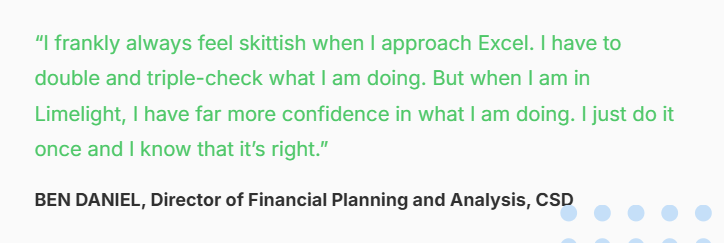
Client testimonial from CSD on Limelight’s capabilities
See how Limelight helps finance teams build board reports in minutes. Request a demo.
The most critical practices include starting preparation at month-end close, assigning clear ownership across your team, building reports around specific board decisions rather than data dumps, and unifying numbers with narrative context. Distribute packs 5–7 days early with a one-page cover memo, standardize your template quarter-over-quarter, separate board-level summaries from executive details, and eliminate multi-tool workflows with a single platform.
Governance best practices recommend distributing board reports 5–7 days before meetings, giving directors time to review, reflect, and prepare informed questions. This transforms meetings from slide presentations to high-value discussions on implications and decisions. Pair the pack with a concise cover memo highlighting the top three issues.
Aim for 20–40 pages for the core board pack, focusing on strategic priorities; supplement with a separate appendix for details. Board Intelligence data shows average packs hit 226 pages (nearly 300 for large firms), but shorter, decision-focused reports earn higher director satisfaction. 63% currently rate theirs "weak" or "poor." Prioritize clarity over completeness.
Board reporting is strategic, concise, and decision-oriented, covering high-level financials, risks, KPIs, and CEO narrative to support oversight. Management reporting is granular and operational, with line-item budgets, departmental metrics, and tactical actions for running the day-to-day business. Boards need outcomes and trends; executives need inputs and execution details.
Pair live data with visuals (trend charts, traffic lights), concise narrative "why it matters" boxes, and multimedia like annotated images or short videos. Tag sections as "Pre-read," "Discuss," or "Decide" to guide attention, and enable drill-downs from summary to detail. Forward-looking elements like scenarios keep discussions dynamic.
FP&A platforms like Limelight excel by connecting ERPs (Sage Intacct, NetSuite) to unified docs for collaborative authoring, live data, and interactive exports, eliminating Excel-PowerPoint chaos. Customers cut assembly time from hours to minutes with fewer errors.
Subscribe to our newsletter