
%20(1).svg)

By Limelight Team |
Last Updated: September 25, 2026

Most FP&A software lists cover enterprise buyers. They rank platforms that require six-figure implementation budgets, dedicated FP&A admin teams, and multi-month rollouts. A 150-person healthcare company or a 300-person SaaS firm has none of those things, and the lists aren't written for them. A SaaS team, for instance, needs a saas revenue forecast model driven by MRR, ARR, and churn, not an enterprise consolidation suite.
So, in this article, we have covered the best FP&A software for small businesses. If forecasting is your top priority, our guide to the best financial forecasting software compares platforms specifically on forecasting depth. Here, you'll find a pricing comparison table with platform architecture, honest pros/cons, AI capability, and a three-step decision framework with TCO reference data.
Enterprise FP&A buying criteria and SMB buying criteria are not the same list. Here is what actually matters for lean finance teams in 2026.
|
Architecture |
How it works |
Best for |
Examples on this list |
|
Spreadsheet-native |
Keeps Excel or Sheets as primary interface; adds automation and governance around existing models |
Teams embedded in Excel models that want consolidation and governance without changing workflows |
Datarails, Cube, Vena |
|
Web-based |
Replaces spreadsheet with a purpose-built finance UI; ERP sync pulls actuals automatically |
Teams ready to move off Excel and want a dedicated planning environment with ERP-native actuals |
Limelight, Abacum, Workday Adaptive |
|
Hybrid |
Web platform that exports to or embeds Excel for input and presentation |
Teams that want modern planning but still present board decks and management packs in Excel |
Prophix, Planful |
These seven criteria form the filter behind every tool write-up below. Platform architecture and ERP compatibility eliminate at least half the list before you read a single feature comparison. Start there, then layer in AI depth, pricing, and support model.
The table below helps you filter FP&A software for small businesses by budget and architecture first. Starting prices reflect known floor costs from G2, ITQlick, and Claryx. "Contact us" flags indicate no public pricing; listed minimums are third-party estimates.
|
Tool |
Architecture |
Best for buyer |
Starting price |
ERP integrations |
G2 rating |
Implementation |
|
Limelight |
Web-based |
Mid-market: NetSuite, Sage Intacct, or Dynamics |
$1,399/mo (starter plan() |
NetSuite, Sage Intacct, Dynamics, QuickBooks |
4.7/5 |
4-12 weeks |
|
Jirav |
Web-based |
Driver-based planning, SMB to mid-market |
~$10,000/yr |
QuickBooks, Xero, Sage Intacct, NetSuite, ADP |
4.7/5 |
2-4 weeks |
|
Datarails |
Spreadsheet-native |
Excel-native SMB and mid-market teams |
~$400/user/mo (ITQlick) |
QuickBooks, Xero, Sage Intacct, NetSuite |
4.6/5 |
4-8 weeks |
|
Cube |
Spreadsheet-native |
Excel and Sheets governance, SMB to mid-market |
~$1,250/mo (G2 est.) |
Excel, Google Sheets, QuickBooks, NetSuite |
4.5/5 |
Days to weeks |
|
Mosaic |
Web-based |
VC-backed SaaS, real-time dashboards |
Contact us; tiered upsell model |
QuickBooks, NetSuite, Salesforce, Workday |
4.3/5 |
2-4 weeks |
|
Prophix |
Hybrid |
Mid-market Excel migration, non-technical teams |
Contact us; lower enterprise tier |
NetSuite, Sage Intacct, Dynamics, Workday |
4.4/5 |
8-16 weeks |
|
Planful |
Hybrid |
Full financial performance management, 500+ employees |
Contact us; enterprise pricing |
NetSuite, Workday, SAP, Dynamics |
4.3/5 |
3-6 months |
|
Vena Solutions |
Spreadsheet-native |
Excel-committed teams needing governance controls |
Contact us; mid-to-high 5 figures |
Excel, NetSuite, Dynamics, Salesforce |
4.5/5 |
8-16 weeks |
|
Workday Adaptive |
Web-based |
Enterprise FP&A teams only (500+ employees) |
Contact us; six figures |
NetSuite, Workday, SAP, Salesforce |
4.3/5 |
3-6 months |
Tools were selected using four criteria: confirmed G2 rating of 4.3 or higher, documented SMB or mid-market reviewer representation, deployment capability within six months under typical SMB conditions, and native ERP integration with at least one major mid-market system.
Enterprise platforms at positions 8 to 9 are included so buyers understand the ceiling of the category, not as active shortlist recommendations for sub-300-employee companies.
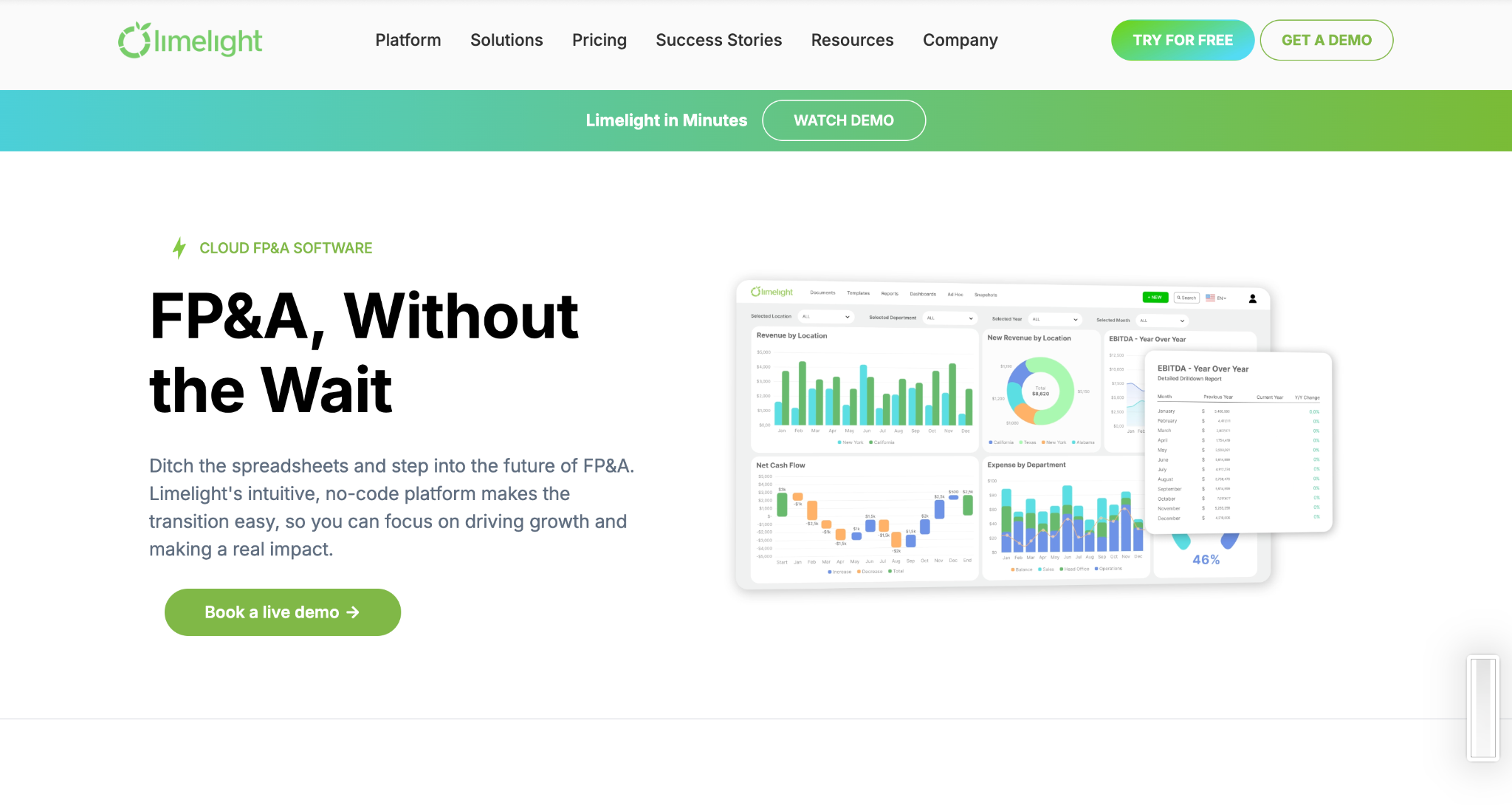
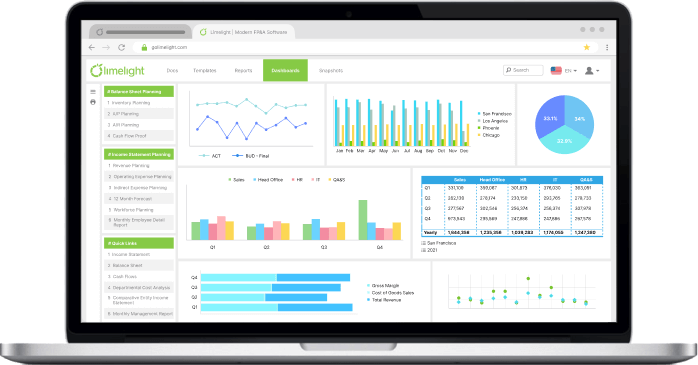
Limelight is a web-based cloud FP&A platform built for mid-market finance teams running NetSuite, Sage Intacct, or Microsoft Dynamics. The interface is designed to feel like Excel, which means finance teams can model, plan, and report without rebuilding how they think. In January 2024, Limelight launched its own no-code analytical engine, enabling finance teams to build and modify models without engaging consultants. Most clients go live within 90 days; some complete deployment in as little as two to three weeks (golimelight.com).
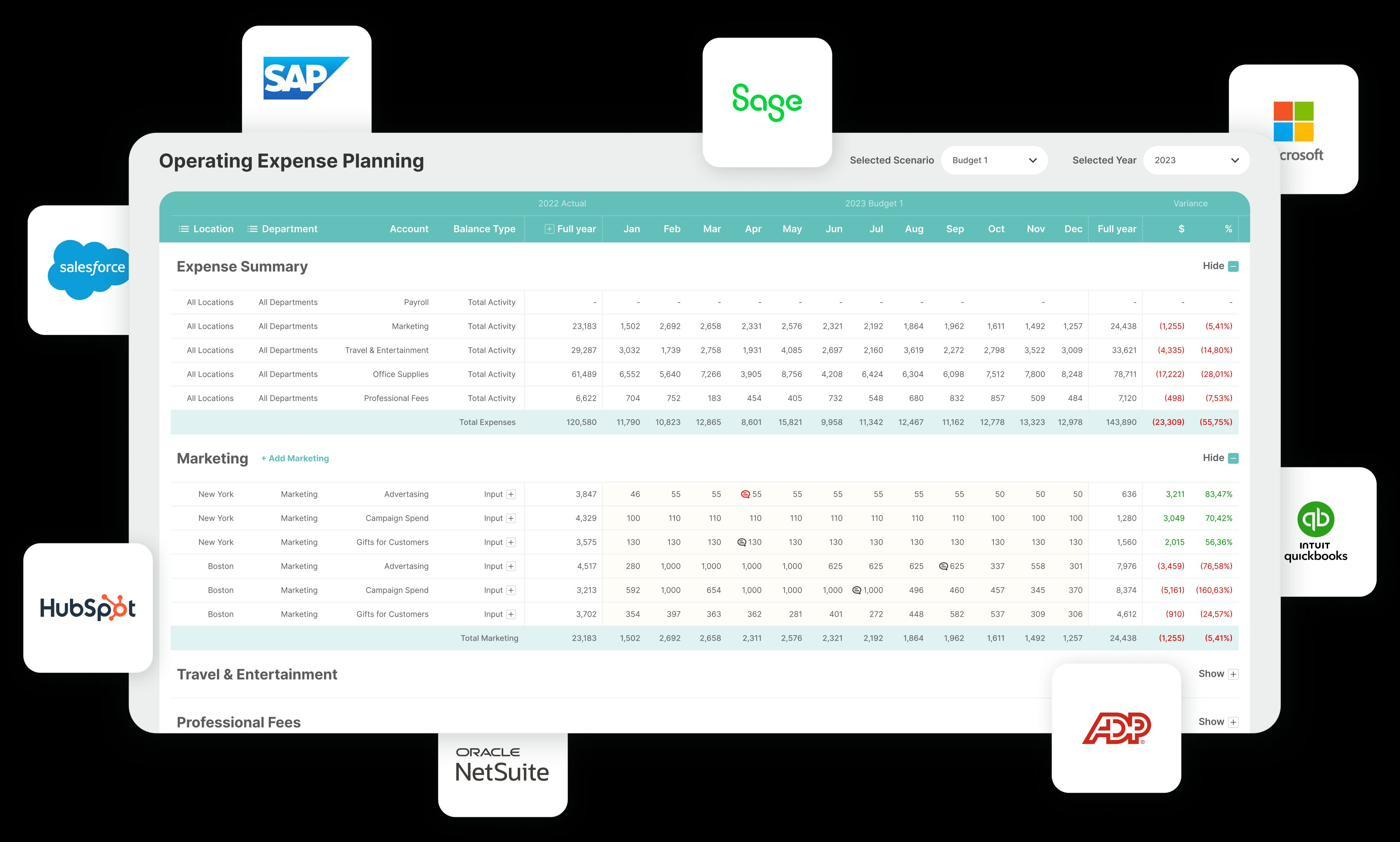
Limelight FP&A platform: operating expense planning view with ERP integrations.
|
Pros |
Cons |
|
Excel-familiar interface; no steep learning curve for finance-trained teams |
Best fit is 100 to 1,000 employees; lighter-touch tools exist for companies under 50 |
|
No-code analytical engine (January 2024) eliminates consultant dependency for model changes |
Primarily serves US and Canada-based organizations |
|
Native integrations with NetSuite, Sage Intacct, and Dynamics; actuals sync automatically |
Full feature depth may exceed immediate needs for very early-stage finance teams |
|
90-day deployment SLA; some clients live in 2 to 3 weeks (golimelight.com) |
|
|
Three integrated AI components: Insights, Assistant, and Forecaster (2026) |
|
G2 Rating: |
|
|
Pricing: |
Starts at $1,400/month for 5 users. |
|
Integrations: |
NetSuite, Sage Intacct, Microsoft Dynamics, QuickBooks, Salesforce, ADP, HubSpot, Payworks. |
|
Best for: |
Nonprofits, healthcare, higher education, and SaaS companies at 100 to 1,000 employees on NetSuite, Sage Intacct, or Microsoft Dynamics wanting fast deployment and no-code model building. |
For the complete list of connected systems, see golimelight.com/integrations.
Jirav is a web-based driver-based planning platform built for small to mid-market companies. It earns high marks on G2 for dashboard quality and reporting depth, with 64.6% of its G2 reviewer base self-identifying as small business (source: Claryx). The $10,000/year minimum is the key budget threshold to clear before adding Jirav to your shortlist.
|
Pros |
Cons |
|
Driver-based planning engine handles headcount, revenue, and operational models |
$10,000/year minimum is a step up from entry-level tools like Fathom |
|
Autoforecast AI generates forecasts from historical drivers with one click |
No native Microsoft Dynamics integration |
|
64.6% small business reviewer mix on G2 (source: Claryx) |
G2 setup score of 7.9 indicates more initial configuration than Fathom or Cube |
|
Integrates with QuickBooks, Xero, Sage Intacct, NetSuite, ADP |
|
G2 Rating: |
|
|
Pricing: |
From approximately $10,000/year. |
|
Integrations: |
QuickBooks, Xero, Sage Intacct, NetSuite, ADP. |
|
Best for: |
Finance teams at 50 to 300-employee companies that want driver-based planning and already have some FP&A modeling discipline in place. |
Datarails is a spreadsheet-native FP&A platform that keeps your team inside Excel and adds automation, version control, and consolidation infrastructure around the spreadsheets you are already using. This makes it one of the lowest-friction adoption paths for teams deeply embedded in Excel models. The trade-off is that the underlying model is still Excel, so structural spreadsheet constraints persist as models grow more complex.
|
Pros |
Cons |
|
Stays inside Excel; minimal workflow disruption for spreadsheet-heavy teams |
Underlying model is still Excel; structural constraints grow with model complexity |
|
FP&A Genius AI adds variance detection and plain-English financial querying |
Mid-market skew on G2; fewer small business use cases documented publicly |
|
Integrates with QuickBooks, Xero, Sage Intacct, NetSuite, Salesforce |
Custom pricing; ITQlick estimates approximately $400/user/month (itqlick.com) |
|
Strong audit trail and version control for compliance-sensitive teams |
|
G2 Rating: |
|
|
Pricing: |
Custom; approximately $400/user/month per ITQlick estimates. |
|
Integrations: |
QuickBooks, Xero, Sage Intacct, NetSuite, Salesforce. |
|
Best for: |
Finance teams at 100 to 500-employee companies committed to Excel that want consolidation and automation without abandoning existing models. |
Cube is a spreadsheet-native FP&A platform that acts as a governance layer for Excel and Google Sheets users. Finance teams continue modeling in their existing spreadsheets while Cube handles version control, data integrity, and multi-source consolidation in the background. Standard setups deploy in days to a few weeks, making it one of the faster options in the mid-market tier.
|
Pros |
Cons |
|
Works inside Excel and Google Sheets; no modeling workflow change required |
Formatting does not save in Excel view; persistent documented G2 reviewer complaint |
|
Centralizes governance and version control across spreadsheet-based models |
Admin licensing structure can be restrictive for multi-admin teams |
|
Standard setups live in days to weeks; fast relative to mid-market competitors |
AI capabilities cover basic variance identification; no proactive monitoring or narrative generation |
|
Integrates with QuickBooks, NetSuite, Salesforce, Xero |
|
G2 Rating: |
|
|
Pricing: |
Custom; approximately $1,250/month per G2 estimates. |
|
Integrations: |
Excel, Google Sheets, QuickBooks, NetSuite, Salesforce, Xero. |
|
Best for: |
Finance teams at 50 to 300-employee companies that model in Excel or Google Sheets and want governance and centralization without switching tools. |
Mosaic is a web-based strategic finance platform built for VC-backed SaaS companies. It delivers real-time metric dashboards and automated reporting optimized for investor-facing output: board decks, monthly reporting packages, and ARR analysis. Setup runs 2 to 4 weeks for standard SaaS configurations. In 2026, Mosaic was acquired by HiBob; buyers should verify current product independence and roadmap continuity before signing a contract.
|
Pros |
Cons |
|
Real-time metric dashboards built for investor reporting and board decks |
Acquired by HiBob in 2026; verify product roadmap continuity before signing |
|
Strong integrations with SaaS-native systems including Salesforce and QuickBooks |
Pricing structure splits reporting and planning; upsells to full feature set are common |
|
2 to 4 week implementation for standard SaaS configurations |
Not suitable for multi-entity, multi-ERP, or non-SaaS cost structures |
|
Arc AI chatbot enables quick financial queries for non-finance stakeholders |
|
G2 Rating: |
|
|
Pricing: |
Contact us; tiered model with reporting and planning sold separately. |
|
Integrations: |
QuickBooks, NetSuite, Salesforce, Workday. |
|
Best for: |
VC-backed SaaS companies at 50 to 200 employees reporting frequently to investors and needing real-time metric visibility more than deep planning depth. Verify acquisition status before evaluating. |
Prophix is a hybrid CPM platform targeting mid-market companies making the move away from Excel. It covers budgeting, forecasting, reporting, and consolidation in one system and integrates with the ERP stack common at mid-market companies (NetSuite, Sage Intacct, Dynamics, Workday). Implementation runs 8 to 16 weeks. Prophix positions at the lower end of enterprise pricing, meaning it tends to run above SMB-tier tools; a 100-person company is likely paying for capabilities they will not use for 18 to 24 months.
|
Pros |
Cons |
|
Full budgeting, forecasting, reporting, and consolidation in one platform |
8 to 16 week implementation; consultant-led for most configurations |
|
Designed for non-technical finance teams migrating from Excel |
Pricing positions at lower end of enterprise; typically above SMB budget thresholds |
|
Strong ERP integration: NetSuite, Sage Intacct, Dynamics, Workday |
G2 rating of 4.4/5 is the lowest among the first seven tools on this list |
|
AI virtual analyst flags errors and anomalies during forecast cycles |
|
G2 Rating: |
|
|
Pricing: |
Contact us; lower-end enterprise pricing tier. |
|
Integrations: |
NetSuite, Sage Intacct, Microsoft Dynamics, Workday. |
|
Best for: |
Mid-market companies at 200 to 1,000 employees moving off Excel that want a full-suite platform without Workday Adaptive's enterprise price tag. |
Planful is a hybrid financial performance management platform, a broader category than FP&A software alone. It covers consolidation, close, reporting, and planning under one roof, replacing multiple point solutions with a single integrated system. Implementation runs 3 to 6 months and pricing is enterprise. For a 100-person company that needs budgeting and forecasting, Planful is more platform than the situation warrants. It is included here as a ceiling option so buyers understand where the category ends.
|
Pros |
Cons |
|
Full financial performance management: close, consolidation, reporting, and planning |
3 to 6 month implementation; significant change management commitment required |
|
Planful Predict AI automates rolling forecasts and flags anomalies |
Enterprise pricing; typically exceeds SMB budget thresholds |
|
Strong ERP coverage: NetSuite, Workday, SAP, Dynamics; 492 G2 reviews |
Feature depth is overkill for most companies under 300 employees |
|
G2 Rating: |
|
|
Pricing: |
Contact us; enterprise pricing. |
|
Integrations: |
NetSuite, Workday, SAP, Microsoft Dynamics. |
|
Best for: |
Companies at 500+ employees with a dedicated FP&A team and a mandate to consolidate close, reporting, and planning onto a single platform. Not recommended for SMBs under 300 employees. |
Vena is a spreadsheet-native enterprise platform that keeps Excel at the center but layers governance, workflow controls, and collaborative budgeting on top. In February 2026, Vena acquired Acterys, extending its Power BI analytics integration. Vena's AI layer (Vena Copilot) now orchestrates three agents (Planning, Reporting, and Analysis), all in active development as of Q2 2026.
Teams comparing that spreadsheet-native model against web-based options can review the vena alternatives roundup.
|
Pros |
Cons |
|
Excel-native; finance teams keep existing models and familiar workflow |
Consultant-led implementation typically required (8 to 16 weeks) |
|
Vena Copilot: three AI agents for planning, reporting, and analysis |
Mid-to-high five figures annually once implementation costs are included |
|
Acterys acquisition (February 2026) extends Power BI analytics integration |
Planning Agent AI remains in beta as of Q2 2026; verify GA status before signing |
|
464 G2 reviews provide strong social proof for evaluation teams |
|
G2 Rating: |
|
|
Pricing: |
Contact us; typically mid-to-high five figures annually including implementation. |
|
Integrations: |
Excel, NetSuite, Microsoft Dynamics, Salesforce, Power BI (via Acterys). |
|
Best for: |
Mid-market finance teams at 200 to 1,000 employees committed to Excel modeling that need enterprise-grade governance and workflow controls layered on top. |
Workday Adaptive Planning is the most powerful platform on this list and the one most likely to be wrong for a small business. The decision rule is simple: if your company has fewer than 300 employees and no dedicated FP&A admin, skip Workday Adaptive and start your evaluation at Limelight or Jirav. For companies at 500 to 2,000 employees with a mature finance function and a full implementation runway, the product is excellent.
|
Pros |
Cons |
|
Most feature-complete FP&A platform available; handles complex multi-entity planning |
3 to 6 month implementation; requires dedicated FP&A admin resources |
|
Deep Workday HCM integration; workforce-linked AI forecasting more accurate than standalone tools |
Six-figure pricing at enterprise scale |
|
Strong analyst recognition and large practitioner community |
Overkill for companies under 300 employees without a dedicated FP&A team |
|
G2 Rating: |
|
|
Pricing: |
Contact us; six-figure range at enterprise scale. |
|
Integrations: |
NetSuite, Workday, SAP, Salesforce. |
|
Best for: |
Enterprise finance teams at 500+ employees with a dedicated FP&A function, complex consolidation requirements, and a full implementation runway. Not recommended for SMBs. |
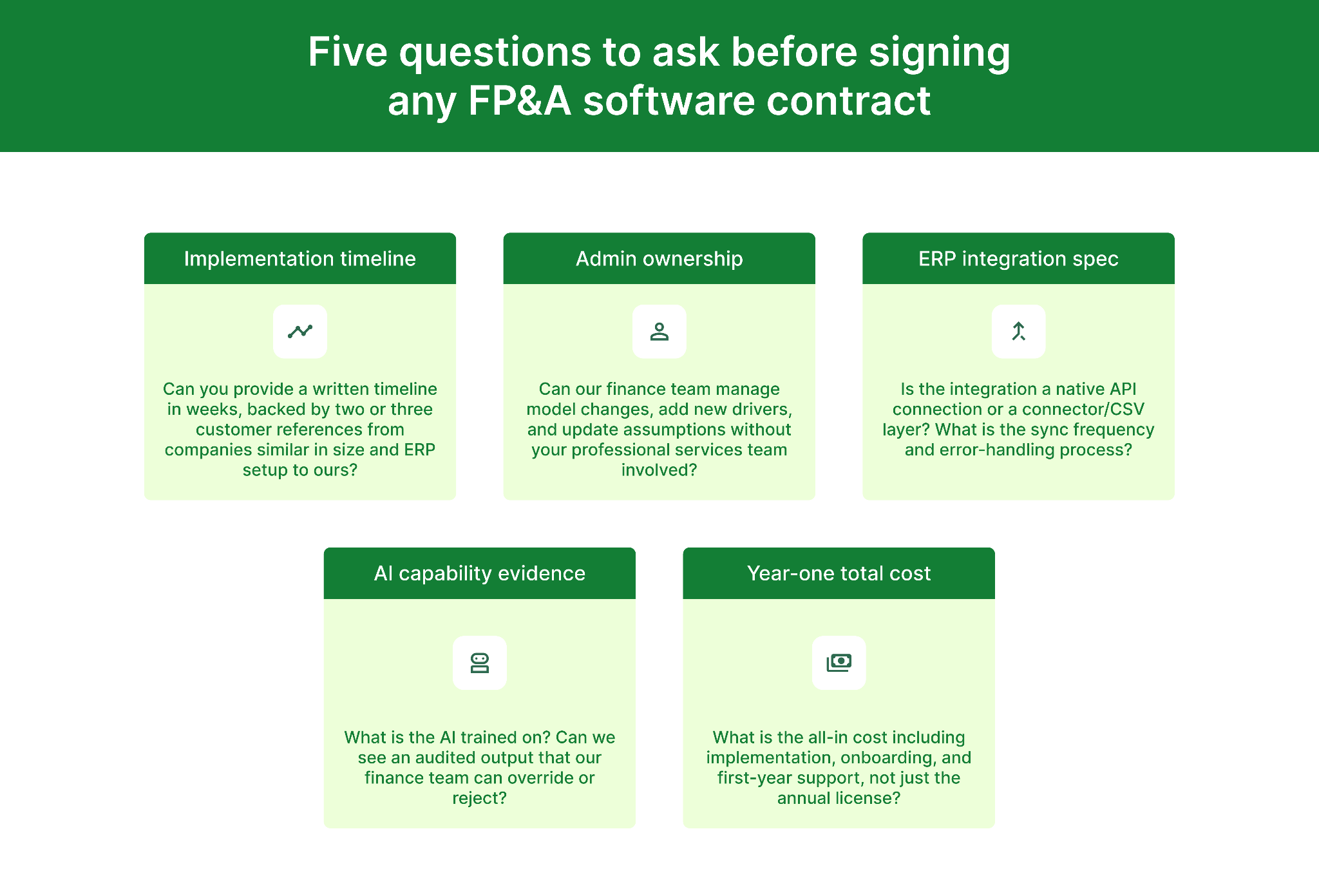
Picking the right tool starts with understanding what is actually broken, not with reading feature marketing. The AFP's 2026 FP&A Benchmarking Survey found that planning technology investments frequently fail to deliver expected efficiency gains because the platform exceeded the team's capacity to use it effectively. The three-step framework below is designed to prevent exactly that.
Year-one total cost of ownership reference (estimated ranges)
|
Company size |
License range (annual) |
Implementation estimate |
Typical year-one total |
|
50-100 employees |
$5,000-$15,000 |
Self-serve to $5,000 |
$5,000-$20,000 |
|
100-300 employees |
$10,000-$40,000 |
$5,000-$20,000 |
$15,000-$40,000 |
|
300-500 employees |
$20,000-$80,000 |
$10,000-$40,000 |
$30,000-$60,000 |
|
500+ employees |
$50,000-$200,000+ |
$25,000-$100,000+ |
$75,000-$100,000+ |
Ranges are estimates based on publicly available pricing and third-party TCO data (Aleph Q2 2026, CentSight June 2026). Actual costs vary by vendor, configuration, and negotiated terms.
|
For mid-market companies on NetSuite, Sage Intacct, or Microsoft Dynamics: Limelight is purpose-built for your ERP stack. No-code model building, 90-day deployment, and a finance-first interface your team can use without IT involvement. Explore the FP&A platform. |
The framework above applies across the full SMB range. A 50-person company on QuickBooks needing basic reporting should start with Fathom. A 400-person company on NetSuite running multiple departments through a two-person finance team should be looking at Limelight or Jirav. The ERP question and the architecture question together eliminate more than half the list before you book a single demo.
Most FP&A software lists are not filtered for SMBs, which means buyers at 100 to 500-employee companies waste evaluation cycles on platforms that require enterprise budgets and IT teams. The 9 tools above were selected specifically for small and mid-market buyers, with explicit overkill callouts for platforms that do not fit the profile.
For finance teams on NetSuite, Sage Intacct, or Microsoft Dynamics needing fast deployment, no-code model building, and a platform that does not require consultants to maintain, Limelight is the purpose-built option. It is the only platform on this list with native integrations across all three of those ERPs, a 90-day deployment SLA, and an Excel-familiar interface designed for finance practitioners, not IT administrators. If you are on QuickBooks or Xero and need reporting fast, start with Fathom. If you need driver-based planning with a cleared $10,000/year budget, add Jirav to your shortlist. If you're specifically on Sage Intacct, our guide to sage intacct fp&a software compares the top tools head to head.
Book a 30-minute demo to walk through how Limelight works with your existing ERP and your team's actual planning workflow.
|
See how Limelight helps finance teams at 100 to 1,000-employee companies close faster and forecast with more confidence, without the enterprise bloat. |
Accounting software (QuickBooks, Sage Intacct, NetSuite) records transactions and produces financial statements. FP&A software connects to those systems and adds budgeting, forecasting, scenario modeling, and management reporting on top. You need both; FP&A software does not replace your ERP or general ledger.
No. Most platforms on this list are designed for controllers, finance managers, or fractional CFOs running lean teams. Tools like Fathom and Limelight are built specifically for non-enterprise finance functions. A two-person finance team can implement and manage either platform without a full-time CFO in seat.
Entry-level tools like Fathom offer tiered pricing with free trials. Mid-market platforms like Jirav start around $10,000/year (Claryx). Limelight starts at $1,400/month for 5 users. Enterprise platforms like Workday Adaptive enter six figures. Always add implementation costs; year-one total typically runs 1.5 to 3 times the annual license for consultant-led platforms.
Fathom deploys in hours to days for QuickBooks or Xero users. Cube deploys in days to weeks for Excel and Google Sheets teams. Limelight's typical implementation runs 2 to 12 weeks, with some clients live in under three weeks (golimelight.com). Vena and Prophix typically require 8 to 16 weeks. Workday Adaptive and Planful run 3 to 6 months.
No, for most small businesses. Workday Adaptive is designed for enterprise finance teams with dedicated FP&A staff, complex multi-entity structures, and 3 to 6 month implementation timelines. Companies under 300 employees should evaluate purpose-built mid-market tools like Limelight or Jirav first.
"Contact us" pricing without a third-party floor estimate, implementation timelines stated in "phases" rather than weeks, and ERP integrations that are connector layers rather than native APIs. These are the three most common traps for SMB buyers in FP&A software evaluations.
Limelight is the only tool on this list with native integrations across all three. Datarails, Prophix, and Vena cover multiple ERPs from that set but none covers all three plus QuickBooks. If your company runs any of those three ERPs, ERP compatibility should be the first filter in your evaluation.
Subscribe to our newsletter