

By Limelight Team |
Last Updated: November 23, 2026

Financial Edge NXT is Blackbaud’s cloud-based fund accounting and financial management software for nonprofits and other social good organizations. It supports core financial functions including general ledger, budgeting, financial reporting, grants, projects, and internal controls.
For organizations already using Financial Edge NXT, the question is rarely whether the accounting system works. The harder question is whether the spreadsheets and manual steps built around it can keep up with how finance plans today.
Limelight integrates with Financial Edge NXT, so the two work together. Financial Edge NXT stays the source for recorded financial results. Limelight is the planning layer that picks up those actuals for budget collection, forecasting, scenarios, and management analysis.
This guide covers the signs that your planning process needs that extra layer, what Financial Edge NXT and Limelight each handle, and how to add Limelight alongside Financial Edge NXT without touching your accounting setup.
Blackbaud FE can provide the accounting foundation for budgeting. Planning gets harder when finance needs to manage frequent reforecasts, department-level submissions, driver-based assumptions, and multiple scenarios alongside the ledger.
The clearest signs are:
These questions require finance to duplicate the base budget and create a separate scenario file. Once several scenarios are circulating, each with different assumptions, finance has to reconcile the outputs manually and make sure decision-makers are comparing the same baseline.
Financial Edge NXT is Blackbaud’s fund accounting software for nonprofits. It tracks restricted funds, grants, projects, and endowments through subfund functionality. It also automates reconciliation and gives finance a single source of truth for revenue sources when reporting to funders.
Limelight, the FP&A platform, integrates with Financial Edge NXT and brings the financial data into one planning model. With Limelight, finance collects department budgets, updates drivers and assumptions, compares the final budget with monthly forecast versions, runs scenarios, and reviews actuals against plan.
Since Limelight integrates with Financial Edge NXT, finance does not have to choose between the two. Financial Edge NXT keeps running the accounting, and Limelight takes over the budgeting, forecasting, and reporting work that happens around it.
|
Area |
Financial Edge NXT |
Limelight |
|
Fund and grant tracking |
Tracks restricted funds, grants, projects, and endowments through subfunds |
Plans grant, program, and project funding and consolidates budgets by fund or program |
|
Chart of accounts |
Holds the chart of accounts used for accounting |
Maps accounts into flexible hierarchies and rollups for planning and reporting |
|
Actuals and data |
Records revenue and financial results in one source of truth |
Syncs those actuals without manual entry or file exports |
|
Budgeting |
Works with budgeting tools through the Blackbaud Marketplace |
Collects department budgets in connected templates and consolidates them by department, entity, fund, or program |
|
Forecasting and scenarios |
Supplies the recorded actuals that forecasts start from |
Connects growth, hiring, and spending assumptions to the forecast and tests scenarios |
|
Workforce and operating expenses |
Connects to payroll and HR tools through the Blackbaud Marketplace |
Models salary changes and planned hires alongside operating expenses |
|
Compliance and reporting |
Enforces purpose and restriction with compliance tools and reports to funders |
Compares actuals, budgets, and forecasts by department, entity, account, or scenario and explains variances |
What Financial Edge NXT and Limelight each handle
The exact division depends on how the organization has configured Financial Edge NXT and which accounts, dimensions, and historical data are available through the integration.
Before setting up the planning model, finance should confirm what can be brought into Limelight and at what level of detail. It includes:
Accounting continues to own the numbers recorded in Financial Edge NXT, including posted actuals, transaction data, and the controls around the close. FP&A owns the planning layer:
Budget owners provide and update their inputs in the planning process, while accounting remains responsible for the underlying financial records.
The workflow is less about moving financial data out of one system and more about giving each system a clear job. Financial Edge NXT provides the actuals and accounting structure. Limelight uses the information for budgets, forecasts, scenarios, and management analysis.
Financial Edge NXT remains the starting point for historical financial data. Through the Limelight and Financial Edge NXT integration, finance brings the relevant posted actuals and accounting structure into Limelight, based on the accounts and dimensions available for the organization.
For example, a detailed set of expense accounts can provide the actuals used to establish the starting point for an operating-expense forecast. The ledger does not need to be reorganized simply because finance wants to forecast those expenses differently.
The accounting structure and the planning structure do not have to be identical.
Finance can map individual source accounts directly to planning lines or group several ledger accounts into a broader planning category. For example, several payroll-related accounts might roll into a Personnel planning category, while detailed program expenses can be grouped into the categories department leaders actually use when reviewing their budgets.
Once the actuals are in place, Limelight becomes the working environment for forward-looking planning.
Finance can collect department submissions, set assumptions, update headcount or operating-cost drivers, and create forecast versions. If leadership wants to test a different hiring plan or a change in program activity, those assumptions can be modeled without creating another copy of the accounting ledger.
Before finance relies on the data for a forecast or management report, mapped actuals should reconcile to the agreed totals in Financial Edge NXT. Finance should also have a process for reviewing new accounts, renamed dimensions, or mapping changes so that a change in the ledger does not quietly create a difference in the planning model.
The refresh process should follow how the finance team actually works.
If management reporting happens after month-end close, the planning model may be refreshed after the relevant actuals are posted and reviewed. If finance runs a more frequent forecast, the refresh cadence may need to be different. The production schedule should be based on the organization’s confirmed Blackbaud integration behavior rather than assuming that every data element updates in real time.
A controlled rollout reduces the risk of carrying spreadsheet problems into a new platform. Each phase should have a clear owner, output, and acceptance check.
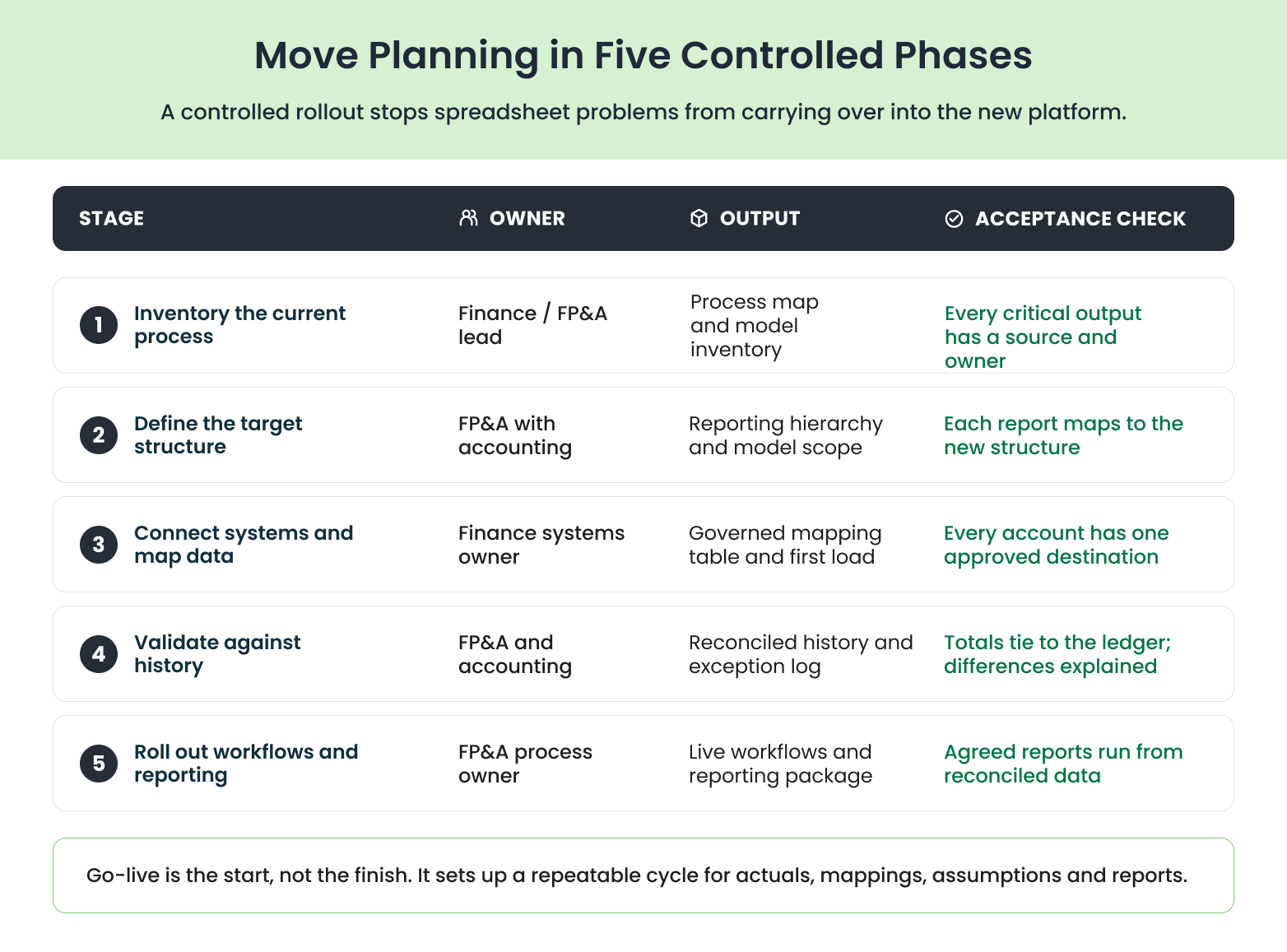
Document how budgets, forecasts, and management reports are produced today. Include source files, contributors, approval steps, formulas, manual adjustments, reporting deadlines, and recurring reconciliation work.
This phase prevents the new planning model from inheriting unnecessary work. A spreadsheet may contain a calculation because it is essential, or somebody added it five years ago and nobody has challenged it since.
Decide how leaders need to view revenue, expenses, headcount, programs, departments, entities, or other relevant dimensions. The planning hierarchy should support decisions without reproducing every detail in the ledger.
Configure the approved integration, load the relevant source structure, and map accounts and dimensions into Limelight. Document direct mappings, grouped mappings, exclusions, and exceptions.
Mapping governance begins here. Accounting should review classifications that affect financial interpretation, while FP&A should own how the mapped data supports planning and management analysis.
Historical data gives finance a basis for trends, assumptions, and variance analysis. Load a representative period, apply the mappings, and reconcile the results to Financial Edge NXT.
Run the new planning workflow beside your existing spreadsheet process. The goal is to prove that differences are intentional, traceable, and useful.
Once the data foundation is stable, configure contributor inputs, assumptions, approvals, forecast versions, dashboards, and recurring reports. Train users on the work they need to complete rather than every feature in the platform.
A successful rollout does not end at go-live. It establishes a repeatable operating process for updating actuals, changing mappings, adding accounts, revising assumptions, and issuing reports.
Adding a planning layer does not mean changing everything at once, and it does not change how Financial Edge NXT is used for accounting. Finance can work through the rollout in stages:
Each phase should have a clear owner, deliverable, and check before the team moves to the next one.
If Financial Edge NXT meets your accounting needs, there is no reason to change it. Finance can keep the ledger exactly where it is and address the planning problems with Limelight that integrates with it.
The practical approach is to define what each system should own. Financial Edge NXT remains the source for recorded financial results, while Limelight supports the work finance does around those results:
For finance teams dealing with spreadsheet-heavy budgets and frequent reforecasts, this improves planning while leaving the accounting system untouched. Start by reviewing the current Financial Edge NXT setup, identifying where the existing planning process creates the most manual work, and deciding which planning tasks Limelight should take on alongside the ledger.
Ready to see how that could work for your finance team?
Book a demo of Limelight to walk through your current planning process and see how it works alongside Financial Edge NXT.
Finance typically needs the actuals and accounting structure required for budgeting, forecasting, variance analysis, and management reporting. The exact accounts, history, and dimensions should follow the approved model scope and the capabilities confirmed for the integration.
Load a representative historical period, apply the approved mappings, and reconcile agreed totals to Financial Edge NXT. Investigate unmapped accounts, changed classifications, and unexplained differences before using history to set forecast assumptions.
Yes. The chart of accounts stays in Financial Edge NXT as is. Finance can map detailed source accounts into a separate planning and management-reporting hierarchy in Limelight instead of redesigning the chart of accounts solely for FP&A.
No. Limelight integrates with Financial Edge NXT and complements it. Financial Edge NXT remains the accounting system of record for the general ledger, transactions, and period close, while Limelight handles budgeting, forecasting, scenarios, and management reporting.
Subscribe to our newsletter