

By Limelight Team |
Last Updated: November 23, 2026

A three-year financial projection gives nonprofit leaders a structured view of how funding, programs, staffing, costs, and cash could develop over time. Building one requires more than extending current numbers into future years. Finance needs to establish a reliable baseline, identify the assumptions that drive the outlook, connect those assumptions across the organization, and show where funding or timing changes could affect operations.
This guide explains how to build a three-year nonprofit financial projection, from reconciling actuals and setting model dimensions to projecting revenue, workforce, operating costs, liquidity, and scenarios. It also covers how to model grant restrictions, separate planning responsibilities from accounting, and keep the forecast useful after approval.
Nonprofit organizations include charities, healthcare providers, higher education institutions, museums and cultural organizations, and religious institutions, among others. They share a mission-driven purpose, but their funding sources, cost structures, and planning pressures differ.
|
Organization type |
What it does |
Typical funding and revenue |
Planning considerations |
|
Charities and human service organizations |
Deliver services such as food assistance, housing, youth programs, or disaster relief |
Individual donations, foundation grants, government contracts, fundraising events |
Grant award timing, restricted funding, renewal risk, and program growth against hiring plans |
|
Healthcare nonprofits |
Provide clinical care, community health services, or related research |
Patient service revenue, payer reimbursements, grants, philanthropy |
Staffing levels, reimbursement cycles, equipment purchases, and cash timing |
|
Higher education institutions |
Offer instruction, research, and student services |
Tuition, research awards, gifts, endowment distributions, auxiliary services |
Enrollment shifts, faculty hiring, research grant periods, and facilities commitments |
|
Museums and cultural organizations |
Preserve collections and deliver exhibitions, education, and public programs |
Admissions, memberships, donations, grants, capital campaigns |
Seasonal attendance, exhibition schedules, collections care, and campaign timing |
|
Religious institutions |
Support worship, community programs, and outreach |
Member giving, designated gifts, facility use, program fees |
Facilities costs, staffing, outreach programs, and designated or restricted funds |
Common nonprofit types, funding sources, and planning considerations
Other organizations, such as advocacy groups, professional associations, and community foundations, face similar planning questions with their own funding and cost drivers.
Whatever the type, the projection needs the same foundation: a reconciled baseline, clear planning dimensions, documented drivers, and a view of cash timing. The type of organization determines which drivers carry the most weight.
Financial projections for nonprofit organizations are forward-looking estimates built from historical actuals, current plans, and explicit assumptions. They show how funding, programs, staffing, costs, and liquidity may develop over future periods, helping leaders test whether strategic and operating decisions remain financially supportable.
The terms budget, forecast, projection, and scenario are related, but they are not interchangeable:
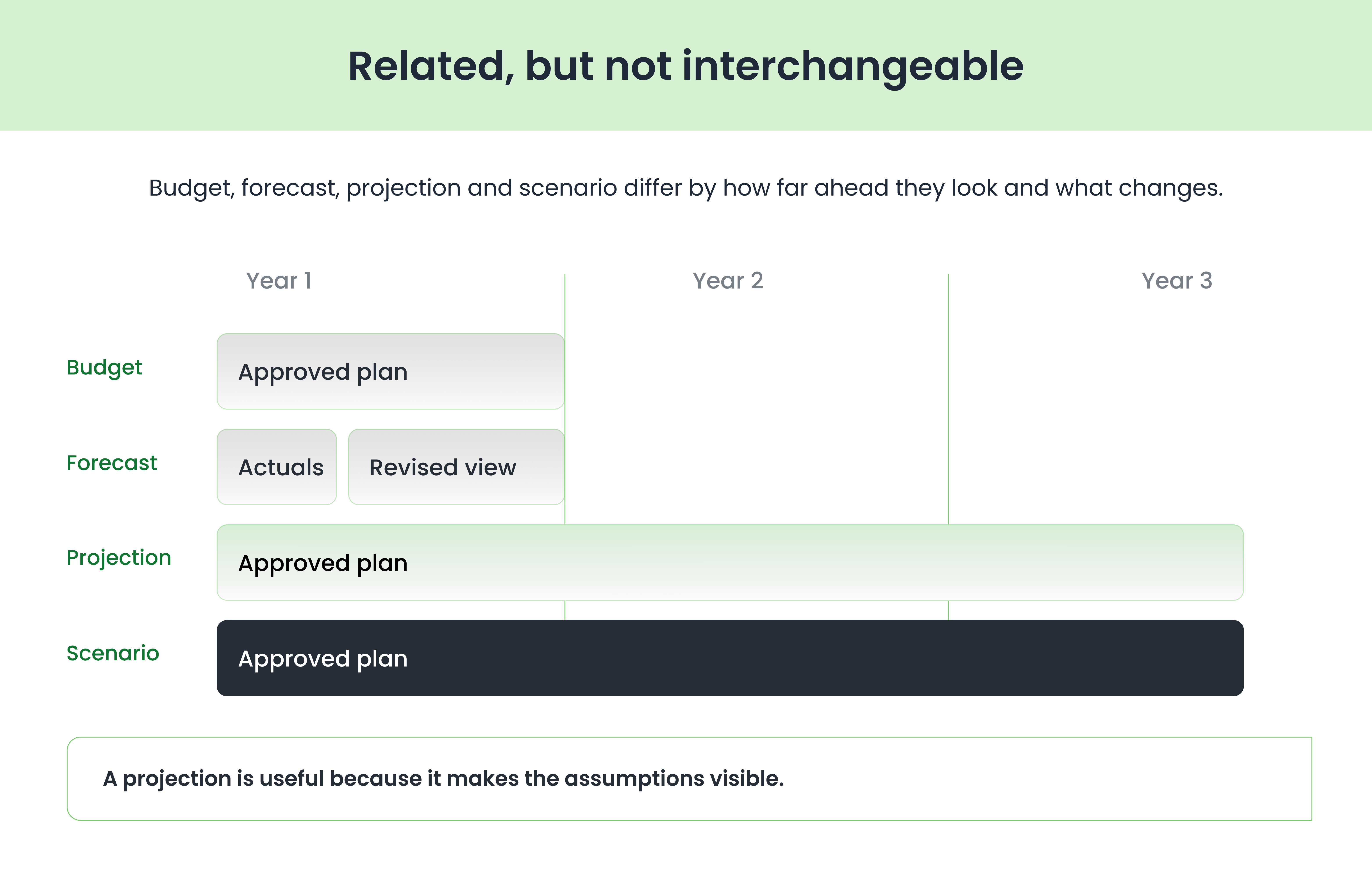
A projection is useful because it makes assumptions visible. Instead of showing only that compensation increases in year two, it can show whether the change comes from planned hires, revised start dates, compensation assumptions, or benefit costs.
Projections do not replace the general ledger, required financial statements, individual grant budgets, accounting policies, or professional judgment. The ledger remains authoritative for posted actuals. The model uses those actuals as a starting point for decisions about what may happen next.
A three-year nonprofit forecast should connect projected revenue and support with program activity, workforce plans, shared operating costs, capital decisions, and liquidity. Each component should use assumptions appropriate to its economics and timing rather than one uniform growth rate across the model.
|
Model component |
What to project |
Example drivers |
|
Revenue and support |
Funding by meaningful source or type |
Award timing, renewal assumptions, fundraising plans, earned activity |
|
Programs |
Direct operating activity |
Service volume, program schedule, delivery model |
|
Workforce |
Salaries, benefits, open and planned roles |
Start dates, compensation assumptions, vacancy timing |
|
Shared operating costs |
Facilities, technology, insurance, professional services |
Contracts, inflation assumptions, step changes |
|
Capital and financing |
Planned purchases and related cash effects |
Timing, useful planning horizon, funding source |
|
Liquidity |
Cash timing and available resources |
Collection and disbursement timing, minimum operating needs |
Key components of a nonprofit financial planning model
If a program expands, the model may need to reflect additional service activity, staff, facilities, technology, and administrative support. If a funding assumption changes, the model should reveal which operating plans and cash periods are affected.
The model also needs enough dimensional detail to answer management questions. Funds, grants, programs, departments, natural accounts, projects, entities, and bank accounts describe different aspects of the organization. They should not be combined merely because doing so makes the model smaller.
At the same time, more detail is not automatically better. A three-year model should carry only the dimensions required for decision-making, accountability, and traceability. Excess detail creates maintenance work without improving the decision.
Build a three-year nonprofit financial projection by establishing a reconciled baseline, selecting decision-useful dimensions, defining operating drivers, projecting each major component with an appropriate method, connecting results to liquidity, and documenting ownership and changes. The model should become less granular as uncertainty increases across the horizon.
Start with closed or otherwise agreed general-ledger actuals. Identify the reporting period, entities, accounts, and dimensions included, then reconcile the baseline to the totals finance already uses for management reporting.
Next, determine how the current year enters the model:
|
Planning situation |
Baseline approach |
|
Year is underway |
Use actuals for completed periods and the current forecast for remaining periods |
|
Planning begins before the year starts |
Use the approved budget as the starting point where appropriate |
|
Actuals are available but not yet agreed |
Resolve reconciliation issues before treating them as the model baseline |
Choose the right baseline for your planning period
Label each source clearly so users can distinguish actuals from assumptions.
The level of detail should also reflect the planning horizon. Monthly detail can be useful when hiring dates, award timing, or cash movements materially affect decisions. Annual or quarterly views may be sufficient farther out.
The accounting structure provides an important starting point, but the planning model should reflect how management makes decisions.
|
Dimension |
Planning use |
|
Natural accounts |
Roll detailed accounts into broader planning lines |
|
Programs |
Show financial activity by program or service |
|
Departments |
Assign operating responsibility and review performance |
|
Grants and funds |
Preserve purpose, restriction, accountability, or timing where relevant |
|
Projects |
Track specific initiatives or investments |
|
Entities |
Separate organizations or operating units |
|
Bank accounts |
Support cash and liquidity analysis where relevant |
Map each dimension to its role in financial planning
These dimensions describe different aspects of the organization and should not be collapsed simply to make the model smaller. A grant may support a program, for example, but the grant and program are still different dimensions.
List the assumptions that can materially change the outlook. The relevant drivers will vary by organization, but common examples include:
|
Driver area |
Examples |
|
Funding |
Award dates, renewal expectations, fundraising plans |
|
Programs |
Service volume, program schedule, delivery model |
|
Workforce |
Hiring dates, vacancies, compensation changes |
|
Benefits |
Benefit assumptions and enrollment changes |
|
Contracts |
Renewal dates, rate changes, usage terms |
|
Facilities |
Lease commitments and planned changes |
|
Capital |
Planned purchases and timing |
Key drivers behind each planning assumption
For each material driver, document:
Different components require different projection methods. A nonprofit should model each major component according to the factors that actually drive it.
|
Component |
Projection approach |
Example drivers |
|
Revenue and support |
Project by meaningful source or type |
Award timing, renewal assumptions, fundraising plans, earned activity |
|
Workforce |
Model roles and timing |
Current positions, open roles, planned additions, start dates, compensation |
|
Operating costs |
Use the driver that best reflects the cost |
Headcount, activity, contracts, schedules, step changes |
|
Shared operating costs |
Model significant commitments separately |
Facilities, technology, insurance, professional services |
|
Capital |
Reflect planned purchases and timing |
Purchase date, planning horizon, funding source |
Project the financial components using their key operating drivers
A projected surplus is not the same as projected cash, and projected cash is not necessarily available for every purpose. Add a liquidity view when the timing of receipts and payments affects management decisions.
|
Liquidity question |
What to model |
|
When will funding arrive? |
Expected receipt timing |
|
When will cash leave? |
Payroll, major obligations, and planned purchases |
|
What resources are available? |
Available cash and relevant restrictions |
|
Where could timing gaps occur? |
Delayed funding, early spending, or collection changes |
|
What depends on another assumption? |
Funding, hiring, program activity, and cash timing |
Connect projected results to cash timing and liquidity needs
Map when expected funding may be received, when payroll and major obligations occur, and when planned purchases require cash.
A projection should be checked before management relies on its results.
Reconciliation checklist:
Document who owns each major assumption and what changed between versions.
Review the results for economic sense as well as mathematical correctness. A model can balance while still relying on an implausible hiring sequence or inconsistent funding assumption.
The projection should also communicate uncertainty appropriately. As the forecast extends further into the future, the assumptions become less certain.
Use:
Avoid adding decimal-level precision to year three when the underlying assumptions cannot support it.
Restrictions and grant timing should remain visible wherever they affect the organization’s ability to carry out its plan. A consolidated projection can overstate flexibility when it treats expected resources as interchangeable or ignores when funding and related program activity occur.
For a program expansion supported by an expected restricted, multi-year grant, the projection should connect:
|
Planning element |
What to model |
|
Grant |
Expected award period and timing |
|
Workforce |
Planned hiring and start dates |
|
Program |
Expected delivery and activity |
|
Direct costs |
Costs associated with program activity |
|
Shared costs |
Operating needs that continue across the organization |
|
Liquidity |
Timing of funding receipts and related cash needs |
Model grant timing alongside workforce, program, costs, and liquidity
Suppose the award begins later than expected. Finance should be able to move the grant timing assumption and see the connected effects.
The model should also expose mismatches. If hiring moves but the award does not, or the award moves but related commitments remain unchanged, the dependency becomes visible.
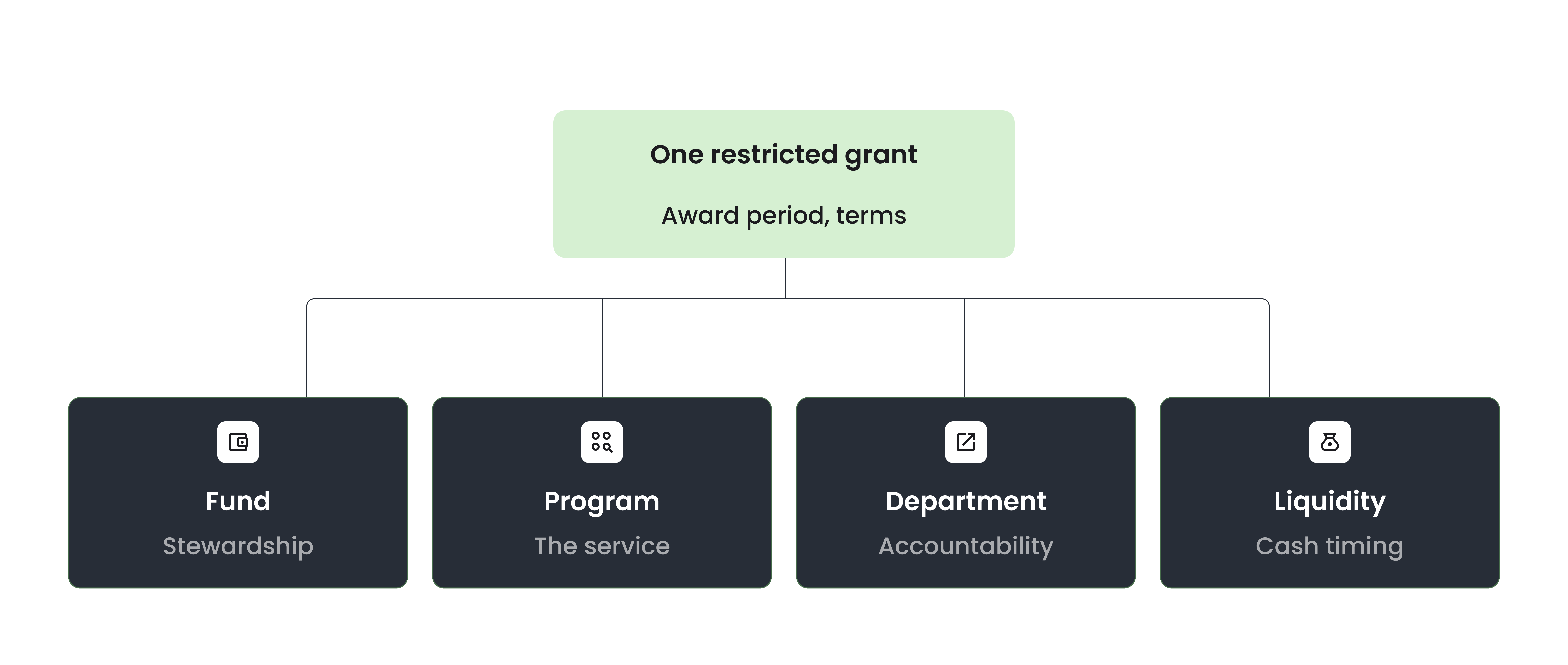
A grant, fund, program, and department should remain separate dimensions in the model.
|
Dimension |
What it represents |
|
Grant |
A funding source with specific terms, timing, or restrictions |
|
Fund |
The stewardship or designation of resources |
|
Program |
The activity or service being delivered |
|
Department |
The organizational responsibility for operating activity |
Keep grants, funds, programs, and departments clearly distinguished
A grant may support a program, but it is not necessarily the program itself. A fund designation may describe how resources are managed, but it is not a bank account.
The planning model should help management understand how the timing and purpose of expected resources affect the operating plan. It does not change donor restrictions or determine accounting treatment.
Accounting treatment for grants, restrictions, and net assets should follow current authoritative guidance and the organization’s accounting policies. The planning model should carry enough information to support financial decisions while leaving accounting authority with the accounting system and applicable policies.
Nonprofit finance teams should test a supportable base case, a funding-delay or downside case, and a program-growth or upside case. Each scenario should change a small set of decision-relevant assumptions in the same governed model so leaders can compare consequences and responses consistently.
|
Scenario |
Changed assumptions |
Operating effect |
Liquidity consideration |
Possible management response |
|
Base case |
Current supportable funding, hiring, and activity assumptions |
Planned operating path |
Expected receipt and payment timing |
Monitor assumptions and execute the approved plan |
|
Funding delay or downside |
Award, renewal, or fundraising outcome occurs later or below plan |
Hiring, program timing, or discretionary spending may need revision |
Timing gap or reduced flexible capacity |
Phase commitments, revise timing, or identify alternative support |
|
Program growth or upside |
Service activity expands faster than the base case |
Added staffing and shared support may be required |
Growth may create earlier cash needs |
Sequence growth, confirm capacity, and update funding plans |
Compare scenarios, operating effects, liquidity needs, and management responses
Scenarios are most useful when they isolate the assumptions management can discuss. If the downside case changes every line, leaders cannot tell which dependency caused the outcome. If it changes only an award date and amount, the model can show which hiring, program, and liquidity decisions depend on that funding.
Avoid maintaining separate workbook copies with independent formulas. Scenario logic should share the same baseline, mappings, and calculation structure. Only the selected assumptions should change.
The accounting system should remain authoritative for posted transactions, ledger actuals, accounting classifications, historical records, and close controls. Limelight can provide the planning and modeling system for budgets, forecasts, planning hierarchies, driver assumptions, multi-year projections, scenarios, and management reporting, subject to the confirmed configuration.
|
Accounting system |
Limelight planning and modeling layer |
|
Posted transactions and ledger actuals |
Baseline budgets and forecasts |
|
Chart of accounts and accounting dimensions |
Planning hierarchies and governed mappings |
|
Period close and accounting controls |
Driver assumptions and multi-year projections |
|
Accounting classifications and historical records |
Scenarios and management reporting |
What stays in accounting systems and planning models
This boundary preserves control. Accounting determines how transactions are recorded, which classifications apply, and when the books are ready for reporting. The planning model consumes agreed actuals but does not replace those responsibilities.
Finance uses the planning layer to organize assumptions and evaluate future choices. It can map detailed accounts into planning lines, connect workforce and program drivers, maintain forecast versions, and compare scenarios through a common model. Budget owners can contribute operational knowledge while finance retains governance over the model and its assumptions.
Keep a three-year forecast useful by governing assumptions and versions, updating the outlook when actuals or material events change, reconciling every refresh, and reporting uncertainty openly.
A forecast remains useful when leaders can trace an outcome to its assumptions and decide what to do when those assumptions change.
Choose one material decision, like a planned hire, a program expansion, dependence on a major grant, a facility commitment, or a period of expected liquidity pressure.
Trace the decision across three years. Identify the source actuals, relevant planning dimensions, operational drivers, timing assumptions, funding dependencies, shared costs, and cash effects. Name the owner of each assumption and the event that would cause it to change.
That map is the first version of the model. It does not need to forecast every account with equal detail. It needs to make one consequential decision explainable. Once the structure works, finance can extend it to the next decision while preserving common mappings, assumptions, scenarios, and controls.
The test is simple: if a funding date, hiring plan, or activity assumption changes, can leadership see the connected effect and choose a response? If so, the projection has moved beyond a three-year spreadsheet. It has become a management tool.
Build governed budgets, forecasts, multi-year projections, and scenarios in one planning and modeling environment.
Book a demo and see how Limelight can support nonprofit planning
A nonprofit financial projection is a forward-looking estimate built from historical actuals, current plans, and explicit assumptions. It shows how funding, programs, staffing, costs, and liquidity may develop over future periods, so leaders can test whether decisions remain financially supportable. It does not replace the general ledger, which stays authoritative for posted actuals.
A budget is the approved near-term plan, a forecast updates expected results using current actuals, and a projection extends the view across multiple future periods. A scenario then applies an alternative set of assumptions to the same model, so leaders can compare possible outcomes side by side.
A three-year nonprofit forecast should connect projected revenue and support, program activity, workforce plans, shared operating costs, capital purchases, and liquidity. Each component needs assumptions suited to its own timing, such as award dates for funding or start dates for hires, rather than one uniform growth rate applied across the whole model.
Grant timing and restrictions should stay visible wherever they affect the plan. Model the award period alongside hiring, program activity, direct costs, and cash receipts, so a delayed award shows its effect on each. Keep grants, funds, programs, and departments as separate dimensions, and leave accounting treatment to the accounting system.
Year three is less certain than year one, so it should show direction and capacity rather than precision. Report ranges, scenarios, documented dependencies, and clear assumption owners, and avoid decimal-level figures the inputs cannot support. The model should also become less granular as uncertainty increases across the horizon.
Subscribe to our newsletter