

By Limelight Team |
Last Updated: November 23, 2026

A nonprofit can have cash in the bank and still have limited money available for general operations because of the following reasons:
Finance has to track those differences in the accounting records and still give leadership a clear view of what the organization can spend and what it can commit to.
The accounting structure needs to preserve funds, grants, programs, departments, entities, natural accounts, and applicable restrictions so finance can explain where resources came from and how they can be used.
Finance has to turn accounting actuals into budgets and forecasts that reflect hiring dates, grant timing, program activity, shared costs, and changes in expected revenue. When those inputs exist across separate systems and reporting processes, even basic questions can take significant manual work.
This guide looks at how nonprofit fund accounting works, where those planning challenges arise, and how finance can connect accounting data to budgeting and forecasting.
Nonprofit fund accounting is an accounting method that tracks an organization’s financial resources by their purpose or restrictions, rather than treating all funds as one pool of money. It helps nonprofits monitor how funds are received, allocated, and spent, and whether spending complies with donor, grant, or legal restrictions.
Nonprofit financial decisions often depend on details that a single revenue, expense, or cash figure cannot show. Fund accounting gives finance the structure needed to preserve those details in the accounting records and financial reports.
A fund ledger is built to preserve financial accountability. A planning model is built to support decisions about what comes next. Financial planning starts with accounting actuals, but adds assumptions, targets, operational drivers, budget-owner input, and scenarios that do not exist in the ledger.
|
Dimension |
Fund ledger |
Budget and forecast |
|
Purpose |
Record and classify financial activity |
Define and update the operating plan |
|
Time orientation |
Historical and current actuals |
Future periods and expected outcomes |
|
Source of truth |
Posted accounting records |
Approved assumptions and planning inputs |
|
Level of detail |
Transaction and account structure |
Decision-useful planning lines and drivers |
|
Restrictions |
Record applicable accounting classifications and restrictions |
Model how available resources can support planned activity |
|
Assumptions |
Not the primary purpose |
Central to revenue, cost, staffing, and timing estimates |
|
Scenarios |
Records what occurred |
Tests what could happen under different assumptions |
|
Ownership |
Accounting and controllership |
FP&A, finance leaders, and budget owners |
|
Primary audience |
Accounting, auditors, regulators, and oversight bodies |
Executives, the board, program leaders, and budget owners |
Fund Accounting vs. Budgeting and Forecasting
The ledger records the financial activity as it occurs. The forecast uses those actuals and updated assumptions to show how the change affects the rest of the year.
Although the ledger and planning model stay connected, they do different jobs. Finance can use posted actuals as the starting point and add staffing plans, funding expectations, program activity, shared costs, and other assumptions to build the forecast. When an assumption changes, finance updates the forecast without changing the underlying accounting record.
Accurate accounting records do not always give finance enough information to answer forward-looking questions. Planning gaps appear when funding, staffing, program activity, timing, and shared costs change during the year.
A strong cash position does not always mean the organization has enough flexible resources for general operations. Some resources may be restricted or committed to specific purposes, which can leave less available for payroll, shared costs, or other operating needs.
A grant period may not align with the fiscal year. Finance needs to account for when funding is expected, when program costs will occur, and when planned roles or other expenses will begin. A change in grant timing can affect the forecast even when the accounting records remain accurate.
Expanding a program can affect staffing, facilities, technology, travel, and administrative support across multiple accounts or departments. Leadership may need to see the combined cost of the program and how that cost changes at different levels of activity.
The annual budget reflects assumptions made at a point in time. As actual results come in, funding dates shift, hiring changes, and program activity moves, those assumptions can become outdated. Finance needs a current forecast that reflects what is now expected rather than repeatedly rebuilding the annual budget in a new spreadsheet.
Fund accounting provides the actuals and accounting structure that finance needs as a starting point. The FP&A model uses that information to build budgets, forecasts, scenarios, and management views without changing the underlying accounting records.
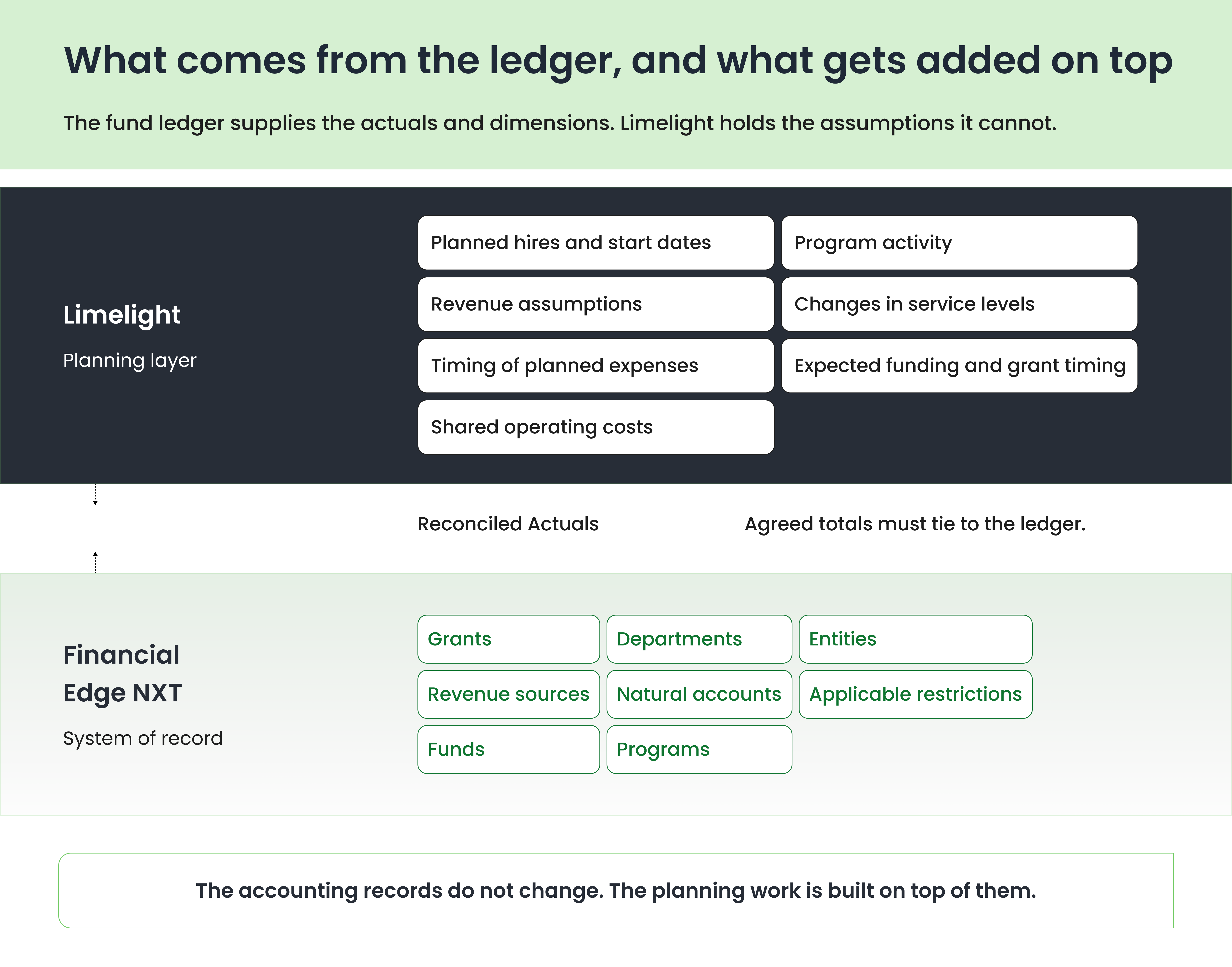
Finance starts with posted results from the fund ledger and the accounts and dimensions needed for planning. Depending on the organization, that may include:
The planning structure does not need to copy the chart of accounts. Several detailed accounts may roll into one planning category. For example, salaries, payroll taxes, and benefits may be grouped into a personnel view that department leaders use for budgeting. Program expenses can also be grouped into management categories without changing how those transactions are recorded in the ledger.
A governed mapping keeps the accounting structure intact while giving finance a planning view that matches how leaders review the business.
Once actuals are in place, finance and budget owners can add the information that does not come from the ledger.
It can include:
These inputs turn historical actuals into a forward-looking budget or forecast.
The planning model still needs to tie back to the accounting records. Finance should define which totals must reconcile to the ledger and review differences before using the model for management reporting.
Once actuals are refreshed, the forecast can be updated using the latest assumptions. A delayed hire, changed grant timeline, or increase in program activity can change the forecast without changing the underlying accounting record.
Consider a restricted grant supporting a community program. The ledger records the grant-related activity according to the organization's accounting policies and accounting structure. The planning model brings in those actuals and maps the related program costs into the planning structure.
The program then expects to hire a new employee two months later than originally planned. Finance updates the hiring assumption, which changes the expected personnel costs for the remaining forecast period.
If service activity also increases, the model can update the related program costs. Shared support costs can be included using the organization's approved planning methodology.
The accounting records remain unchanged. The forecast changes because the expected timing and operating assumptions have changed.
Planning preserves the accounting structure needed for traceability while giving finance a way to model how changes in funding, staffing, program activity, and timing affect the organization's expected results.
The ledger should remain the system of record for posted financial activity and accounting control. Limelight serves as the working environment for budgets, forecasts, scenarios, and management reporting. The exact boundary depends on the organization’s systems, policies, and confirmed product configuration.
|
Keep in the general ledger |
Manage in Limelight |
|
Posted transactions and actuals |
Budget inputs and consolidation |
|
Chart of accounts |
Planning hierarchies and mappings |
|
Accounting classifications |
Driver and timing assumptions |
|
Records of applicable restrictions |
Workforce and operating plans |
|
Period close and accounting controls |
Forecast versions and scenarios |
|
Historical accounting records |
Actual-versus-budget and actual-versus-forecast analysis |
|
Audit trail for recorded activity |
Management reporting and dashboards |
Accounting continues to own the books and determines:
FP&A owns the planning model:
Budget owners contribute operational knowledge. A program leader may know when positions are likely to be filled or when service activity will change. A development leader may have current information about expected funding. The planning process gives those contributors a controlled way to update inputs without changing recorded actuals.
Limelight’s all-in-one FP&A gives finance one place to collect department budgets, update forecasts, model staffing and program costs, compare scenarios, and report actual results against budget and forecast. Finance can update a hiring date, revise expected grant funding, change program activity, or adjust shared costs and see the effect across the forecast and management reports.
It keeps the planning work connected. Budget inputs feed the model, actuals can be compared against those inputs, and forecast changes flow into the reports leadership uses to review performance.
The accounting system remains the source for posted actuals, accounting classifications, and financial controls. Limelight handles the planning work built around those actuals, giving finance a current view of expected revenue, expenses, staffing, funding, and program activity.
Alignment depends on efficient governance across accounting and planning systems. Finance needs clear ownership for mappings, reconciliation, structural changes, forecast versions, and review. Those controls preserve traceability as the ledger and planning model evolve.
Name the person or team responsible for mapping accounts, funds, grants, programs, departments, and other in-scope dimensions into the planning hierarchy. Accounting should review decisions that affect financial interpretation. FP&A should own how the structure supports planning and management reporting.
Define which totals must tie to the ledger, when reconciliation occurs, and who approves exceptions. Unmapped accounts and unexplained differences should remain visible. They should not disappear into a broad “other” category simply to make a report balance.
A new grant, program, fund, department, or natural account can affect budgets and reports even before it carries a material balance. Establish an intake process with an effective date, approved mapping, reporting treatment, and a decision about whether prior periods require reclassification.
Give each approved budget, forecast, and scenario a clear name, status, owner, and time period. Document the assumptions that changed between versions. Version control gives every team a consistent view of the latest forecast.
Use a monthly or quarterly review that matches the finance calendar. Confirm that actuals have refreshed as expected, mappings remain complete, material variances have owners, and forecast assumptions still reflect current operating information.
A connected planning model earns trust when leaders can move from a management view to the underlying accounting detail, and finance can explain every bridge between them.
Accurate accounting gives finance a reliable record of activity. Effective financial management also requires a current view of staffing, funding, program costs, and expected results.
Keep the ledger authoritative for actuals, accounting classifications, and financial controls. Use the planning for the work that comes after the close:
Start with one recurring management report. Trace each number back to its source. Identify which figures come from the ledger, which are adjusted in spreadsheets, which depend on assumptions, and where finance still relies on manual reconciliations. It will show where the accounting process ends and where the planning process needs stronger support.
Limelight’s All-in-One FP&A + Reporting brings planning, forecasting, reporting, and analysis into one environment while keeping the accounting system as the source for actuals.
See how Limelight can support your nonprofit planning process. Book a demo
Fund accounting records and classifies actual financial activity so the organization can track resources, restrictions, and stewardship. Nonprofit budgeting sets an approved forward-looking plan based on assumptions about funding, staffing, programs, timing, and costs. The budget should use and reconcile to accounting data without replacing it.
A nonprofit may maintain a consolidated organizational budget, but the model must retain enough detail to distinguish resources and plans with different restrictions or purposes. A total surplus or cash balance alone may not show what is available for a particular operating need. The structure should follow the organization’s accounting policies and planning requirements.
The model should represent grants and programs at the level needed for planning, reporting, and traceability. Finance may connect them with departments, accounts, staffing plans, revenue assumptions, and shared costs through governed mappings. The exact design depends on the ledger structure and management-reporting needs.
No. FP&A software supports forward-looking budgeting, forecasting, scenarios, analysis, and management reporting. Accounting software remains responsible for recording transactions, maintaining the general ledger, and supporting accounting controls and the close.
There is no universal cadence. Reforecast often enough to support material decisions and reflect meaningful changes in funding, staffing, program activity, or costs. Many organizations align reviews with monthly or quarterly finance cycles, but the right frequency depends on volatility, leadership needs, and the effort required to update reliable assumptions.
Subscribe to our newsletter