Key takeaways
- Top-down budgeting starts with executive targets. Leadership sets company-wide limits, and departments plan within the allocations they receive.
- Bottom-up budgeting starts with operational requirements. Departments estimate the people, programs, and resources they need, and finance consolidates those submissions.
- Neither method is automatically more accurate. Top-down plans can overlook operating detail, while bottom-up plans can include inconsistent assumptions or budget padding.
- A hybrid process usually resolves the core trade-off. Executives set guardrails, departments build the detail, and finance reconciles the two before approval.
- Driver-based planning strengthens either approach. Linking material budget lines to headcount, volume, pricing, or other operating drivers makes assumptions easier to test and update.
Budgeting still takes close to nine weeks on average, even after years of investment in planning tools. The 2026 AFP FP&A Benchmarking Survey, based on responses from 332 finance professionals across 54 countries, also found that alignment remains strongest at the executive level while operational and cross-functional alignment lags behind. That gap captures the practical tension between top-down and bottom-up budgeting.
Top-down budgeting gives leadership control over targets and resource limits. Bottom-up budgeting gives departments room to build plans around operating reality.
This guide explains how both methods work, where each can fail, and how finance teams can combine them without turning the annual budget into a long spreadsheet-reconciliation exercise.
What Is Top-Down and Bottom-Up Budgeting?
Top-down and bottom-up budgeting describe where a budget begins and how financial targets move through the organization. They are directions of planning, not rigid templates. A company can use different forecasting, costing, and review methods within either approach.
- Top-down budgeting: Senior leadership sets revenue, margin, spending, and investment targets, then allocates budget limits to departments or business units. Department leaders decide how to operate within those limits and escalate requests that exceed them.
- Bottom-up budgeting: Departments build budgets from planned headcount, projects, contracts, purchases, and operating assumptions. Finance standardizes and consolidates those submissions, then leadership reviews whether the combined plan supports company-wide targets.
The trade-off is more nuanced than speed versus accuracy. Top-down budgeting is usually faster because fewer people shape the first version, but an unrealistic allocation can create rework later. Bottom-up budgeting captures more operating detail, but detail does not guarantee accuracy. Department assumptions still need consistent definitions, evidence, and challenges from finance.
For the broader sequence around target-setting, submissions, consolidation, approval, and monitoring, see Limelight's guide to the annual budgeting process.
Top-Down vs. Bottom-Up Budgeting at a Glance
The clearest way to compare the methods is to focus on who sets the first constraint, where the detail comes from, and what finance must control during review.
At-a-glance comparison
|
Criterion
|
Top-Down Budgeting
|
Bottom-Up Budgeting
|
|
Starting point
|
Executive financial targets and spending limits
|
Department-level operating plans and cost assumptions
|
|
Initial ownership
|
Senior leadership and finance
|
Department heads, budget owners, and finance
|
|
Planning speed
|
Usually faster at the first-draft stage
|
Usually slower because many contributors submit inputs
|
|
Operating detail
|
Limited until departments translate allocations into plans
|
High, provided submissions use consistent assumptions
|
|
Strategic alignment
|
Strong at the company level
|
Requires finance to test departmental requests against strategy
|
|
Risk of bias
|
Unrealistic targets or underfunded departments
|
Budget padding, inconsistent assumptions, or local optimization
|
|
Coordination burden
|
Lower during initial target-setting
|
Higher during collection, review, and consolidation
|
|
Best use
|
Centralized decisions, tight deadlines, or stable allocation logic
|
Decentralized operations, specialized departments, or locally owned plans
|
|
Common practical model
|
Executive guardrails followed by departmental planning
|
Departmental submissions reviewed against executive guardrails
|
Table: Top-down budgeting prioritizes central control and speed, while bottom-up budgeting prioritizes operating detail and departmental input.
How the Two Approaches Differ
The direction of the budget changes who makes the first assumptions, where errors tend to enter, and how much reconciliation finance must perform before approval.
1. Speed and planning effort
A top-down first draft can be produced quickly because leadership defines the main parameters before departments become involved. That advantage shrinks when the targets are disconnected from staffing plans, contractual commitments, or operational capacity. Departments then return with exceptions, and finance spends the saved time negotiating revisions.
Bottom-up budgeting takes longer at the front end. Finance must issue templates, explain assumptions, collect submissions, and resolve inconsistencies. The additional effort can reduce later surprises when department owners have already documented the activities behind their requests.
2. Detail and forecast quality
Top-down budgeting often relies on historical ratios, growth targets, or broad allocation rules. These can work well when business units have similar economics and the cost base is stable. They work less well when departments face different hiring needs, contract renewals, equipment cycles, or service volumes.
Bottom-up budgeting produces more detail, but detail can create false confidence. A plan is only as credible as its assumptions. Finance still needs to challenge hiring dates, vendor estimates, utilization rates, revenue dependencies, and duplicated requests across departments.
3. Strategic control and departmental ownership
Top-down budgeting keeps spending closely tied to leadership priorities. The risk is that departments receive a number without understanding the reasoning behind it. That can reduce ownership and encourage off-budget requests later in the year.
Bottom-up budgeting gives budget owners more influence over the figures they will be held accountable for. The risk moves in the opposite direction. Each department may submit a reasonable local plan that becomes unaffordable when combined with every other reasonable local plan.
4. Flexibility and governance
Neither approach is inherently fixed or flexible. A top-down budget can include contingency reserves and clear reallocation rules. A bottom-up budget can become rigid once every detailed line is approved. Flexibility depends on review frequency, approval rights, and whether finance updates assumptions as conditions change.
A flexible budget, for example, adjusts expected costs for changes in activity volume. That technique can sit inside either a top-down or bottom-up process.
5. Coordination cost and organizational structure
Top-down planning requires fewer contributors at the initial stage, which lowers coordination cost. It tends to suit organizations with centralized authority, comparable business units, or short decision windows.
Bottom-up planning requires stronger process discipline. It works best when cost-center owners understand their drivers, finance can standardize inputs, and the organization has enough time to review competing requests. Company size alone does not determine the right method. A large decentralized group may need extensive bottom-up input, while a small founder-led company may operate almost entirely top-down.
Which Approach Fits Your Organization?
The right choice depends on decision rights, cost predictability, planning maturity, and the consequences of getting the first version wrong. Most organizations should choose the direction that best fits the current planning problem rather than adopting one method for every budget cycle.
Decision guide
|
Organizational condition
|
Better starting point
|
Why
|
|
Leadership must impose a rapid spending reset
|
Top-down
|
A central target prevents weeks of submissions that will later be cut
|
|
Business units have similar cost structures
|
Top-down
|
Historical ratios and common allocation logic are more reliable
|
|
Department plans depend on specialized local knowledge
|
Bottom-up
|
Frontline owners hold information leadership cannot estimate credibly
|
|
Contract, staffing, or project detail drives most costs
|
Bottom-up
|
The budget needs operating assumptions before a credible total can emerge
|
|
Leadership has clear targets, but departments control execution
|
Hybrid
|
Executive guardrails preserve strategy while departments build the operating plan
|
|
The company faces high uncertainty
|
Hybrid with scenarios
|
Multiple assumption sets are more useful than forcing one precise annual number
|
Table: The best starting point depends on where reliable information sits and how quickly leadership must establish financial limits.
Use top-down budgeting when the organization needs immediate control, when leadership has reliable allocation logic, or when a turnaround leaves little room for consensus-building. Use bottom-up budgeting when departments operate differently, when cost drivers sit close to frontline teams, or when execution depends on detailed project and workforce plans.
Choose a hybrid process when both statements are true: leadership must protect company-wide targets, and departments hold information required to make those targets operationally credible.
How Top-Down Budgeting Works
A top-down process begins with the company's financial capacity and strategic priorities. Departments receive boundaries first, then decide how to use the resources available within them.
Step 1: Set company-wide targets
The CEO, CFO, and other senior leaders define the main financial parameters for the planning period. These may include:
- Revenue and growth targets.
- Gross-margin expectations.
- Operating-expense limits.
- Headcount ceilings.
- Capital-allocation priorities.
- Cash or liquidity requirements.
The assumptions should be explicit. A revenue target without price, volume, churn, or capacity assumptions gives departments little basis for testing whether the plan is achievable.
Step 2: Allocate budget envelopes
Finance converts the company's targets into department or business-unit allocations. Historical spending ratios can provide a starting point, but they should not substitute for judgment. A department's prior share of operating expense may be irrelevant if the company is launching a product, entering a market, freezing hiring, or exiting a program.
A budget envelope is the spending limit assigned to a team for the period. It establishes the constraint, but department leaders still decide how to distribute the amount across people, vendors, programs, and projects.
Step 3: Build operating plans within the limits
Departments translate their allocations into practical plans. Requests above the assigned amount should identify the business case, the expected outcome, and the trade-off required elsewhere. Finance then decides whether to preserve the original limit, reallocate resources, or revise the company target.
For the forecasting methods used to test these assumptions, see Limelight's guide to budget forecasting.
Top-down budgeting pros and cons
|
Advantages
|
Limitations
|
|
Produces an initial plan quickly
|
Can understate department-level requirements
|
|
Keeps resource allocation tied to leadership priorities
|
Depends heavily on the quality of executive assumptions
|
|
Makes company-wide cost limits clear
|
Can weaken ownership when departments do not understand the rationale
|
|
Simplifies rapid reallocation or cost reduction
|
May create exception requests and rework later
|
|
Works well when units share similar economics
|
Can hide operational differences behind broad ratios
|
Table: Top-down budgeting improves central control, but weak assumptions can shift work from planning into later exception management.
How Bottom-Up Budgeting Works
A bottom-up process begins with the activities required to run each department. Finance owns the standards and consolidation process, while budget owners supply the operating assumptions.
Step 1: Define cost centers and planning categories
Finance maps the organizational units responsible for costs and provides a common structure for submissions. Typical categories include headcount, software, contractors, travel, marketing programs, facilities, and capital expenditures.
Definitions matter. One department may classify implementation work as a project cost, while another treats it as a recurring software expense. Without consistent account mapping, the consolidated budget will compare unlike items.
Step 2: Build department-level assumptions
Budget owners estimate what they need to execute their plans. A credible submission explains the mechanism behind each material figure, such as:
- Headcount cost based on role, start date, salary, benefits, and payroll taxes
- Software cost based on seat count, contract renewal date, and expected price increase
- Marketing spend based on campaign timing, channel, and expected volume
- Capital cost based on purchase date, useful life, and approval status
Finance should separate committed costs from discretionary requests. That distinction makes later cuts more informed than applying the same percentage reduction to every line.
Step 3: Consolidate and challenge submissions
Finance rolls department plans into a company-wide view and checks for gaps, overlaps, and incompatible assumptions. This is where the process either creates value or becomes administrative work.
Review should focus on the largest drivers, not every minor line. Finance can test whether hiring plans support revenue capacity, whether two teams requested the same tool, and whether project timing matches the cash and staffing plan. The combined total is then compared with leadership's revenue, margin, and liquidity expectations.
Step 4: Revise and approve the plan
Leadership reviews the consolidated budget and identifies the changes required to make it financially and strategically coherent. Departments may revise assumptions, defer projects, reduce scope, or exchange resources with other teams. Finance documents the final assumptions and the owners responsible for them.
Bottom-up budgeting pros and cons
|
Advantages
|
Limitations
|
|
Captures operational detail from budget owners
|
Requires more coordination and review time
|
|
Makes assumptions visible at the department level
|
Can produce inconsistent submissions without firm standards
|
|
Builds ownership around approved figures
|
Creates room for budget padding or conservative estimates
|
|
Surfaces project, contract, and workforce dependencies
|
Can optimize individual departments at the expense of company priorities
|
|
Gives finance a detailed basis for variance analysis
|
Becomes difficult to consolidate across disconnected files
|
Table: Bottom-up budgeting improves operating visibility, but finance must control assumptions, definitions, and consolidation.
How Hybrid Budgeting Works
Hybrid budgeting combines top-down limits with bottom-up operating detail. It does not mean averaging two conflicting numbers. It creates an explicit negotiation between what leadership wants to fund and what departments believe execution will require.
A practical two-cycle process
- Leadership sets guardrails. Finance communicates revenue, margin, spending, cash, and headcount expectations.
- Departments build plans. Budget owners translate those guardrails into detailed operating assumptions.
- Finance consolidates the submissions. The first rollup identifies where department plans exceed or fall short of the company targets.
- Leadership and departments resolve the gaps. Teams revise scope, timing, or allocation rather than applying unexplained cuts.
- Finance locks assumptions and ownership. The approved budget records who owns each major driver and when it should be reviewed.
The process works best when finance defines the rules before collecting data. Contributors need common templates, account definitions, deadlines, approval rights, and a clear policy for changes after submission.
Why spreadsheets make hybrid planning harder
The hybrid model creates a version-control problem when every department works in a separate file. The 2025 AFP FP&A Benchmarking Survey, based on 362 practitioners worldwide, found that 96% used spreadsheets for planning and 61% identified unreliable data as a technology challenge.
Separate files are not automatically wrong, but they make it harder to know which assumptions changed, whether every department used the same baseline, and how a revision affects the consolidated plan.
A workable hybrid process needs one controlled set of assumptions, visible ownership, automated rollups, and a clear change history. Technology cannot resolve a disagreement about priorities, but it can prevent the disagreement from being hidden inside conflicting spreadsheet versions.
How Driver-Based, Zero-Based, and Activity-Based Budgeting Fit
Top-down and bottom-up describe the direction of planning. Driver-based, zero-based, and activity-based budgeting describe how figures are calculated or justified. Finance teams can combine these methods rather than treating them as mutually exclusive options.
How the methods relate
|
Method
|
What it changes
|
How it works with top-down or bottom-up budgeting
|
|
Driver-based budgeting
|
Links material lines to operational variables
|
Executives can set high-level drivers, or departments can submit local driver assumptions
|
|
Zero-based budgeting
|
Requires spending to be justified rather than automatically carried forward
|
Departments usually prepare the justification, while leadership sets decision criteria and funding limits
|
|
Activity-based budgeting
|
Builds costs around activities needed to produce an outcome
|
Activities can be estimated centrally or built from departmental operating plans
|
Table: Directional methods determine where planning starts, while calculation methods determine how budget figures are built and challenged.
Driver-based budgeting
Driver-based budgeting connects selected budget lines to measurable operating variables. Headcount, units sold, occupancy, customer count, conversion rate, and price are common examples. When a driver changes, the related revenue or cost estimate changes with it.
In a top-down model, executives may set a growth rate, hiring ceiling, or production target and let the model calculate the downstream effect. In a bottom-up model, departments submit their own volume and resource assumptions, and finance aggregates the financial impact. See Limelight's guide to driver-based planning for a fuller explanation.
Zero-based budgeting
Zero-based budgeting requires teams to justify spending for the new period instead of assuming the previous budget should continue. The method often uses bottom-up analysis because department owners know the activities and commitments behind each request. Leadership still provides top-down criteria for which activities deserve funding and how much the organization can spend in total.
Activity-based budgeting
Activity-based budgeting estimates the work required to deliver products or services, then assigns resources and costs to those activities. It is useful when department-level budgets obscure the true cost of shared processes such as onboarding, order fulfillment, claims handling, or product development.
Which Industries Use Each Approach?
Industry affects the type of operating data available, the degree of central control, and the variables that drive spending. The examples below describe common patterns rather than fixed rules.
Common industry patterns
|
Industry
|
Common approach
|
Why
|
|
Manufacturing
|
Top-down or hybrid
|
Production, margin, and capital targets often begin centrally, while plants submit labor, maintenance, and material requirements
|
|
Healthcare
|
Hybrid
|
System-wide financial limits must be reconciled with department-level staffing, service volume, and regulatory requirements
|
|
SaaS and technology
|
Hybrid
|
Leadership sets growth and cash targets, while teams build hiring, infrastructure, sales, and product plans
|
|
Nonprofit
|
Bottom-up or hybrid
|
Program owners build spending plans around grants, restrictions, service delivery, and donor commitments
|
|
Hospitality
|
Bottom-up or hybrid
|
Property-level occupancy, rate, labor, and maintenance assumptions roll into the group plan
|
|
Higher education
|
Hybrid
|
Institution-wide revenue and funding assumptions must be reconciled with faculty, research, program, and capital plans
|
Table: Most industries combine central financial guardrails with local assumptions when operating conditions differ across departments, programs, or locations.
How Limelight Supports Both Approaches
Budgeting software should support the organization's planning direction rather than force every team into the same workflow.
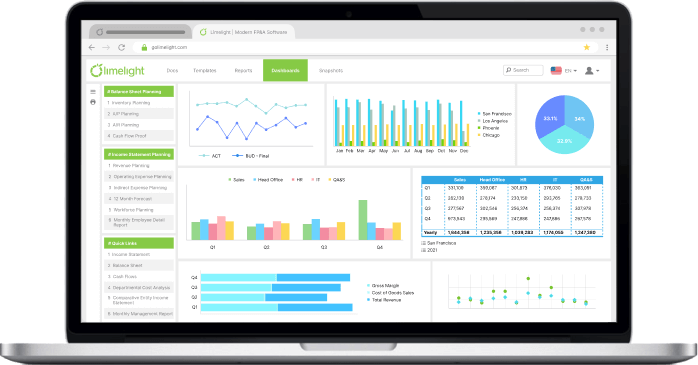
The practical requirement is not cloud access alone. Finance needs controlled assumptions, contributions from budget owners, and a model that updates the consolidated view when inputs change.
Limelight's budgeting and planning software supports those requirements in four ways.
1. Set and distribute top-down assumptions
Finance can maintain revenue, expense, workforce, allocation, and operational assumptions in one planning model. Executive targets can be reflected across department plans without recreating separate files for each contributor.
2. Collect detailed bottom-up inputs
Departments can plan at the level of detail the organization needs, including departments, entities, funds, programs, vendors, employees, scenarios, and years. Comments, notifications, live actuals, and change tracking give finance more context around submissions.
3. Consolidate plans across teams and dimensions
Inputs can be automatically consolidated across departments and other planning dimensions. Finance can compare the resulting plan with company targets and trace a gap back to the assumptions or cost areas that created it.
4. Update driver-based plans without rebuilding the model
Finance can create drivers for growth, headcount, rates, volumes, expenses, and allocations. When an assumption changes, the impact flows through connected forecasts, reports, and variance analysis. The same underlying FP&A model supports budgets, forecasts, actuals, and management reporting.
See Limelight in action
Frequently Asked Questions
What is the main difference between top-down and bottom-up budgeting?
Top-down budgeting begins with company-wide targets set by senior leadership. Bottom-up budgeting begins with detailed plans prepared by departments or business units. Finance may use both by setting executive guardrails first and then collecting departmental assumptions within those limits.
Is bottom-up budgeting more accurate?
It can be more operationally detailed, but it is not automatically more accurate. Department submissions may contain inconsistent definitions, optimistic assumptions, duplicated spending, or budget padding. Finance must standardize and challenge the inputs before consolidation.
What are the main disadvantages of top-down budgeting?
The method can produce unrealistic targets, overlook department-specific requirements, and weaken ownership when budget owners do not understand how their allocations were determined. These problems often appear later as exception requests or missed operational commitments.
What is a hybrid budgeting approach?
Hybrid budgeting combines executive target-setting with departmental planning. Leadership sets financial boundaries, departments build the operating detail, and finance reconciles the submissions with the company targets before approval.
How does driver-based budgeting relate to top-down and bottom-up planning?
Driver-based budgeting links revenue or cost lines to measurable operating variables. Executives can set the drivers in a top-down process, or departments can submit driver assumptions in a bottom-up process. The calculation method works in either direction.
Can a company switch from top-down to bottom-up budgeting?
Yes. The lowest-risk transition is usually to introduce a hybrid process in the next full planning cycle. Leadership retains company-wide guardrails, while finance adds standardized department templates, submission deadlines, review rules, and a formal consolidation stage.


%20(1).svg)



.png?width=381&height=235&name=linkedinreal%20(27).png)