
%20(1).svg)
Financial Ratios: Types, Formulas & Examples
By Aravind Swaminathan |
Last Updated: September 24, 2026
Finance teams spend hours pulling numbers from income statements, balance sheets, and cash-flow reports. Without the right context, those numbers remain disconnected, making decisions harder than they should be.
Financial ratio analysis helps cut through this noise. By turning raw financial data into comparable metrics, ratios allow teams to evaluate performance, spot trends, and understand financial health with greater clarity. When applied correctly, financial ratios support stronger planning, forecasting, and operational decisions.
In this guide, you will learn what financial ratios are, how each category works, the formulas behind key ratios, and how finance teams apply them in real FP&A workflows.
Financial ratios are calculations that compare two or more figures from a company's financial statements to measure performance, financial health, and operational efficiency.
Analysts, investors, and managers use these ratios to understand how effectively a business can meet debt obligations, generate profits, and use its resources. Because the outputs are standardized, financial ratios allow performance to be evaluated without relying only on absolute dollar values.
These ratios are derived from three primary data sources. The balance sheet provides information on assets, liabilities, and equity, which supports liquidity and leverage analysis.The income statement provides revenue, cost, and profit figures used to calculate profitability and efficiency ratios.
The cash flow statement shows how cash moves through the business and is essential for assessing liquidity and debt coverage from actual operating cash flows.
Financial ratios matter because they make comparison possible. Teams can compare companies of different sizes, track performance trends over multiple periods, and benchmark results against industry standards. This context supports more informed, data-driven decisions across planning, forecasting, and performance reviews.
It is also helpful to distinguish between financial ratios and financial ratio analysis. Financial ratios are the individual metrics themselves. Financial ratio analysis is the structured process of computing and interpreting these ratios across time periods and against industry benchmarks to evaluate performance, liquidity, leverage, and efficiency.
Major types of financial analysis ratios
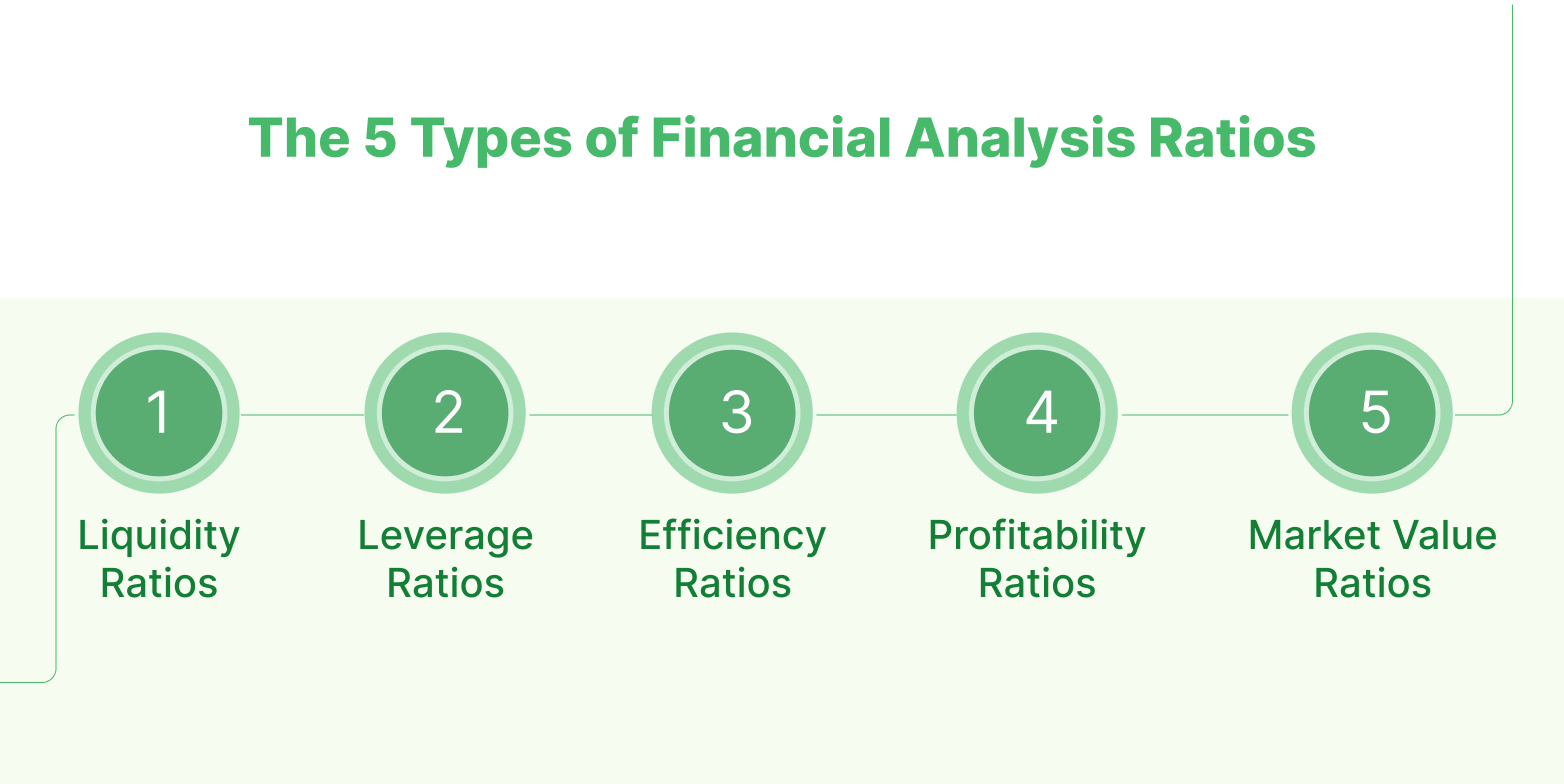
Financial ratios are typically grouped into five categories, each answering a different question about a company's financial position and performance. Reviewing these categories together helps finance teams move beyond surface-level metrics and build a more complete view of business health.
At a high level, liquidity ratios focus on short-term stability, profitability ratios explain earnings performance, efficiency ratios show how well resources are used, leverage ratios assess long-term risk, and market value ratios reflect investor expectations.
These categories form the foundation of most ratio-based financial reviews used in FP&A, corporate finance, and investment analysis.
The table below covers all eighteen ratios addressed in this guide:
|
Category |
What it measures |
Key ratios (Examples) |
Primary users |
|
Liquidity |
Ability to meet short-term obligations |
Current ratio, quick ratio, cash ratio |
CFOs, FP&A teams, creditors |
|
Profitability |
Earnings relative to revenue, assets, or equity |
Gross margin, net margin, ROA, ROE |
Executives, investors |
|
Efficiency |
How effectively assets generate revenue |
Asset turnover, inventory turnover |
FP&A, operations leaders |
|
Leverage |
Use of debt and long-term financial risk |
Debt-to-equity, interest coverage |
Lenders, finance leaders |
|
Market Value |
Stock valuation and investor perception |
P/E ratio, EPS, dividend yield |
Investors, analysts |
Major financial ratio categories at a glance
Liquidity ratios measure whether a company can cover near-term liabilities without financial strain. Profitability ratios focus on how much profit is generated from sales, assets, and invested capital. Efficiency ratios evaluate how well a business converts assets into revenue and manages working capital.
Leverage ratios analyze the balance between debt and equity and a company's ability to service long-term obligations. Market value ratios, mainly used by public companies, connect financial performance to stock price and shareholder returns.
In the sections that follow, each category is broken down into individual ratios with formulas, examples, and interpretation guidance.
Financial ratios are applied across several distinct functions within and outside a company. Understanding which ratios matter to which audience helps finance teams prioritize what to track and report.
The table below provides a compact formula reference for all ratios covered in this guide. It is designed to serve as a quick index for finance teams building ratio models or reviewing formula logic in financial modeling workflows.
|
Ratio |
Formula |
|
Current Ratio |
Current Assets ÷ Current Liabilities |
|
Quick Ratio |
(Current Assets − Inventory) ÷ Current Liabilities |
|
Cash Ratio |
(Cash + Cash Equivalents) ÷ Current Liabilities |
|
Operating Cash Flow Ratio |
Operating Cash Flow ÷ Current Liabilities |
|
Working Capital |
Current Assets − Current Liabilities |
|
Gross Profit Margin |
(Revenue − COGS) ÷ Revenue × 100 |
|
Operating Profit Margin |
Operating Income ÷ Revenue × 100 |
|
Net Profit Margin |
Net Income ÷ Revenue × 100 |
|
Return on Assets (ROA) |
Net Income ÷ Total Assets × 100 |
|
Return on Equity (ROE) |
Net Income ÷ Shareholders' Equity × 100 |
|
Return on Invested Capital (ROIC) |
NOPAT ÷ Invested Capital |
|
Asset Turnover |
Net Sales ÷ Average Total Assets |
|
Inventory Turnover |
COGS ÷ Average Inventory |
|
Days Sales in Inventory (DSI) |
365 ÷ Inventory Turnover |
|
Accounts Receivable Turnover |
Net Credit Sales ÷ Average Accounts Receivable |
|
Days Sales Outstanding (DSO) |
365 ÷ Accounts Receivable Turnover |
|
Debt-to-Equity Ratio |
Total Liabilities ÷ Shareholders' Equity |
|
Debt Ratio |
Total Liabilities ÷ Total Assets |
|
Interest Coverage Ratio |
EBIT ÷ Interest Expense |
|
Debt Service Coverage Ratio (DSCR) |
Net Operating Income ÷ Total Debt Service |
|
P/E Ratio |
Market Price per Share ÷ EPS |
|
Earnings Per Share (EPS) |
(Net Income − Preferred Dividends) ÷ Average Outstanding Shares |
|
Price-to-Book (P/B) Ratio |
Market Price per Share ÷ Book Value per Share |
|
Dividend Yield |
Annual Dividend per Share ÷ Market Price per Share × 100 |
Summary of calculating financial ratios formulas
The following walkthrough demonstrates how to move from raw financial statement data to an interpreted, benchmarked ratio result. Operating margin is used because it draws from the income statement and sits at the intersection of revenue management and cost control.
Define what you are trying to understand. In this case: How efficiently does the company convert revenue into operating profit after accounting for operating expenses?
Locate the relevant line items on the income statement, balance sheet, or cash-flow statement. From the income statement, identify operating income, also reported as EBIT or earnings before interest and taxes, and total revenue for the same period.
Illustrative figures: Revenue = $1,000,000; operating income = $200,000.
Operating profit margin = operating income ÷ revenue × 100.
$200,000 ÷ $1,000,000 × 100 = 20%.
A 20% operating margin means the company retains $0.20 in operating profit for every $1.00 of revenue after covering operating costs. Whether this is strong or weak depends on the sector and the company's performance trend over time.
Compare the result against industry-peer averages and the company's own prior-period results. A margin that has declined from 25% to 20% over three years may warrant further investigation into the company's cost structure, even if 20% appears acceptable in isolation.
 Liquidity Ratios: Measuring Short-Term Financial Health
Liquidity ratios measure a company's ability to meet short-term obligations using assets that can be converted to cash within a year. These ratios are a core component of financial ratio analysis because they help finance teams evaluate whether day-to-day operations can continue without cash strain.
Creditors, lenders, and FP&A teams rely on liquidity ratios to assess risk, manage working capital, and plan for near-term funding needs.
Below are the most commonly used liquidity ratios.
Definition: The current ratio measures whether current assets are sufficient to cover current liabilities.
|
Formula |
|
Current ratio = Current Assets ÷ Current Liabilities |
Example: If a company has $600,000 in current assets and $300,000 in current liabilities, the current ratio is 2.0.
What it tells you: A higher ratio indicates stronger short-term financial flexibility. A low ratio may signal difficulty meeting obligations without external funding.
Benchmark range: 1.5 to 3.0 is commonly viewed as healthy, depending on the industry.
Definition: The quick ratio measures short-term liquidity without relying on inventory.
|
Formula |
|
Quick ratio = (Current Assets − Inventory) ÷ Current Liabilities |
Example: With $600,000 in current assets, $200,000 in inventory, and $300,000 in current liabilities, the quick ratio equals 1.33.
Quick assets = $600,000 − $200,000 = $400,000
Quick ratio = $400,000 ÷ $300,000 = 1.33
What it tells you: This ratio focuses on assets that can be converted to cash quickly, making it useful when inventory is slow-moving or uncertain.
Benchmark range: 1.0 or higher is often considered acceptable.
Definition: The cash ratio measures the ability to pay current liabilities using only cash and cash equivalents.
|
Formula |
|
Cash ratio = (Cash + Cash Equivalents) ÷ Current Liabilities |
Example: If cash and equivalents total $150,000 and current liabilities are $300,000, the cash ratio is 0.5.
What it tells you: This is the most conservative liquidity measure and highlights immediate cash coverage.
Benchmark range: No universal benchmark; acceptable levels vary widely by industry, cash flow stability, and access to credit.
Definition: This ratio evaluates whether operating cash flow can cover short-term liabilities.
|
Formula |
|
Operating cash flow ratio = Operating Cash Flow ÷ Current Liabilities |
Example: If operating cash flow is $360,000 and current liabilities are $300,000, the ratio is 1.2.
What it tells you: It links liquidity to actual cash generation rather than balance sheet snapshots.
Benchmark range: 1.0 or higher suggests operating cash flows support obligations.
Definition: Working capital represents the difference between current assets and current liabilities.
|
Formula |
|
Working capital = Current Assets − Current Liabilities |
Example: $600,000 − $300,000 = $300,000 in working capital.
What it tells you: Positive working capital indicates a buffer for operations, while negative values may create funding pressure.
Benchmark range: Industry-specific; best evaluated over time.
Liquidity ratios are most useful when reviewed together. Strong results in one ratio do not offset weaknesses in others. For this reason, financial ratio analysis should always incorporate multiple measures, not a single figure in isolation.
Profitability ratios measure how effectively a company generates earnings relative to revenue, assets, equity, and invested capital. Financial ratio analysis of profitability helps finance teams understand whether growth translates into sustainable returns and how costs, pricing, and capital structure affect overall performance. Executives, investors, and FP&A teams rely on profitability ratios to evaluate margins, compare results across periods, and assess how efficiently capital is deployed.
Each ratio below follows a consistent structure to support clear interpretation and comparison.
Definition: Gross profit margin shows how much revenue remains after direct production costs.
|
Formula |
|
Gross profit margin = (Revenue − Cost of Goods Sold) ÷ Revenue × 100 |
Example: If revenue is $1,000,000 and COGS is $600,000, gross profit margin is 40%.
What it tells you: This ratio reflects pricing discipline and cost control at the production level.
Benchmark range: Varies by industry; service and software businesses often report higher margins.
Definition: Operating profit margin measures earnings from core operations before interest and taxes.
|
Formula |
|
Operating profit margin = Operating Income ÷ Revenue × 100 |
Example: Operating income of $200,000 on $1,000,000 in revenue results in a 20% margin.
What it tells you: It shows how efficiently a company manages operating expenses relative to sales.
Benchmark range: Industry-dependent; trends over time provide the most insight.
Definition: Net profit margin measures the percentage of revenue that becomes net income.
|
Formula |
|
Net profit margin = Net Income ÷ Revenue × 100 |
Example: $120,000 in net income on $1,000,000 in revenue equals a 12% margin.
What it tells you: This ratio reflects overall profitability after all expenses, taxes, and interest.
Benchmark range: Highly variable by sector and business model.
Definition: ROA measures how efficiently a company uses its assets to generate profit.
|
Formula |
|
Return on assets = Net Income ÷ Total Assets × 100 |
Example: $120,000 in net income and $2,000,000 in total assets yields an ROA of 6%.
What it tells you: Higher ROA indicates stronger asset utilization.
Benchmark range: Capital-intensive industries (manufacturing, utilities, infrastructure) typically report lower ROA (2%–10%) compared to asset-light sectors like software (15%–30%), due to substantial investments in property, plant, equipment, and infrastructure that increase the asset base relative to profit generation.
Definition: ROE measures returns generated on shareholders' equity.
|
Formula |
|
Return on equity = Net Income ÷ Shareholders' Equity × 100 |
Example: $120,000 in net income and $1,000,000 in equity equals a 12% ROE.
What it tells you: It shows how effectively equity capital is producing returns.
Benchmark range: Often compared against cost of equity. If ROE exceeds the cost of equity, the company generates returns sufficient to compensate shareholders for their risk and creates value. If ROE falls below cost of equity, returns are insufficient to meet investor expectations.
Definition: ROIC evaluates how effectively a company converts invested capital into operating profits, measuring the percentage return generated from both shareholder equity and debt-funded assets.
Before applying the formula, two terms require definition. NOPAT (Net Operating Profit After Tax) is a company's after-tax operating profit excluding financing effects; it equals EBIT multiplied by (1 minus the effective tax rate).
Invested capital is total equity plus interest-bearing debt minus non-operating cash — the total funds committed by debt and equity holders to finance operations.
|
Formula |
|
Return on invested capital (ROIC) = NOPAT ÷ Invested Capital |
Example: $150,000 in NOPAT and $1,500,000 average invested capital results in a 10% ROIC, meaning the company generates $0.10 in operating profit per dollar of invested capital.
What it tells you: ROIC reveals how efficiently management uses both equity and debt capital to generate operating profits. Higher ROIC indicates superior capital allocation and operational efficiency. By comparing ROIC to WACC, teams assess whether capital deployment is creating or destroying shareholder value.
WACC (Weighted Average Cost of Capital) is the blended minimum return a company must earn across its debt and equity to avoid destroying value; ROIC above WACC signals value creation.
Benchmark range:
Profitability ratios yield the most useful signals when reviewed alongside liquidity and efficiency ratios, which is why financial ratio analysis should span all five categories rather than treating profitability in isolation.
Efficiency ratios, also called activity ratios, measure how effectively a company uses its assets and manages day-to-day operations. Financial ratio analysis of efficiency helps FP&A teams understand how quickly resources such as inventory and receivables are converted into revenue or cash.
Strong efficiency ratios often indicate disciplined operations and tighter working capital management, while weaker results can signal process gaps or excess capital tied up in assets.
Below are the different types of efficiency ratios:
Definition: Asset turnover measures how efficiently a company converts its total asset base into revenue. It indicates how effectively management deploys capital and operational resources to generate sales.
|
Formula |
|
Asset turnover ratio = Net Sales ÷ Average Total Assets, where Average Total Assets = (Beginning Total Assets + Ending Total Assets) ÷ 2 |
Example: If net sales are $2,000,000 and average total assets are $1,000,000, the asset turnover ratio is 2.0, meaning the company generates $2 in revenue for every $1 in assets.
What it tells you: A higher asset turnover ratio indicates more efficient use of assets to generate sales. The ratio reveals whether the company is effectively utilizing its capital and resources, or whether assets are sitting idle or underdeployed.
Benchmark range:
Definition: Inventory turnover measures how many times a company sells and replaces its entire inventory during a period. It indicates how quickly inventory moves through the business.
|
Formula |
|
Inventory turnover = Cost of Goods Sold ÷ Average Inventory, where Average Inventory = (Beginning Inventory + Ending Inventory) ÷ 2 |
Example: If COGS is $900,000 and average inventory is $150,000, inventory turnover equals 6.0x, meaning the company sold and replaced its entire inventory 6 times during the period (approximately every 61 days: 365 ÷ 6).
What it tells you: Higher turnover indicates inventory moves quickly through the business, suggesting efficient inventory management and strong demand. Lower turnover may indicate overstocking, slow-moving products, or weak demand.
Excessively high turnover can signal insufficient stock levels, leading to stockouts. The optimal balance depends on industry and business model.
Benchmark range: Industry-specific; best assessed against peers. Compare year-over-year trends within your company to identify improving or declining efficiency, rather than targeting a single benchmark number.
Definition: DSI measures the average number of days inventory remains unsold. It indicates how long capital is tied up in inventory. (Also known as Days Inventory Outstanding or DIO.)
|
Formula |
|
DSI = 365 ÷ Inventory Turnover |
Example: With an inventory turnover of 6.0x, DSI = 365 ÷ 6 = approximately 61 days. This means inventory sits for an average of 61 days before being sold.
What it tells you: Lower DSI indicates inventory moves faster, and capital is freed more quickly. Higher DSI means capital is tied up longer in inventory, increasing carrying costs and working capital requirements. Very low DSI (under 10–15 days) may indicate stockout risk. DSI is a key component of working capital management and directly affects cash conversion cycle performance.
Benchmark range: Highly dependent on product type and supply chain model. Compare against industry peers and track year-over-year trends.
Definition: This ratio measures how efficiently a company collects cash from its credit sales. It shows how many times, on average, receivables are converted to cash during a period.
|
Formula |
|
Accounts receivable turnover = Net Credit Sales ÷ Average Accounts Receivable, where Net credit sales = credit sales minus returns/allowances and Average accounts receivable = (Beginning AR + Ending AR) ÷ 2 for the period |
Example: $1,800,000 in net credit sales and $300,000 in average AR yield a turnover of 6.
What it tells you: A higher ratio generally indicates faster collection of receivables and better credit policy compliance. Very high turnover can sometimes signal overly restrictive credit terms that may constrain revenue.
Benchmark range: Best interpreted relative to the company's stated credit terms and peer averages within the same industry.
Definition: DSO measures the average number of days required to collect receivables.
|
Formula |
|
DSO = 365 ÷ Accounts Receivable Turnover |
Example: A turnover of 6 results in a DSO of roughly 61 days.
What it tells you: Lower DSO supports stronger cash flow and liquidity. DSO is a primary indicator in accounts receivable aging analysis; increases in DSO relative to stated payment terms signal potential credit policy compliance issues or deterioration in receivables quality requiring collection review.
Benchmark range: DSO should approximate or fall below stated payment terms.
Efficiency ratios complement liquidity and profitability measures by showing how operational decisions affect cash flow and returns. Interpreting all three categories together gives finance teams the fullest picture of working capital health.
Leverage ratios assess how a company finances its operations and growth through debt compared to equity and earnings. Financial ratio analysis of leverage helps finance teams understand long-term financial risk, capital structure balance, and the ability to meet ongoing debt obligations.
Solvency ratios are the long-term subset of leverage ratios — they assess whether a company's asset base and earnings can sustain debt obligations over multiple years, as distinct from liquidity ratios that focus on obligations due within twelve months.
Lenders, investors, and CFOs rely on leverage ratios to evaluate solvency, borrowing capacity, and exposure to interest rate or cash flow pressure.
Unlike liquidity ratios, which focus on the short term, leverage ratios look at sustainability over multiple years. High leverage can amplify returns during growth periods but increases financial risk during downturns, making careful interpretation essential.
Definition: The debt-to-equity ratio compares total liabilities to shareholders' equity.
|
Formula |
|
Debt-to-equity ratio = Total Liabilities ÷ Shareholders' Equity |
Example: If total liabilities are $1,200,000 and equity is $800,000, the ratio is 1.5.
What it tells you: Higher ratios indicate greater reliance on debt financing. A ratio of 1.0 or below is generally conservative; capital-intensive industries often operate at 2.0–3.0, while technology and services companies typically fall between 0.4–0.9.
Benchmark range: Industry-dependent. Capital-intensive industries (utilities, manufacturing, real estate, energy) typically operate with ratios between 2.0–3.0, while technology and consumer discretionary sectors average 0.4–0.9.
Definition: The debt ratio measures the portion of assets financed through debt.
|
Formula |
|
Debt ratio = Total Liabilities ÷ Total Assets |
Example: $1,200,000 in liabilities and $2,000,000 in assets results in a ratio of 0.6.
What it tells you: It shows how much of the company is funded by creditors rather than owners.
Benchmark range: Lower ratios suggest lower financial risk.
Definition: This ratio evaluates the ability to pay interest using operating income.
|
Formula |
|
Interest coverage ratio = EBIT ÷ Interest Expense |
Example: EBIT of $300,000 and interest expense of $75,000 yield a ratio of 4.
What it tells you: Higher coverage indicates stronger capacity to service debt.
Benchmark range:
Definition: DSCR measures the ability to cover total debt payments from net operating income (NOI). It compares the cash flow available for debt repayment against all debt service obligations, including principal, interest, and lease payments.
|
Formula |
|
Debt service coverage ratio = Net Operating Income (NOI) ÷ Total Debt Service, where Total Debt Service = Principal Repayment + Interest Payments + Lease Payments |
Example: $360,000 in net operating income and $300,000 in debt service equals 1.2.
What it tells you: Values above 1.0 indicate cash flow covers debt obligations. A ratio of 1.2 means the company generates 20% more cash flow than needed to cover annual debt service.
Benchmark range: Most commercial lenders require a minimum DSCR of 1.25x. A DSCR of 1.20x is the absolute minimum acceptance threshold, while 1.25x or higher is considered standard across conventional lenders. In commercial real estate, 1.25x indicates that net operating income is 25% greater than annual debt service, providing lenders with an adequate buffer.
Leverage ratios are most actionable when tracked across reporting periods and set against covenant thresholds. Reviewing them alongside liquidity and profitability ratios reveals whether a company's capital structure is sustainable across both the near and long term.
Market value ratios connect a company's financial performance to how it is valued by investors. These ratios are primarily used for publicly traded companies, where share price data is available. Analysts and investors rely on market value ratios to assess growth expectations, earnings quality, and how the market prices risk and future returns.
While liquidity, efficiency, and leverage ratios focus on internal performance, market value ratios reflect external sentiment. They help explain how financial results translate into shareholder value and how a company compares to peers in the same industry.
Definition: The P/E ratio compares a company's share price to its earnings per share.
|
Formula |
|
P/E ratio = Market Price per Share ÷ Earnings per Share (EPS) |
Example: If a stock trades at $40 and EPS is $4, the P/E ratio is 10.
What it tells you: Higher P/E ratios often reflect stronger growth expectations and investor optimism about future earnings potential. A high P/E may also indicate overvaluation if growth expectations are not met. Lower P/E ratios may suggest undervaluation or lower growth prospects.
Benchmark range: Highly industry-dependent and best compared against peers.
Definition: EPS measures the portion of profit allocated to each outstanding share.
|
Formula |
|
EPS = (Net Income − Preferred Dividends) ÷ Average Outstanding Shares |
Example: $1,000,000 in net income and 500,000 shares results in $2 EPS.
What it tells you: Higher EPS indicates stronger profitability on a per-share basis.
Benchmark range: Compared over time and against competitors.
Definition: The P/B ratio compares a company's market value to the book value of its equity, revealing what investors are willing to pay for each dollar of net assets. Book value per share is total shareholders' equity divided by shares outstanding — the net asset value attributed to each share based on historical accounting figures.
|
Formula |
|
P/B ratio = Market Price per Share ÷ Book Value per Share |
Example: A $30 share price and $15 book value yield a P/B of 2.0.
What it tells you:
Benchmark range: Highly dependent on industry composition and asset base.
Definition: Dividend yield shows the annual dividend relative to the share price.
|
Formula |
|
Dividend yield = Annual Dividend per Share ÷ Market Price per Share × 100 |
Example: A $2 dividend on a $40 stock equals a 5% yield.
What it tells you: It reflects income return from holding the stock.
Benchmark range: Varies based on sector and growth strategy.
Market value ratios complete the picture by showing how financial results are perceived externally. For a complete financial ratio analysis, these ratios should be reviewed alongside profitability, leverage, and liquidity measures rather than interpreted in isolation.
Financial ratios become useful only when they are interpreted in context. Looking at a single number in isolation rarely explains what is actually happening in a business. The methods below show how finance teams apply financial ratio analysis in a structured, decision-oriented way.
Trend analysis compares the same financial ratios over multiple periods, usually three to five years. This approach helps identify patterns, direction, and momentum rather than focusing on a single point in time. For example, a steadily declining liquidity ratio may signal growing working capital pressure, even if the current value still appears acceptable. Context is critical.
Changes in ratios should always be reviewed alongside business events such as acquisitions, pricing changes, cost restructuring, or shifts in revenue mix.
Industry benchmarking compares a company's financial ratios against industry averages to understand relative performance. Sources such as RMA Annual Statement Studies and Dun & Bradstreet publish benchmark ranges by sector and company size. This matters because healthy ratio ranges vary widely across industries. A debt level that is common in utilities may be risky for a professional services firm. Benchmarking helps teams avoid applying the wrong standards.
Cross-sectional analysis compares ratios against direct competitors or a defined peer group. This method highlights competitive strengths and weaknesses, such as cost efficiency or capital structure differences. Peer averages often provide more relevant insight than broad industry benchmarks.
Financial ratios rely on historical data and do not predict future outcomes. Differences in accounting methods can affect comparability, and seasonal fluctuations may distort results. Most importantly, no single ratio tells the complete story. Ratios should always be reviewed together as part of a broader financial ratio analysis process.

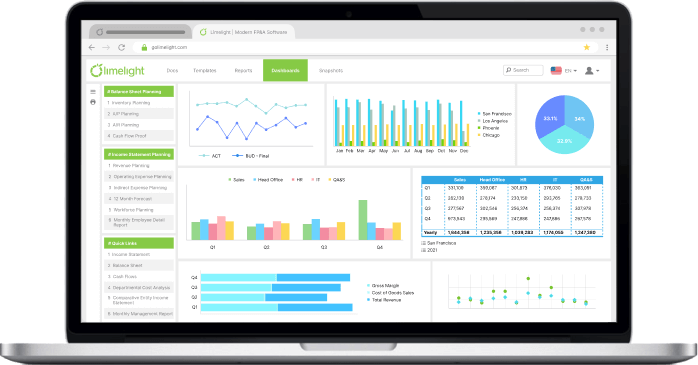
Limelight AI homepage
Here’s how Limelight’s all-in-one FA&P platform comes into play:
 Frequently Asked Questions
The five main types are liquidity, profitability, efficiency, leverage, and market value ratios. Liquidity ratios cover short-term obligations, profitability ratios cover earnings performance, efficiency ratios cover asset utilization, leverage ratios cover long-term debt risk, and market value ratios reflect investor perception of a company's financial position and growth prospects.
Financial ratios are individual calculations, such as the current ratio or return on equity, derived from financial statements. Financial ratio analysis is the broader process of interpreting those ratios together, across time or against benchmarks, to assess performance, risk, and financial health in a meaningful way.
FP&A teams use financial ratios to set performance targets in annual budgets, validate forecast assumptions against historical trends, and monitor actuals versus plan through the close cycle. Ratios such as operating margin, DSO, and interest coverage serve as driver-level guardrails across cost centers and business units, helping teams identify early whether performance is tracking to plan or requires corrective action.
Lenders typically covenant on the debt service coverage ratio (minimum 1.25x), interest coverage ratio (minimum 1.5–2.0x), and debt-to-equity ratio. Breaching a covenant may trigger default provisions, making these priority monitoring items for treasury and FP&A teams throughout the fiscal year.
A current ratio between 1.5 and 3.0 is commonly viewed as healthy, though this varies by industry. It is more useful to track the ratio over time and against peers, and to assess whether a high ratio reflects efficient asset management or idle cash and slow-moving inventory that is not being productively deployed.
In Excel, financial ratios are calculated using manual formulas and linked data, which requires frequent updates and validation. FP&A software like Limelight automates calculations by pulling real-time ERP data and tracking trends continuously, reducing formula errors and close-cycle preparation time.
Subscribe to our newsletter