
%20(1).svg)
8 FP&A Models for Financial Forecasting in 2026
By Laks Satchi |
Last Updated: August 17, 2026
Accurately predicting future revenue and expenses is crucial for finance teams. But relying on spreadsheets and outdated methods can make this process frustrating and inefficient. It’s slow, prone to errors, and often leaves teams second-guessing key decisions.
FP&A modeling offers a more reliable way forward. With the right tools and structure, financial forecasting, budgeting, and scenario planning become much smoother and more accurate.
In this guide, we’ll walk you through the eight essential FP&A models every finance team should know. You’ll learn when to use each model and best practices to build stronger financial forecasts.
With the right FP&A models in place, you can make faster decisions, reduce mistakes, and gain more control over your company’s financial future.
FP&A modeling refers to the creation of financial models used by finance teams to plan, budget, and forecast a company’s financial future. Unlike investment banking models, which focus primarily on transaction analysis (like DCF or LBO models), FP&A models are operational and designed to support day-to-day business decisions.
They help finance teams anticipate financial trends, plan for various scenarios, and make data-driven decisions that align with the company’s strategic goals.
Key characteristics of FP&A models include a focus on practical data, such as revenue, costs, and cash flow, rather than theoretical valuations. These models serve as the backbone for budgeting, forecasting, and financial reporting within a company.
Historically, Excel has been the go-to tool for FP&A modeling due to its flexibility and widespread use. However, as businesses face more complex financial landscapes, purpose-built FP&A software is rapidly gaining traction. These tools streamline processes, integrate data from multiple sources in real-time, and eliminate the limitations of spreadsheet-based modeling.
FP&A models are crucial for finance teams because they enable more accurate forecasting, better decision-making, and faster responses to changes in the business environment. Let’s break down why these models matter:
FP&A models provide a structured approach to predicting future financial outcomes based on real-time and historical data. By identifying patterns and leveraging key metrics, finance teams can predict cash flow, revenue growth, and expenses with greater accuracy. This results in fewer surprises and more reliable financial forecasts.
KPMG’s 2024 survey of 330 leaders at large public and private U.S.-based companies showed that one in six respondents were planning data quality improvements. Data quality is crucial for producing accurate forecasts. FP&A teams leveraging AI achieve 25% higher forecast accuracy compared to teams using legacy systems.
One of the key benefits of FP&A modeling is its ability to model different scenarios. This means finance teams can assess the impact of various decisions, like price changes, new product launches, or market entry, and prepare for different outcomes.
By modeling “what-if” scenarios, teams can make more informed decisions and be ready for any eventuality.
For example, current events are raising concerns for many operations and supply chain leaders. Nearly 90% of them expect significant increases in supplier and material costs in the coming year, which could strain budgets, lower profit margins, prompt renegotiations with suppliers, and disrupt planning. Additionally, 91% of respondents say changes in U.S. trade policy are forcing them to adjust their supply chain strategies, while 87% cite geopolitical risks as a reason for shifting towards more flexible operations. These challenges are amplifying the need for more effective scenario planning and adaptability within supply chains.
With more accurate and timely data at their fingertips, finance teams can make decisions faster. Whether reallocating resources, adjusting forecasts, or revising budgets, FP&A models help speed up the decision-making process by providing clear, actionable insights. This leads to quicker pivots and an ability to respond to changing market conditions.
Finance teams using automation typically cut their close cycle by 60-80%, and 75% of CFOs say digital transformation is gaining momentum, enabling faster strategic decisions.
Traditional methods of financial forecasting, such as using spreadsheets, are prone to human error. Manual data entry, version control issues, and formula mistakes can lead to significant discrepancies.
FP&A software eliminates these risks by automating data consolidation and updating models in real-time, ensuring all stakeholders work with the same accurate data.
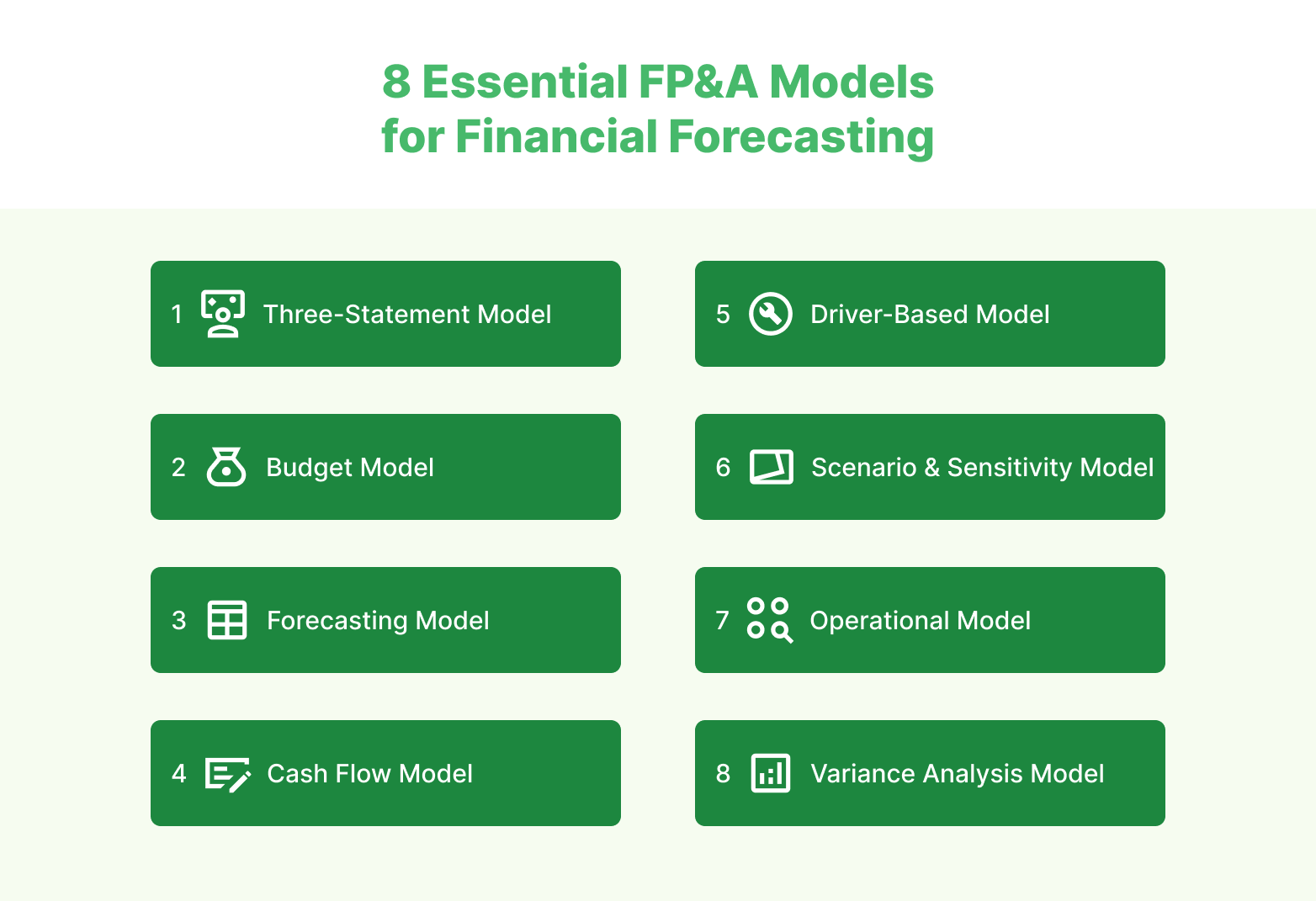
When it comes to financial planning and analysis (FP&A), having the right models at your disposal is key to making smart, data-backed decisions. These FP&A models help guide everything from budgeting to forecasting, ensuring you have a solid plan in place.
Here are eight essential FP&A models every finance team should be familiar with:
Definition:
The Three-Statement Model brings together a company’s income statement, balance sheet, and cash flow statement into a unified framework. It’s an essential tool for getting a comprehensive view of your company’s financial health.
Key components:
When to use it:
This model is the foundation of financial analysis. Use it for basic financial evaluations, long-term profitability projections, and cash flow management. It’s essential for creating forecasts and assessing sustainability.
Example:
If you’re evaluating the financial viability of launching a new product, the Three-Statement Model helps you see how projected revenue impacts profits and cash flow over time.
Definition:
The budget model is a forward-looking financial plan that estimates future revenues, expenses, and profits. It’s a guide to help steer your business operations for the upcoming period (usually annually).
For a step-by-step breakdown of how to actually build and execute this process, see our guide on how to do budget forecasting.
Key components:
When to use it:
Use this model during your annual planning cycle. It helps align your business teams with financial targets and ensures you allocate resources effectively.
Example:
A company preparing for the next fiscal year can use the budget model to set realistic financial goals for different departments, ensuring resources are allocated efficiently while staying within budget.
Definition:
A forecasting model projects future financial outcomes based on historical data and current trends. It helps adjust business expectations in real-time as new information becomes available.
Key components:
When to use it:
This model is vital for regular financial updates, such as monthly or quarterly forecasts, and for adjusting expectations as new data comes in.
Example:
A SaaS company might use a forecasting model to predict their monthly recurring revenue (MRR) for the next quarter, factoring in customer acquisition rates and churn trends to refine their marketing and sales strategies.
Definition:
The cash flow model focuses on tracking the cash coming in and going out of your business. It’s not about profits, but about liquidity, ensuring you have enough cash flow to cover daily expenses.
Key components:
When to use it:
This model is a must when you need to assess your business’s ability to meet its short-term obligations and manage liquidity. It’s particularly useful for managing cash shortages or planning large capital expenditures.
Example:
During peak seasons, a retail company can use a cash flow model to ensure they have enough liquidity to restock inventory or cover marketing campaigns without risking cash shortages.
Definition:
The driver-based model connects key business drivers, such as sales volume, headcount, or marketing spend, to your company’s financial outcomes. It helps you understand the impact of operational decisions on your financials.
Key components:
When to use it:
This model is perfect for understanding how changes in operational decisions (like increasing marketing spend) affect your financial results. It's often used in scenario planning and what-if analysis.
Example:
A subscription-based service could use a driver-based model to predict how increasing their marketing budget would drive new customer acquisitions and increase monthly recurring revenue (MRR).
Definition:
Scenario modeling tests multiple future financial scenarios, while sensitivity analysis examines how changes in key assumptions affect the model’s outcomes.
Key components:
When to use it:
This model is ideal when you need to prepare for uncertainty, such as during strategic planning or market expansion.
Example:
A company planning to launch a new product can use scenario modeling to predict sales under different market conditions and pricing strategies, helping to decide whether to proceed with the launch.
Definition:
An operational model focuses on the daily activities of a business, linking financial outcomes to cost structures, workforce management, and operational efficiency.
Key components:
When to use it:
Use this model for managing operational budgets, tracking key performance indicators (KPIs), and optimizing day-to-day business performance.
Example:
A manufacturing company might use an operational model to track labor costs and operational efficiency, pinpointing areas for improvement in its production processes to cut costs.
Definition:
The variance analysis model compares actual financial performance to budgeted or forecasted figures, identifying and explaining discrepancies.
Key components:
When to use it:
This model is used to assess the accuracy of budgets and forecasts, making it essential for performance evaluation and strategic planning.
Finance teams looking to build this model quickly can start with our free budget vs actual Excel template ,pre-built with automated variance calculations and visual indicators.
Example:
A company noticing higher-than-expected operational costs can use variance analysis to identify whether the increase is due to higher supplier prices or inefficiencies in the supply chain, and adjust accordingly.
Building accurate and reliable FP&A models is a complex task that requires a structured approach. By following best practices, finance teams can ensure that their models are both accurate and flexible, capable of handling unexpected market shifts and operational changes.
Here are the key six best practices to keep in mind when building FP&A models:
Definition:
A fundamental best practice in FP&A modeling is to start with the desired financial outcomes and work backward to determine the inputs needed to achieve them. This approach ensures that the model aligns directly with business goals and strategic objectives.
Why it works:
Starting with the outputs (e.g., profit, revenue, cash flow) helps finance teams stay focused on the key financial metrics that matter most to the business. By reverse-engineering the model, you can better structure the assumptions and drivers to ensure the model aligns with real-world business objectives.
Example:
For a business seeking to improve profitability, starting with an operating profit target and working backward allows the finance team to identify the necessary changes in sales volume, cost management, and marketing spend to meet the goal.
Definition:
One of the best practices for building effective FP&A models is using monthly (or even more frequent) periods rather than annual or quarterly periods. This allows businesses to track performance more closely and adjust forecasts based on the latest data.
Why it works:
Monthly periodicity enables real-time insights and quicker adjustments to forecasts. By breaking down data into smaller timeframes, teams can monitor performance more accurately and make proactive adjustments rather than waiting until the end of the quarter or year.
Example:
A SaaS company might use monthly periodicity to track monthly recurring revenue (MRR), ensuring that any dip in customer acquisition or increase in churn is quickly identified and addressed before it affects long-term growth.
Definition:
Linking assumptions to key business drivers (such as sales volume, customer churn, or operating costs) is a crucial best practice for creating relevant and actionable FP&A models.
Why it works:
Assumptions often form the foundation of financial forecasts, and linking them to drivers makes it easier to understand how business changes directly impact financial outcomes. This connection helps finance teams make more informed, data-backed assumptions and adjust models as operational conditions change.
Example:
A retail company might tie assumptions about customer growth and average transaction size to specific business drivers like new product launches, marketing campaigns, and seasonal trends. This makes it easier to adjust the model when new data becomes available.
Definition:
Version control is the practice of maintaining different versions of your financial model, allowing for easy tracking of changes and ensuring that the most up-to-date version is used for decision-making.
Why it works:
FP&A teams often collaborate on complex models, and changes can be made by different team members over time. Version control ensures that the integrity of the model is preserved, prevents errors, and allows for easy comparison between different versions.
Example:
A finance team working on a budget model might use version control to track and compare budget revisions as they incorporate new assumptions about market conditions. This way, they can easily assess how changes impact the financial forecast.
Definition:
Automating data connections is essential for ensuring that your FP&A models are accurate, timely, and up-to-date. By linking financial models to real-time data sources, businesses can eliminate the need for manual data entry and minimize errors.
Why it works:
Automation helps reduce human error and speeds up the process of updating financial models. This allows teams to shift focus from time-consuming tasks like data entry and system consolidation to more strategic activities such as analysis and decision-making.
Based on the 2024 FP&A Trends Survey, nearly 45% of FP&A time is still spent on cleaning and reconciling data, limiting the time available for more strategic tasks. AI, however, is now automating much of this process, boosting confidence in the data and speeding up its application in decision-making.
Example:
A company using cloud-based FP&A software might automate connections to its ERP system and CRM platforms, ensuring that real-time data on sales, expenses, and cash flow are automatically fed into the model, without manual intervention.
Definition:
Documenting the assumptions behind each element of the FP&A model is a critical practice that ensures transparency and allows others to understand how the model was constructed.
Why it works:
Documenting assumptions provides clarity, making it easier for other stakeholders to review the model, validate the assumptions, and make necessary adjustments. It also serves as a reference for future revisions or audits, ensuring consistency and accuracy over time.
Example:
When creating a cash flow model, documenting assumptions about growth rates, capital expenditures, and payment terms ensures that all stakeholders are on the same page regarding the model’s foundations and makes it easier to revise the model as assumptions change.
Following these best practices will help ensure that your FP&A models are not only accurate but also adaptable, enabling better decision-making and agility in financial planning. By starting with desired outcomes, using monthly periodicity, linking assumptions to business drivers, and automating processes, your models can become powerful tools for steering your business toward success.
Spreadsheets like Excel have been a long-standing tool in FP&A modeling, but as businesses grow and financial needs become more complex, they start to show their limitations.
The challenges they pose, like version control chaos, formula errors, and manual data consolidation, can make the process slow, error-prone, and inefficient. These issues not only hinder collaboration but also impact the accuracy and scalability of your financial models.
Let’s break down the common pain points of spreadsheet-based FP&A modeling:
Spreadsheets are often shared between team members, with multiple versions floating around. This can lead to confusion, as different stakeholders may be working off outdated or inconsistent data. Without a central, controlled system, tracking changes and ensuring everyone is on the same page becomes a real headache.
Having different versions of the same spreadsheet means it’s easy to make mistakes, overlook important updates, or waste time reconciling discrepancies. Finance teams often circulate multiple versions via email, creating confusion over which file holds the most current data.
Purpose-built FP&A software fixes this by offering real-time collaboration with a single source of truth. Now, teams can work on the same model at once, and any changes made are instantly updated for everyone, removing the chaos of version control.
Spreadsheets are full of complex formulas, and even the smallest mistake in a formula can lead to significant inaccuracies. A simple error, whether accidental or due to manual input, can result in incorrect forecasts, budgeting errors, and even misreported financial data.
Formula errors can be hard to spot, especially in large, intricate models. A mistake might not show up right away, but it could lead to major decision-making errors with long-term consequences.
In fact, a 2024 study found that 94% of business spreadsheets contain critical errors, which can seriously impact forecasts. Even large institutions like JPMorgan Chase have fallen victim to spreadsheet errors, such as in their Basel II.5 model, where they mistakenly used the sum instead of the average.
FP&A software automates calculations and offers pre-built templates, ensuring formulas are error-free. With real-time data integration, you can minimize human error and ensure your financial forecasts are based on accurate, consistent data.
In Excel, data must be manually collected, updated, and consolidated from various sources like ERP systems, CRMs, and accounting software. This is a time-consuming process that is prone to errors, especially when working with large datasets or frequent updates.
Manually consolidating data takes up valuable time and increases the risk of missing key figures or misreporting data. When data isn’t automatically synced or updated, forecasts and budgets become outdated quickly, leading to decisions based on old information.
FP&A software integrates easily with your existing systems and automatically pulls data from multiple sources, ensuring that your financial models are always up-to-date and accurate. This automation not only saves time but ensures you’re working with the most current data.
As a company grows, its financial models become more complex. Spreadsheets, however, often struggle to handle this complexity. Adding more data, users, or reports can make models sluggish and harder to manage, ultimately hindering the ability to make timely decisions.
The larger and more complex a spreadsheet becomes, the harder it is to maintain. With Excel, performance slows down as the file size grows. Even though Excel can technically handle over one million rows, the processing speeds drop significantly, and the risk of errors increases.
FP&A software is built to handle large datasets, multiple users, and more intricate models without slowing down. It can scale with your business, making it easier to manage increasingly complex financial planning as your company grows.
One major limitation of spreadsheets is their inability to update in real-time. When someone makes a change, those updates don’t automatically sync across versions or linked models, leading to outdated data being used for decision-making.
In a fast-paced business environment, outdated data can result in poor decisions. Financial teams need access to the most current figures to make accurate forecasts and responsive decisions. The lack of real-time updates is a significant challenge for modern FP&A teams.
With FP&A software, all data is updated automatically in real-time, ensuring that teams are always working with the latest information. This enables quick adjustments to forecasts, keeping financial plans accurate and aligned with evolving business realities.
When teams collaborate on spreadsheet-based models, the process can quickly become a bottleneck. Without version control or proper access permissions, it leads to confusion, miscommunications, and errors.
Finance teams often spend time chasing down updated versions or manually reconciling changes, which delays decision-making and adds friction. Spreadsheets weren’t built for real-time collaboration, with only one user able to edit a section at a time, forcing sequential work instead of simultaneous collaboration.
FP&A software enables real-time collaboration, allowing multiple users to work on the same model simultaneously. With access controls, it ensures that sensitive data is only available to authorized users, making collaboration more efficient and seamless.
Spreadsheets don’t automatically generate a detailed audit trail, making it difficult to track changes and identify the source of errors. When multiple people edit a spreadsheet, it becomes nearly impossible to see who changed what and when.
Without an audit trail, compliance reviews and audits become challenging, and accountability suffers. Inaccurate or incomplete records can lead to potential compliance risks during audits.
FP&A software provides robust audit trails, automatically tracking all changes, including who made them, when, and what was changed. This ensures compliance, enhances accountability, and simplifies the audit process.
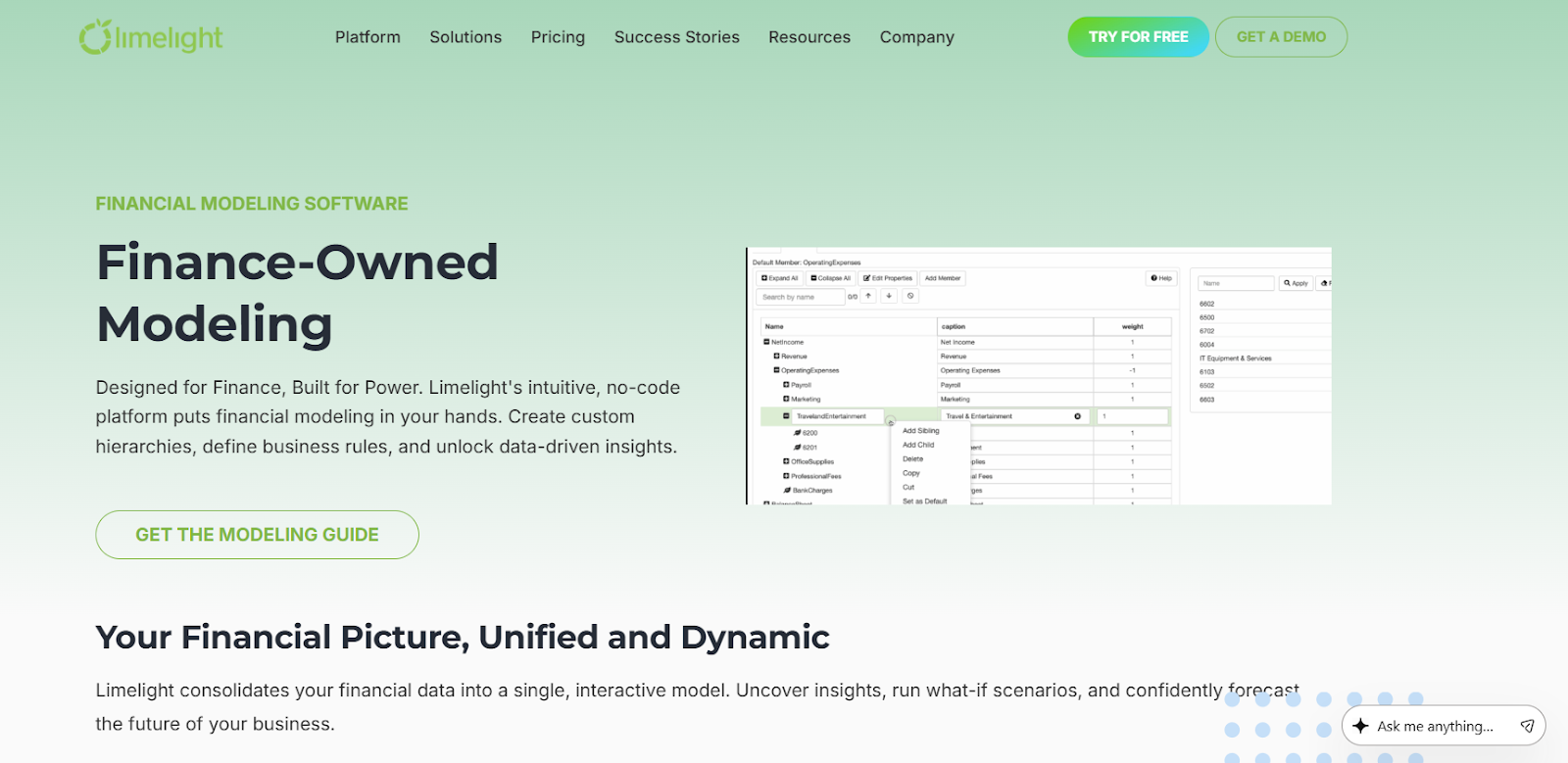
Limelight’s no-code platform helps with financial modeling
When it comes to FP&A modeling, Limelight offers a comprehensive, purpose-built solution that addresses the common pain points of traditional spreadsheet-based models.
With features tailored for agility, accuracy, and real-time data integration, Limelight empowers finance professionals to take control of their financial planning and forecasting with ease.
Here's how Limelight helps businesses streamline their FP&A processes:
One of the key benefits of Limelight is that it allows finance teams to own the modeling process without relying heavily on IT departments. Finance-owned modeling means that finance teams can create, modify, and manage their financial models independently. This speeds up decision-making and empowers finance teams to be more responsive to business needs without waiting for technical support.
GSW Manufacturing, a leading automotive supplier, stated that using Limelight enabled their finance team to take full control of their forecasting models, resulting in a 30x faster budgeting cycle and a more dynamic planning process.
Whether you’re working with simple budget models or need to build advanced, multi-dimensional financial scenarios, Limelight’s flexibility ensures that the platform can accommodate any level of complexity. This adaptability enables you to easily scale your models as your business evolves.
Driver-based planning links financial outcomes directly to the key business drivers that influence them, such as sales volume, headcount, or marketing spend. By identifying and tracking these key drivers, Limelight enables businesses to see exactly how changes in operational metrics will impact their company’s financial performance. This makes your financial models not just a reflection of historical data but a true representation of your business's future potential.
Limelight's what-if scenarios allow finance teams to model different financial outcomes based on varying assumptions. This helps to assess how changing key inputs (like sales growth or cost reductions) will impact the financial forecast. This is invaluable when making strategic business decisions or preparing for uncertain market conditions.
For a full look at Limelight's planning and forecasting capabilities, visit our Planning and Forecasting page.
Rolling forecasts allow businesses to continuously update their financial projections based on the most recent data. This enables teams to adapt their budgets and forecasts on the fly as conditions change throughout the year.
Rather than waiting until the end of the quarter to revise forecasts, rolling forecasts in Limelight keep your financial plans dynamic and up-to-date. This level of agility ensures that your financial models are always reflecting the latest market and operational conditions.
With Limelight’s variance analysis, finance teams can quickly spot areas where actual performance deviates from expectations. This analysis is crucial for uncovering inefficiencies, adjusting strategies, and improving financial performance.
Limelight integrates seamlessly with your existing systems (ERP, CRM, accounting software), automatically pulling in real-time financial and operational data from multiple sources to feed into your financial models.
Limelight empowers finance teams to take control of their FP&A modeling with intuitive features designed to improve forecasting accuracy, streamline decision-making, and eliminate the limitations of spreadsheet-based models. From finance-owned modeling to automated data integration, Limelight equips you to make faster, more informed financial decisions. To explore the full platform, visit our financial modeling software page.
See how Limelight enables accurate, agile FP&A modeling. Request a demo.
FP&A modeling refers to the process of building financial models to support financial planning, budgeting, and forecasting. It helps businesses project future financial outcomes, analyze trends, and make informed decisions based on accurate financial data. These models enable finance teams to simulate different scenarios, plan for uncertainties, and ensure financial sustainability.
The most common FP&A models include:
FP&A modeling focuses on operational and strategic financial planning, including budgeting, forecasting, and scenario analysis for a business’s day-to-day operations. In contrast, investment banking modeling is typically focused on valuing companies for transactions like mergers, acquisitions, or initial public offerings (IPOs), using models like discounted cash flow model (DCF) or LBO that are transaction-based and often forward-looking, but not as operationally detailed as FP&A models.
To excel in FP&A modeling, finance professionals should have:
Yes, you can perform FP&A modeling in Excel, and it has been a go-to tool for many years. However, Excel has limitations such as manual data consolidation, formula errors, lack of real-time updates, and scalability issues. As businesses grow and data becomes more complex, many organizations are turning to purpose-built FP&A software like Limelight for more efficient, accurate, and scalable modeling.
When evaluating FP&A modeling software, consider the following features:
Subscribe to our newsletter