
%20(1).svg)
7 Datarails Alternatives for Nonprofit FP&A
By Laks Satchi |
Last Updated: July 31, 2026
Datarails changed categories in March 2026: the company launched FinanceOS and repositioned itself around governed data infrastructure rather than traditional FP&A software. Nonprofits buying a planning application should weigh that at renewal
In March 2026, Datarails announced that FP&A software is dead. It was the company's own launch message.
What changed: Datarails released FinanceOS and repositioned around governed financial data for AI systems rather than around planning. Reporting by Accounting Today carries a company statement confirming that FinanceOS is not FP&A software in the traditional sense.
For a commercial finance team, that reads as ambition. For a nonprofit controller trying to collect budget submissions from twelve program directors before the board meets on Thursday, it reads as a category change. You are not imagining the mismatch. You bought a planning application, and your vendor has said it is now building infrastructure. Most nonprofits arrive at this comparison for one of two reasons.
This guide is for nonprofit finance teams running Sage Intacct, NetSuite, Blackbaud Financial Edge NXT, or MIP Fund Accounting, with several program budgets, budget owners sitting outside the finance team, and a board that expects the same reporting pack every month. If restricted funds, functional expense allocation, and grant calendars that ignore your fiscal year are part of your week, this is written for you.
How to use this guide: seven alternatives, each judged against the same six nonprofit criteria. These are not generic FP&A summaries with a nonprofit label attached. Every platform is assessed on fund accounting connectivity, budget-holder participation, and board reporting, and every entry names the conditions under which it is the wrong choice, including our own.
For the general-purpose version of this comparison, see our broader roundup of Datarails alternatives and competitors.
First, though, the case for staying put.
Datarails earns its ratings. Before the criticism, it is worth being clear about where it performs well, because a switch you cannot justify is a switch you should not make.
|
Where Datarails performs well |
Evidence |
|---|---|
|
Support quality |
Rated 9.3 out of 10 on G2, the highest score among the platforms in this comparison |
|
Excel continuity |
Teams keep existing models and formulas rather than rebuilding them |
|
Consolidation |
Reviewers cite reliable multi-entity consolidation and a single source for reported figures |
|
Fund accounting connectivity |
Publishes connectors for MIP Fund Accounting and Blackbaud Financial Edge NXT, which many FP&A vendors do not |
With that established, five issues come up repeatedly among nonprofit users.
Review evidence in this section comes from the Datarails product review page on G2 and its Capterra profile, where it holds 4.7 out of 5 across 187 reviews.
Generic FP&A comparison criteria miss most of what makes nonprofit planning difficult. Restricted funds, grant calendars that ignore your fiscal year, and functional expense reporting have no equivalent in commercial FP&A. Use these six criteria instead.
|
Criterion |
What to ask |
|---|---|
|
Fund accounting and ERP integration |
Does the vendor publish a connector for your accounting system, or will this need middleware? Ask specifically about Blackbaud Financial Edge NXT and MIP Fund Accounting, which many FP&A vendors omit |
|
Restricted fund and functional expense reporting |
Can the platform hold restricted and unrestricted views and produce a statement of functional expenses, or does that logic live in a spreadsheet outside the tool? |
|
Budget-holder participation |
Can a program director submit a budget through a browser, with approval routing, without opening a workbook or holding a full license? |
|
Workforce and grant-funded personnel planning |
How are salaries split across grants and programs, and what happens to those allocations when a grant ends mid-year? |
|
Board reporting and narrative commentary |
Can you produce a recurring board pack with commentary that stays synced when figures change, and can people without logins receive it? |
|
Implementation effort and ongoing ownership |
How long to go live, and does the platform assume a dedicated finance systems owner you may not have? |
Two of these deserve extra attention. Functional expense allocation is where most nonprofit planning processes break down, and we cover the mechanics in our guide to nonprofit operating expenses. Board reporting is the other, because it is usually the deliverable that exposes whatever the planning tool cannot do. Our guide to nonprofit board reports sets out what finance committees typically expect.
Contributor model and fund accounting connectivity separate these platforms more than feature counts do. Restricted fund handling requires more nuance than a table cell allows, so it is covered in the individual sections.
|
Platform |
Best for |
Contributor model |
Published nonprofit accounting connectors |
Public pricing |
|---|---|---|---|---|
|
Limelight |
Nonprofits with several program budgets, distributed budget owners, and recurring board reporting |
Web platform with an Excel-like interface |
Blackbaud, Sage Intacct, NetSuite, Microsoft Dynamics, QuickBooks Online |
Not published |
|
Martus |
Mission organizations needing wide budget participation on a modest budget |
Web worksheets with approval routing |
Blackbaud FE NXT, MIP Fund Accounting, Sage Intacct, Sage 100, ShelbyNext |
Not published |
|
Vena |
Finance-led teams preserving complex Excel models |
Excel-native |
Sage Intacct, NetSuite, QuickBooks, Acumatica, Microsoft Dynamics 365 |
Not published |
|
Planful |
Organizations needing planning plus financial close |
Web platform |
Confirm with vendor |
Not published |
|
Prophix |
Organizations wanting full CPM with fund accounting connectivity |
Web platform |
Sage Abila MIP, Sage Intacct, NetSuite, Sage 100 and 300, Ellucian |
Not published |
|
Workday Adaptive Planning |
Organizations already inside the Workday estate |
Web platform |
Confirm with vendor |
Not published |
|
Jirav |
Smaller teams wanting three-statement forecasts and clean visuals |
Web platform |
Sage Intacct, payroll systems, Google Sheets |
Not published |
|
Datarails, incumbent |
Excel-centric teams needing consolidated reporting and cash visibility |
Excel add-in |
MIP Fund Accounting, Blackbaud FE NXT, Sage Intacct, NetSuite, QuickBooks |
Not published |
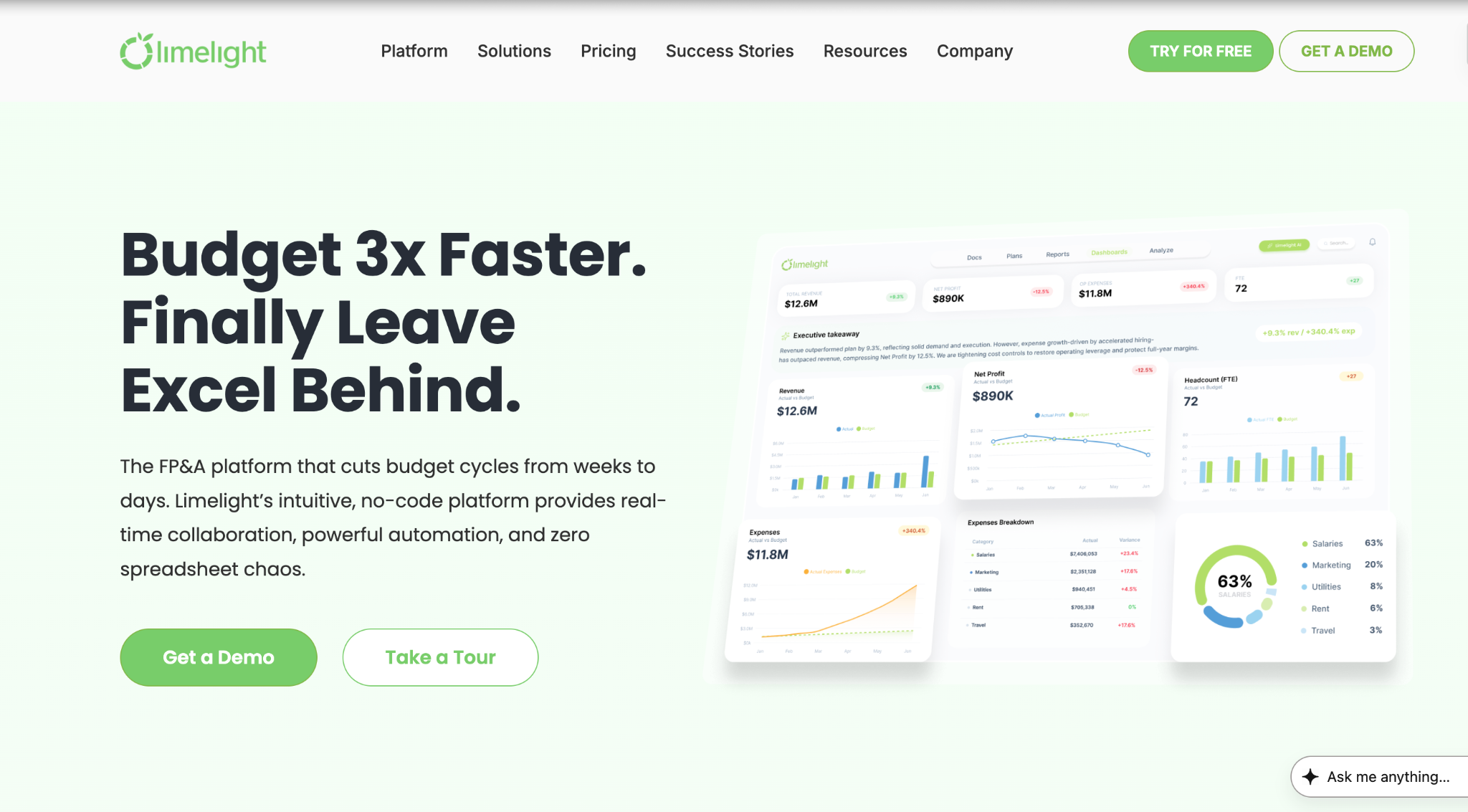
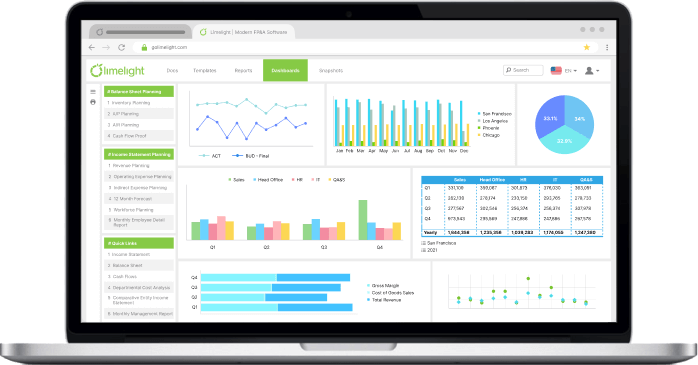
Limelight is a cloud FP&A platform for mid-sized finance teams that have outgrown spreadsheet-based planning. Budgeting, forecasting, reporting, and workforce planning run on a structured planning database with live ERP connections, and the interface is built to feel familiar to people who have spent their careers in Excel. Nonprofit is one of the industries Limelight serves directly, alongside higher education and healthcare.
Nonprofit relevance: Limelight publishes a Blackbaud connector alongside Sage Intacct, NetSuite, Microsoft Dynamics, and QuickBooks Online, so fund accounting actuals arrive without middleware. Budget owners outside finance submit through the browser rather than through a workbook.
|
Dimension |
Limelight |
Datarails |
|---|---|---|
|
Category |
FP&A planning platform |
FinanceOS, positioned by the company as governed data infrastructure |
|
Contributor model |
Web-based entry with role-based permissions |
Excel add-in. A March 2026 nonprofit reviewer cited no native web input forms |
|
Board reporting |
Narrative reporting that combines tables, charts, and commentary |
Reviewers rate dashboards well and describe board-level output as less developed |
|
Nonprofit connectors |
Blackbaud, Sage Intacct, NetSuite, Dynamics, QuickBooks Online |
MIP Fund Accounting, Blackbaud FE NXT, Sage Intacct, NetSuite, QuickBooks |
|
Review base |
4.7/5 across 15 reviews |
4.6/5 across 359 reviews |
|
Strengths |
Limitations |
|---|---|
|
Excel-like interface shortens the learning curve for teams leaving spreadsheets, a point reviewers raise consistently |
Small review base. Fifteen G2 reviews carry far less statistical weight than Vena's 469 or Planful's 491 |
|
Workforce planning covers headcount, salary, and benefits modeling inside the financial plan |
Grant-specific allocation logic should be confirmed against your own fund structure during evaluation |
|
Narrative reporting and anomaly detection reduce the manual work in a recurring board pack |
More platform than a small organization with one centralized budget is likely to need |
Pricing and best fit: Limelight does not publish pricing and quotes per organization. It fits nonprofits running several program budgets with budget owners outside finance, recurring forecasts, and formal board reporting obligations.
You can compare capability in more detail on the FP&A platform overview or see how the AI features handle variance commentary on the Limelight AI page.
Verdict: Shortlist Limelight when the blocking problem is that people outside finance cannot participate in the budget, and when fund accounting actually needs to arrive without a manual step. It is a weaker fit for organizations with a single centralized budget maintained by one person, where the cost of a planning platform outruns the problem. Nonprofits should also confirm during evaluation how grant-funded salary allocations are configured for their specific fund structure, since general workforce planning and grant allocation are not the same capability.
Martus is the only platform in this comparison built for mission organizations first. Programs, ministries, and departments are native concepts rather than adaptations of a business-unit hierarchy, and the integration list covers the fund accounting systems most FP&A vendors skip. Its Capterra profile notes discounts for nonprofits and churches, and nonprofit and religious organizations each account for around 12 percent of its reviewer base.
Nonprofit relevance: Martus publishes connectors for Blackbaud Financial Edge NXT, MIP Fund Accounting, Sage Intacct, Sage 100, and ShelbyNext Financials. Its defining strength is collaborative budgeting, with department and program leads working in their own worksheets under approval routing.
|
Dimension |
Martus |
Datarails |
|---|---|---|
|
Built for |
Nonprofits, churches, associations, schools |
Industry agnostic, predominantly mid-market |
|
Contributor model |
Web worksheets with approval routing and change requests |
Excel add-in without native web input forms |
|
Implementation |
The vendor states roughly three weeks |
G2 ease of setup 7.6, with reviewers citing configuration effort |
|
Statement coverage |
A February 2026 reviewer reported no balance sheet view |
Full statement set available |
|
Review base |
4.7/5 across 64 reviews |
4.6/5 across 359 reviews |
|
Strengths |
Limitations |
|---|---|
|
Program and ministry leads get self-service budget visibility without requesting reports from finance, cited repeatedly across 2026 reviews |
A senior accountant reviewing in February 2026 reported no balance sheet view, so assets and liabilities are not visible |
|
Sage Intacct integration quality, including exporting the approved budget back to the ledger |
A nonprofit reviewer in June 2026 described custom report building as cumbersome and noted that graphs cannot be exported for board members without platform access |
|
Support responsiveness, praised across a large share of its reviews |
Personnel budgeting carries a learning curve, with several reviewers noting limits on benefit configuration |
|
Fast implementation that fits inside a single budget cycle |
A school reviewer in February 2026 found it complex for a small organization, so simplicity is not guaranteed |
Pricing and best fit: Martus does not publish a single price. It sells three tiers, with forecasting, personnel budgeting, and custom report building arriving above the entry level, and licenses are sold in user packs rather than individually. Confirm the current tier structure and viewer arrangements on the Martus Capterra listing and with the vendor, since the licensing model materially affects total cost for organizations with many budget viewers.
Verdict: Martus is the strongest nonprofit-native option here and the right call when broad budget participation matters more than analytical depth. Be clear about the ceiling before committing.
The missing balance sheet view on some integrations is a real constraint for organizations with fiduciary reporting duties, and the inability to export graphs for board members without logins is an awkward gap in a product partly sold on board reporting. Organizations with multi-entity consolidation requirements will likely outgrow it. Ratings and review details are on the Martus G2 review page.

Vena is the most established Excel-native FP&A platform and the closest structural match to what Datarails has been. Finance teams keep working in Excel while Vena provides the central database, version control, workflow, and audit trail underneath. It carries the second largest review base in this comparison at 469 G2 reviews, and it integrates deeply with the wider Microsoft stack including Power BI and Teams.
Nonprofit relevance: Vena's published connector list covers Sage Intacct, NetSuite, QuickBooks, Acumatica, Xero, SAP, and Microsoft Dynamics 365. It does not list Blackbaud Financial Edge NXT or MIP Fund Accounting, so organizations on those systems should establish how data would move before shortlisting.
|
Dimension |
Vena |
Datarails |
|---|---|---|
|
Excel model |
Deeply embedded with two-way sync to source systems |
Add-in based, with reviewers citing manual refresh steps |
|
Category position |
Still positioned as a complete FP&A platform |
Positioned as governed data infrastructure |
|
Scope |
Planning, close, and consolidation |
Reporting, consolidation, and cash management |
|
Nonprofit connectors |
Sage Intacct and NetSuite listed. Blackbaud and MIP not listed |
MIP Fund Accounting and Blackbaud FE NXT both listed |
|
Review base |
4.5/5 across 469 reviews |
4.6/5 across 359 reviews |
|
Strengths |
Limitations |
|---|---|
|
Excel familiarity removes most of the change management burden for finance-heavy teams |
Contributors outside finance still work through spreadsheets, so distributed budget participation is unchanged |
|
Large peer base at 469 reviews, giving buyers substantial reference material |
Reviewers report slower performance on large datasets |
|
Planning, close, and consolidation in one platform |
Neither Blackbaud FE NXT nor MIP Fund Accounting appears on the published connector list |
|
Support quality rated highly for responsiveness |
Implementation scope and cost sit above the nonprofit-native options in this list |
Pricing and best fit: Vena does not publish pricing and lists two plan tiers requiring a quote. It suits finance-led nonprofits with genuine Excel modeling depth that want governance without abandoning their models. We have looked at its commercial model in more detail in our review of Vena pricing and features.
Verdict: Vena is a capable platform, and whether it is the right move depends entirely on why you are leaving Datarails. If the problem is that Excel dependency has broken your budget process, moving to another Excel-anchored platform addresses governance rather than participation.
If instead you want to preserve sophisticated models and simply need the version control, workflow, and audit trail to work properly, Vena is arguably the strongest option in this list. Organizations on Blackbaud or MIP should resolve the connector question first.

Planful is a financial performance platform covering planning, consolidation, close, and reporting, and it carries the largest review base in this comparison at 491 G2 reviews. It sits a tier above the Excel-governance tools in both scope and configuration effort. Reviewers single out reporting flexibility and the speed of building and changing reports.
Nonprofit relevance: Planful becomes relevant when consolidation across entities and a structured monthly close matter as much as budgeting. Nonprofits on Blackbaud Financial Edge NXT or MIP Fund Accounting should confirm connector availability with the vendor, as these do not appear prominently in its published integration material.
|
Dimension |
Planful |
Datarails |
|---|---|---|
|
Scope |
Planning, consolidation, and financial close |
Reporting, consolidation, and cash management |
|
Contributor model |
Web platform, contributors work in the application |
Excel add-in |
|
Reporting |
Reviewers highlight report creation and change speed |
Dashboards rated well, board output less developed |
|
Configuration |
Reviewers cite configuration challenges on specific workflows |
G2 ease of setup 7.6 |
|
Review base |
4.3/5 across 491 reviews |
4.6/5 across 359 reviews |
|
Strengths |
Limitations |
|---|---|
|
High customization and scalability, including complex planning formulas |
Lowest overall G2 rating among the seven alternatives at 4.3 |
|
Reporting capability, with reviewers noting how quickly reports can be built and adjusted |
Reviewers report configuration difficulties that can hinder specific workflow needs |
|
Planning and close in one platform, removing reconciliation between separate tools |
Assumes internal capacity to own and maintain a configured platform |
|
Largest peer base in this comparison, giving buyers extensive reference material |
Fund accounting connectivity is not established in published material and needs confirming |
Pricing and best fit: Planful does not publish pricing. It is best suited to larger nonprofits running several entities where consolidation and close carry as much weight as budgeting, and where someone internally owns the platform as part of their role.
Verdict: Planful is more platform than most nonprofits need, and its 4.3 rating is the lowest of the seven. The configuration criticism appears consistently enough to take seriously, and an organization without a dedicated finance systems owner may struggle to justify the setup and maintenance effort. Where multi-entity consolidation and a structured close are genuine requirements, it is a strong and well-proven choice. Where they are not, the implementation will likely cost more than the problem it solves.
Prophix is a corporate performance management platform spanning planning, budgeting, forecasting, reporting, and consolidation, sold as Prophix One. It is among the longest-established vendors in the category, and its published integration library covers more than 120 ERP systems. Reviewers describe it as capable and deep, with configuration effort as the trade-off.
Nonprofit relevance: Prophix publishes a connector for Sage Abila MIP, which is MIP Fund Accounting, alongside Sage Intacct, NetSuite, Sage 100 and 300, and Ellucian for higher education. That gives it stronger nonprofit and education connectivity than its general-purpose positioning suggests.
|
Dimension |
Prophix |
Datarails |
|---|---|---|
|
Category |
Corporate performance management |
Governed data infrastructure |
|
Contributor model |
Web platform |
Excel add-in |
|
Nonprofit connectors |
Sage Abila MIP, Sage Intacct, NetSuite, Ellucian |
MIP Fund Accounting, Blackbaud FE NXT, Sage Intacct |
|
Configuration |
Reviewers describe substantial time to configure models and workflows |
G2 ease of setup 7.6 |
|
Review base |
4.4/5 across 218 reviews |
4.6/5 across 359 reviews |
|
Strengths |
Limitations |
|---|---|
|
Automates budgeting, forecasting, and reporting deeply enough to free finance capacity for analysis, per a 2026 Capterra reviewer |
A head of finance systems reviewing on Capterra noted that full configuration of models, data structures, and workflows takes substantial time and effort |
|
Fund accounting connectivity through the Sage Abila MIP connector, which several competitors lack |
Some Capterra reviews are vendor-referred with a disclosed incentive, which should temper how much weight they carry |
|
Broad ERP coverage across more than 120 published connectors |
Limited visible nonprofit-segment review coverage compared with Martus |
|
Long operating history, which risk-averse buyers value |
Depth arrives at the cost of a longer runway to value |
Pricing and best fit: Prophix does not publish pricing, and third-party estimates in circulation are unreliable enough that we have not repeated them. It suits organizations with a dedicated finance systems owner, multi-entity consolidation requirements, and a multi-year platform horizon.
Verdict: Prophix is better suited to organizations with a dedicated finance systems owner. Smaller nonprofit teams may struggle to justify the configuration and maintenance effort, and the platform rewards a long commitment rather than a quick switch. The Sage Abila MIP connector makes it a more serious nonprofit candidate than it first appears, so organizations already on MIP Fund Accounting and needing full CPM should include it. Teams looking for a faster, lighter replacement should look elsewhere.

Workday Adaptive Planning is an enterprise planning platform that brings live data from ERP, HR, CRM, and operational systems into a single planning model. It runs on an in-memory calculation engine built for high-dimensional scenario work, and it does not require Workday elsewhere in the estate, although organizations already using Workday get the most from it.
Nonprofit relevance: The strongest case is ecosystem continuity for nonprofits already running Workday HCM or Financials. Fund accounting connectivity for Blackbaud Financial Edge NXT and MIP Fund Accounting should be confirmed with the vendor before shortlisting.
|
Dimension |
Workday Adaptive Planning |
Datarails |
|---|---|---|
|
Target segment |
Mid-market to enterprise, 58.5 percent mid-market on G2 |
SMB to lower mid-market, 73.4 percent mid-market |
|
Scenario modeling |
In-memory engine built for high-dimensional models |
Reviewers describe scenario planning as limited |
|
Ease of setup |
7.4 on G2 |
7.6 on G2 |
|
Support quality |
8.1 on G2 |
9.3 on G2 |
|
Review base |
4.3/5 across 303 reviews |
4.6/5 across 359 reviews |
|
Strengths |
Limitations |
|---|---|
|
Structured and flexible approach to building and updating budgets and forecasts |
Lowest ease of setup score in this comparison at 7.4 |
|
Scenario performance on high-dimensional models that lighter tools cannot handle |
Support quality rated 8.1, materially below the 9.3 that Datarails records |
|
Workforce and financial planning combined in a single model |
Reviewers note challenges with integration and data visualization relative to lighter platforms |
|
A free trial is listed, which is uncommon in this category |
Implementation effort is typically measured in quarters rather than weeks |
Pricing and best fit: Pricing is not published, although a free trial is listed on G2. It fits nonprofits already running Workday HCM or Financials, with an internal administrator and an implementation window measured in quarters.
Verdict: Workday Adaptive Planning is unlikely to be the most practical replacement unless the organization already uses Workday or requires enterprise-level scenario modeling. On the published G2 sub-scores it rates lower than Datarails on setup, support, and overall satisfaction, so the case for switching has to rest on capability you will actually use. Where enterprise scenario modeling is a real requirement and a Workday estate already exists, it is a coherent choice.
Jirav is a driver-based planning platform combining budgeting, forecasting, reporting, and dashboards, with visual output as its most cited strength. Reviewers single out the quality of budget-to-actual presentation. It holds 4.7 out of 5 across 191 reviews, among the highest in this comparison, and the vendor positions the product for organizations between 5 and 500 employees.
Nonprofit relevance: Jirav integrates with Sage Intacct to import trial balance, chart of accounts, and departments automatically, alongside payroll systems and operational data. Fund accounting is not part of the core design, so restricted funds and functional expense allocation need direct examination during evaluation.
|
Dimension |
Jirav |
Datarails |
|---|---|---|
|
Planning model |
Driver-based across profit and loss, balance sheet, and cash flow |
Excel-anchored consolidation and reporting |
|
Primary segment |
Small business, 64.6 percent of reviewers |
Mid-market, 73.4 percent of reviewers |
|
Visual output |
Reviewers cite presentation quality as the standout strength |
Dashboards rated well, board output less developed |
|
Vendor-stated fit |
Positioned for organizations between 5 and 500 employees |
No comparable published range |
|
Review base |
4.7/5 across 191 reviews |
4.6/5 across 359 reviews |
|
Strengths |
Limitations |
|---|---|
|
Visual presentation for monthly budget-to-actual reporting, described by reviewers as a time-saver |
Reviewers ask for a more streamlined setup experience |
|
Driver-based three-statement forecasting without an enterprise implementation |
Support rated good rather than excellent, with reviewers noting room for improvement |
|
Automatic Sage Intacct import of trial balance, chart of accounts, and departments |
Reviewer base is dominated by small businesses, thinning peer signal for larger organizations |
|
Structures that suit advisors managing plans across several client organizations |
Fund accounting and restricted fund handling are not part of the core design |
Pricing and best fit: Jirav does not publish pricing and requires contact. Published third-party estimates conflict, so we have not repeated them. It fits smaller nonprofits and foundations wanting credible three-statement forecasting and presentation-quality reporting without an enterprise project.
Verdict: Jirav is a real option for smaller nonprofits, particularly those working with a fractional CFO or an outsourced accounting firm that already uses it. The rating is excellent and the visual reporting lives up to it. The constraint is fund accounting, which is not part of the design, so ask directly about restricted funds and functional expense allocation before shortlisting. Larger organizations with multiple entities will find the peer base and the feature depth thinner than they need.
The right answer depends less on which platform is best and more on why you are leaving. Find your reason in the left column.
|
Your priority |
Consider |
Why |
|---|---|---|
|
Collaborative program budgeting across non-finance staff |
Limelight or Martus |
Both provide browser-based submission with approval routing, which removes finance as the bottleneck for every change |
|
Preserving complex Excel models with stronger governance |
Vena |
Deep Excel embedding with version control and audit trail, without asking modelers to rebuild |
|
Planning plus financial close and consolidation |
Planful |
Close and consolidation are first-class functions rather than outputs of a planning cycle |
|
Enterprise CPM with fund accounting connectivity |
Prophix |
Full CPM depth plus a published Sage Abila MIP connector |
|
An existing Workday estate |
Workday Adaptive Planning |
Ecosystem continuity and enterprise scenario performance without a separate integration project |
|
Smaller-team forecasting with board-ready visuals |
Jirav |
Driver-based three-statement forecasting and strong presentation output at a smaller scale |
|
Consolidated reporting and cash visibility while staying in Excel |
Staying on Datarails |
If contributor access and forecasting depth are not your constraints, the switching cost may not be justified |
Match your replacement to the specific constraint you are trying to remove rather than to the highest rating on the page. Limelight and Martus solve contributor access, Vena solves Excel governance, Planful and Prophix solve consolidation depth, and Jirav solves smaller-team reporting.
|
SEE HOW LIMELIGHT HANDLES NONPROFIT PLANNING Book a tailored demo to see how Limelight supports program budgeting, fund-level reporting, and collaborative budget submissions using a sample nonprofit planning structure. Request a demo. |
Migration risk in nonprofit finance is mostly calendar risk. The work is manageable. Doing it in the wrong quarter is not.
Timelines vary with model complexity and integration scope. Martus states roughly three weeks for implementation, while enterprise platforms typically run considerably longer. For guidance on sequencing the cycle itself, see our guide to nonprofit budgeting, and for a worked example of the time savings a live ERP connection can produce, see how one finance team halved its budgeting time.
In March 2026 Datarails launched FinanceOS and stated that traditional FP&A software is dead. The company describes FinanceOS as governed data infrastructure, not FP&A software in the traditional sense. Existing FP&A tools remain supported.
Datarails publishes connectors for MIP Fund Accounting and Blackbaud Financial Edge NXT, so fund accounting data flows in. Restricted fund and functional expense logic still depends on your Excel models rather than native platform structures. Confirm your reporting needs during evaluation.
It depends on your operating model. Limelight and Martus suit nonprofits needing non-finance budget holders to contribute. Vena fits teams preserving Excel models. Planful and Prophix handle consolidation and enterprise CPM. Jirav suits smaller teams.
Martus publishes connectors for both. Limelight publishes a Blackbaud connector. Prophix lists Sage Abila MIP. Vena's published connector list covers Sage Intacct and NetSuite but not Blackbaud or MIP Fund Accounting.
Datarails does not publish pricing and lists three plans requiring a quote. One AVP of FP&A described the seat-type structure as challenging and asked for bulk viewer seats, which matters when program directors and board members need access.
Not in Datarails. A March 2026 nonprofit reviewer on G2 noted the absence of native web input forms, which limits collaboration with non-finance teams. Limelight and Martus both support browser-based budget entry with role-based permissions.
Timelines vary with model complexity and integration scope. Martus states roughly three weeks for implementation. Enterprise platforms typically take considerably longer. Time the switch so parallel running finishes before your fiscal year close.
Yes, for Excel-centric teams needing consolidated reporting and cash visibility. It rates 4.6 out of 5 on G2 across 359 reviews, with the strongest support score in this comparison. The concern is category fit if you need a planning application.
Subscribe to our newsletter