
%20(1).svg)
Statement of Functional Expenses: A Practical Guide (Example + Template)
By Laks Satchi |
Last Updated: July 29, 2026
Somewhere in most nonprofit finance offices sits a spreadsheet that quietly runs the organization's credibility. It splits the executive director's salary across program, administrative, and fundraising work using percentages nobody can quite remember deciding on. It gets copied forward every year, tweaked slightly when something feels off, and pulled out again the week before the board meeting or the audit fieldwork begins.
That spreadsheet is doing the job of a statement of functional expenses, just without the documentation an auditor would want to see behind it. This guide covers what the statement is, who has to file one, a full worked example, and how to build an allocation methodology that holds up when someone asks you to defend it, not just show it.
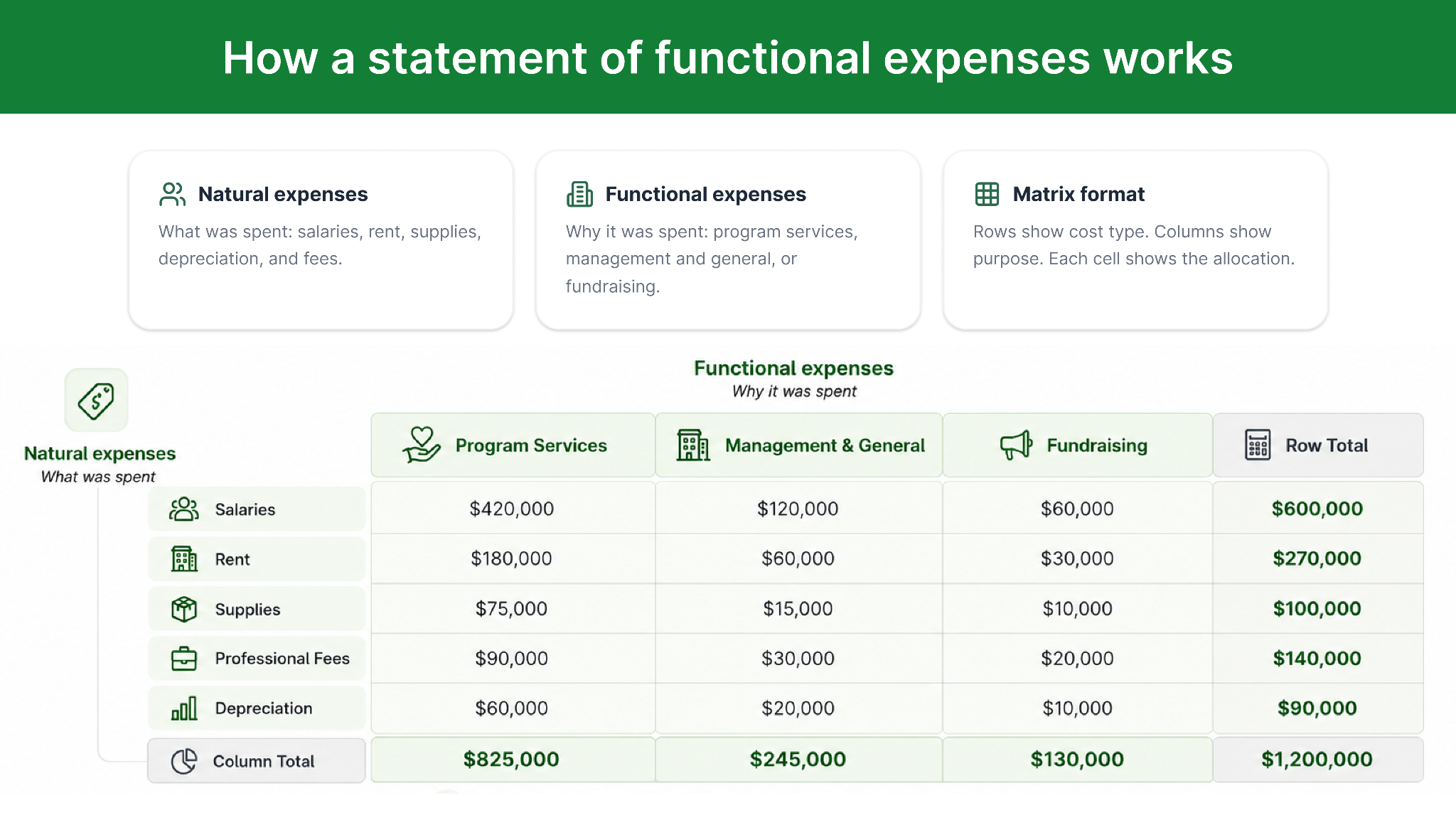
A statement of functional expenses, often shortened to SFE, is a financial report that shows nonprofit spending two ways at once. It lists expenses by natural category down the rows and by functional category across the columns, so a single dollar of rent or salary can be traced both to what it paid for and to which part of the mission it supported.
Because it connects spending to purpose in one view, the SFE is the report donors, grantors, and auditors return to most often when they want to understand how a nonprofit actually operates, not just what it spent.
Filing a statement of functional expenses is not optional once an organization crosses a size threshold. It is required as part of one of the four core nonprofit financial statements reviewed in any audited financial statement set, and it feeds directly into Form 990, Part IX.
|
Filing scenario |
Threshold |
Applicable form |
|
Standard nonprofit filer |
$200,000 or more in gross receipts, or $500,000 or more in total assets |
Form 990, Part IX |
|
Midsize organization |
Below the Form 990 threshold |
Form 990-EZ (abbreviated expense section) |
|
Private foundation |
Any size, foundation structure |
Form 990-PF (abbreviated expense section) |
|
Audited nonprofit |
Subject to independent audit |
Separate SFE statement, footnote schedule, or presented on the Statement of Activities |
Even organizations below the full Form 990 threshold generally benefit from preparing an SFE internally, since grantors and larger donors increasingly ask for one regardless of filing requirements.
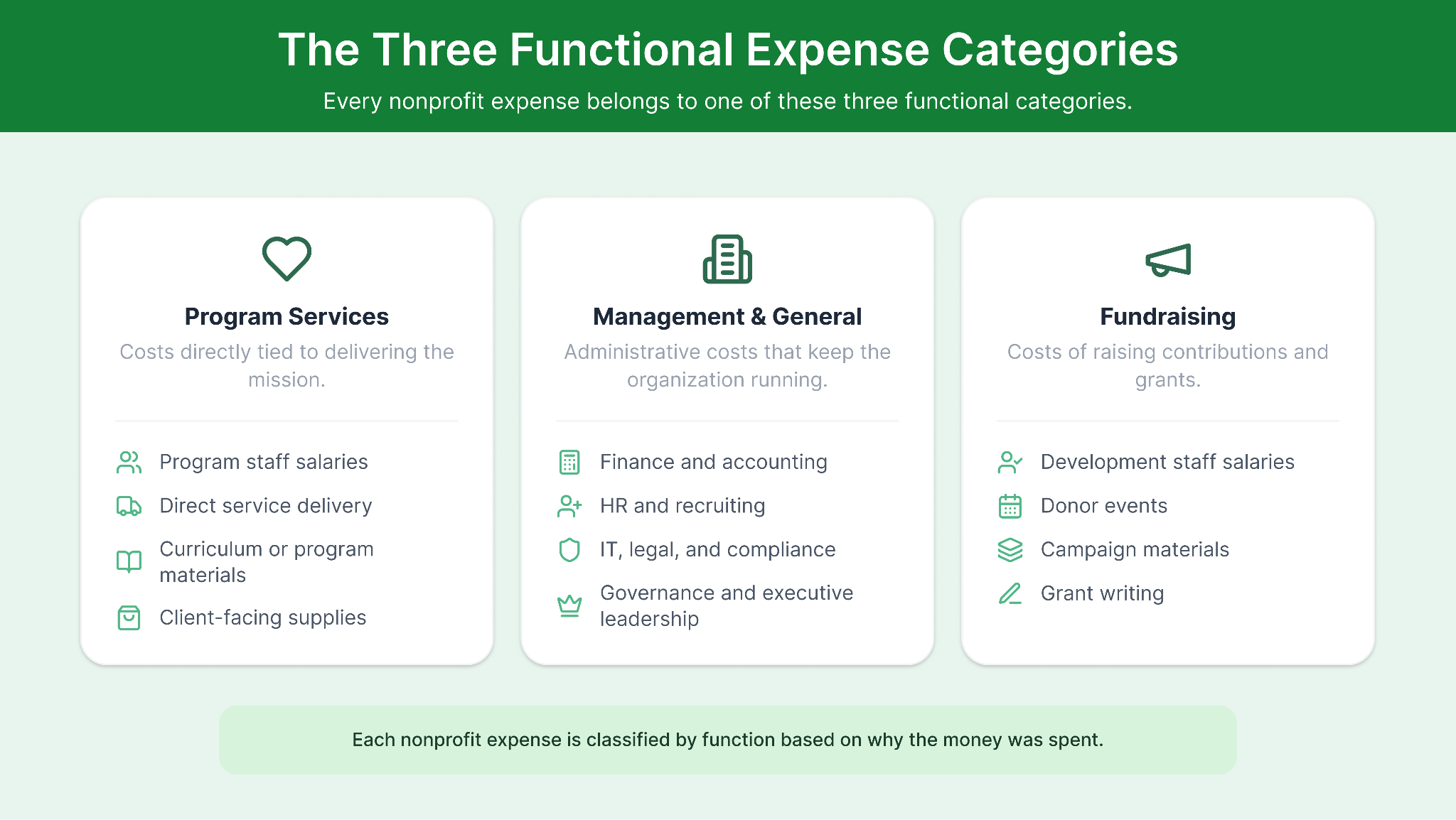
Every dollar a nonprofit spends gets classified into one of three functional categories:
Under FASB ASC 958-720-45, management and general costs like core recordkeeping, payroll processing, and audit fees must stay in that category. They cannot be reallocated to programs or fundraising even if the same staff occasionally touch program work, which is a distinction that trips up a lot of first-time preparers.
For a detailed breakdown of nonprofit operating expenses within each category, including specific line-item examples, see our dedicated guide.
Here is a simplified SFE for a mid-size nonprofit running two programs, showing how the same natural expenses split across functional categories.
|
Natural expense |
Program A |
Program B |
Management & general |
Fundraising |
Total |
|
Salaries & benefits |
$310,000 |
$185,000 |
$140,000 |
$95,000 |
$730,000 |
|
Rent & occupancy |
$28,000 |
$16,000 |
$18,000 |
$8,000 |
$70,000 |
|
Supplies |
$22,000 |
$14,000 |
$4,000 |
$3,000 |
$43,000 |
|
Professional fees |
$5,000 |
$3,000 |
$32,000 |
$6,000 |
$46,000 |
|
Depreciation |
$9,000 |
$5,000 |
$6,000 |
$2,000 |
$22,000 |
|
Total |
$374,000 |
$223,000 |
$200,000 |
$114,000 |
$911,000 |
|
To get a ready-to-use version of the table above, pre-built with formula-driven totals, a Ratio Summary tab, and an Allocation Methodology Log to document shared-cost decisions before an auditor asks, |
In this example, program services (Program A plus Program B) total $597,000, or about 65.5% of total expenses, management and general is roughly 22%, and fundraising is about 12.5%. Every figure here is illustrative only and built for demonstration, not sourced from any real organization.
To allocate the costs, follow these steps:
1. Choose an allocation methodology for each shared cost type (time-based, square footage, or another rational basis)
2. Document why that methodology fits the cost, in writing, before you need to explain it to an auditor
3. Apply the methodology consistently across reporting periods, and revisit it only when facts actually change
Salary allocation deserves particular attention because payroll typically represents 45% to 65% of total nonprofit spending, according to ClickTime, so a small error in how you split it compounds quickly.
|
Note: Some costs are easy to assign directly. A program supply purchased for one program goes entirely to that program. The harder work is allocating shared costs, the rent, the executive director's time, the shared software license, across categories in a way you can defend later. |
Consider an executive director whose duties actually span all three functions. If your allocation is based on a rough guess rather than an actual time study, you could be misallocating thousands of dollars a year into the wrong category, which is exactly the kind of gap an auditor is trained to catch.
For broader budget planning beyond the SFE itself, Limelight's general nonprofit budget template also pre-organizes expenses into Program Services, Management & General, and Fundraising columns and automatically calculates the resulting percentages.
An auditor reviewing your statement of functional expenses is not primarily grading your ratio. They are testing whether your allocation methodology is documented, rational, and applied the same way this year as last year.
|
What they want |
Red flag |
How to pass |
|
A written allocation policy |
Percentages that exist only in someone's memory |
Put the methodology in writing before fieldwork starts |
|
Consistent methodology year over year |
Allocation percentages that shift with no documented reason |
Revisit methodology only when underlying facts change, and note why |
|
Support for time-based splits |
Estimates with no underlying time study or activity log |
Run periodic time studies for staff who span functions |
|
Management and general costs kept separate |
Core finance or governance costs reallocated to programs |
Apply ASC 958-720-45 rules on what must stay in M&G |
This scrutiny is not incidental. According to the Association of Certified Fraud Examiners' Occupational Fraud 2026: A Report to the Nations, more than half of occupational fraud cases correlate with weak or overridden internal controls, and tips remain the leading detection method at 43% of cases. An undocumented, inconsistently applied allocation process is exactly the kind of control gap that report describes, which is one more reason a defensible methodology is worth building before you need it, not during fieldwork.
For years, the shorthand for nonprofit financial health has been a simple ratio: keep program expenses above roughly 65% to 70% of the total, and donors and watchdogs will consider you well run. That framing is quietly losing ground, even among the organizations that popularized it.
That shift does not mean the ratio stops mattering to donors reading your Form 990. It means the ratio is not the finish line for your finance team. A well-documented, consistently applied allocation methodology is what actually protects you in an audit and, increasingly, is what sophisticated funders are asking to see instead of a single percentage.
Manual allocation gets harder as an organization grows, and few examples make that clearer than communication service for the deaf. Before adopting a dedicated FP&A platform, the organization's finance team was scrolling through spreadsheets with thousands of rows just to get a departmental summary, work that made every allocation exercise slower and more error-prone than it needed to be.
Moving that process into a nonprofit FP&A platform lets the team tag expenses by function at the point of entry instead of reconstructing allocations after the fact, cutting their budgeting cycle time in roughly half.
A statement of functional expenses is never just a compliance exercise. It's a record of how deliberately an organization thinks about its own spending, and it becomes far more useful once the ratio itself stops being the goal. Build the methodology first, document it, apply it consistently, and the statement, along with the audit conversation and the donor questions that follow it, takes care of itself.
|
See how Limelight supports nonprofit functional expense reporting Schedule a demo to see how automated allocation and prebuilt nonprofit templates fit into your reporting cycle. |
No. It's required for nonprofits filing a full Form 990, generally those with $200,000 or more in gross receipts or $500,000 or more in total assets. Smaller organizations filing Form 990-EZ report expenses in a simpler format instead.
Natural expenses describe what you spent money on, like salaries, rent, or supplies. Functional expenses describe why you spent it: program services, management and general, or fundraising. The statement of functional expenses shows both at once, in a single matrix.
Estimate the percentage of time spent on program, administrative, and fundraising activities, ideally supported by a time study rather than a guess. Document the methodology and apply it consistently. Auditors look for a defensible, repeatable process, not a specific split.
Yes, if expenses are tagged by function at the point of entry. Platforms built for nonprofits can apply allocation rules automatically and update the statement as actuals come in, reducing the manual spreadsheet work required each reporting period.
Misclassification can distort the program expense ratio donors and grantors rely on, trigger auditor findings about internal controls, and in serious cases delay Form 990 filing or draw regulatory scrutiny. Consistent, documented allocation methodology is the best safeguard.
Subscribe to our newsletter