
%20(1).svg)
What Is Ad Hoc Reporting? Definition, Benefits & Finance Examples
By Laks Satchi |
Last Updated: June 17, 2026
If you're in finance, you've probably faced the frustration of waiting for static reports that just don’t keep up with the pace of your business. When you need to adjust forecasts or analyze a new trend, relying on outdated reports or waiting on IT can feel like an eternity.
This delay in accessing real-time data can seriously affect decision-making, leaving your team playing catch-up instead of leading the way. Without the ability to generate reports on-demand, finance teams often miss opportunities and struggle to stay agile in a competitive landscape. Ad hoc financial analysis changes all that.
It gives your team the power to create custom reports as needed, quickly and without IT’s help. In this article, we’ll break down what ad hoc analysis is, how it can benefit your team, the most common use cases, and how to choose the right ad hoc reporting tools for the job.
Let’s dive into how ad hoc financial analysis can boost your team’s efficiency and help you make faster, smarter decisions.
Ad hoc reporting is the process of creating custom reports tailored to specific, often urgent business needs. The term "ad hoc" comes from Latin, literally meaning "for this" or "to this," which reflects the nature of these reports; they are generated on demand to address particular questions as they arise.
Unlike standard, static reports that follow predetermined templates, ad hoc reports are flexible and designed to answer time-sensitive business queries. For example, a finance team may need an immediate analysis of quarterly revenue variance against forecast, or the HR department may request a breakdown of employee turnover by department and tenure over the past month.
The key benefit of ad hoc reporting is its ability to rapidly provide insights into unique situations without waiting for pre-scheduled reporting cycles or IT assistance. Modern self-service tools empower users, without technical expertise, to create these reports independently, dramatically accelerating decision-making while reducing dependency on technical teams.
Ad hoc analysis refers to the dynamic process of exploring and analyzing data on demand to answer specific business questions. Unlike traditional static reports, ad hoc analysis allows users to manipulate and modify report elements in real-time to explore various perspectives and uncover insights.
A key characteristic of ad hoc analysis is its flexibility. Users can filter, drill down, and pivot data to gain deeper insights, making it an iterative and exploratory process. This enables teams to adapt their analysis as new questions or data emerge, providing a more detailed understanding of business trends.
It’s important to note that ad hoc analysis is not a one-time report generation. It is an ongoing process that allows for continuous exploration, unlike fixed reports that offer pre-determined insights.
With the right analysis tools, even non-technical users can conduct ad hoc analysis without IT support, enabling faster, data-driven decision-making.
Static (canned) reports are regular, pre-configured reports that give you a consistent set of data at scheduled intervals, whether that’s daily, weekly, monthly, or quarterly. These reports are great for routine tasks like tracking KPIs, financial statements, or operational metrics.
Since they follow the same template each time, they’re reliable and comparable over time. But when unexpected business questions arise, these reports can fall short; they don’t offer the flexibility to dig deeper or explore new perspectives.
Ad hoc reports, on the other hand, are created on-demand to address specific, time-sensitive questions. They give users the ability to pull data dynamically, adjusting filters, timeframes, and metrics as needed to uncover insights from different angles.
This flexibility is especially valuable when business conditions change quickly or when you need to examine data in a new context.
Here’s a comparison between static reports and ad hoc reporting:
|
Criteria |
Static Reports |
Ad Hoc Reporting |
|
Schedule |
Predefined intervals (e.g., monthly or quarterly) |
Generated on demand, as needed |
|
Purpose |
Routine tracking of standard metrics |
To answer specific, time-sensitive questions |
|
Flexibility |
Fixed data set; cannot be changed |
Highly flexible; users can modify views and parameters |
|
User |
Typically IT staff or data analysts |
Business users can generate it independently |
|
Data |
Limited to what's predefined in the template |
Data can be manipulated, filtered, and analyzed from various angles |
While static reports are ideal for tracking long-term trends and maintaining consistency, relying only on them can limit a company’s agility. When unexpected changes or trends arise, it can be hard to respond quickly with just static data.
That’s where ad hoc reports come in. They provide the flexibility business teams need to make rapid, data-driven decisions without waiting for the next scheduled report.
Finance teams can no longer afford to be reactive when it comes to reporting and analysis. With the pace of business constantly accelerating, relying solely on scheduled reports or static data just doesn’t cut it. Ad hoc financial analysis provides the speed and flexibility needed to stay competitive and responsive. Here’s why it’s essential:
Ad hoc financial analysis allows teams to get immediate answers to urgent questions. Whether it’s understanding a sudden revenue dip or forecasting expenses for a new initiative, custom reports can be generated instantly, eliminating delays and providing accurate insights when they’re needed most.
For instance, if a CFO needs to adjust budget projections based on unexpected changes, ad hoc analysis makes that possible in real-time, not at the next reporting cycle.
With the right tools, teams no longer need to depend on IT to generate reports. Ad hoc reporting gives them the autonomy to pull the data they need and make informed decisions quickly. This shifts the focus from chasing down information to more strategic tasks, such as deepening financial analysis and driving growth.
IT teams are often bogged down by requests for custom reports, slowing down processes for everyone. Ad hoc analysis tools take the pressure off by enabling teams to create their own reports, freeing up IT resources for more complex technical work. This leads to better resource allocation and smoother operations across the business.
The flexibility of ad hoc analysis allows teams to adjust quickly to new data or changing market conditions. In fast-moving environments, having the ability to modify reports on the fly supports agile decision-making, whether it’s reallocating resources, adjusting forecasts, or seizing new opportunities.
Companies that embrace this kind of agility are better positioned to outperform competitors.
Ad hoc financial reporting and analysis use cases
Ad hoc reporting and analysis have become indispensable for businesses across various industries, empowering departments to make data-driven decisions quickly.
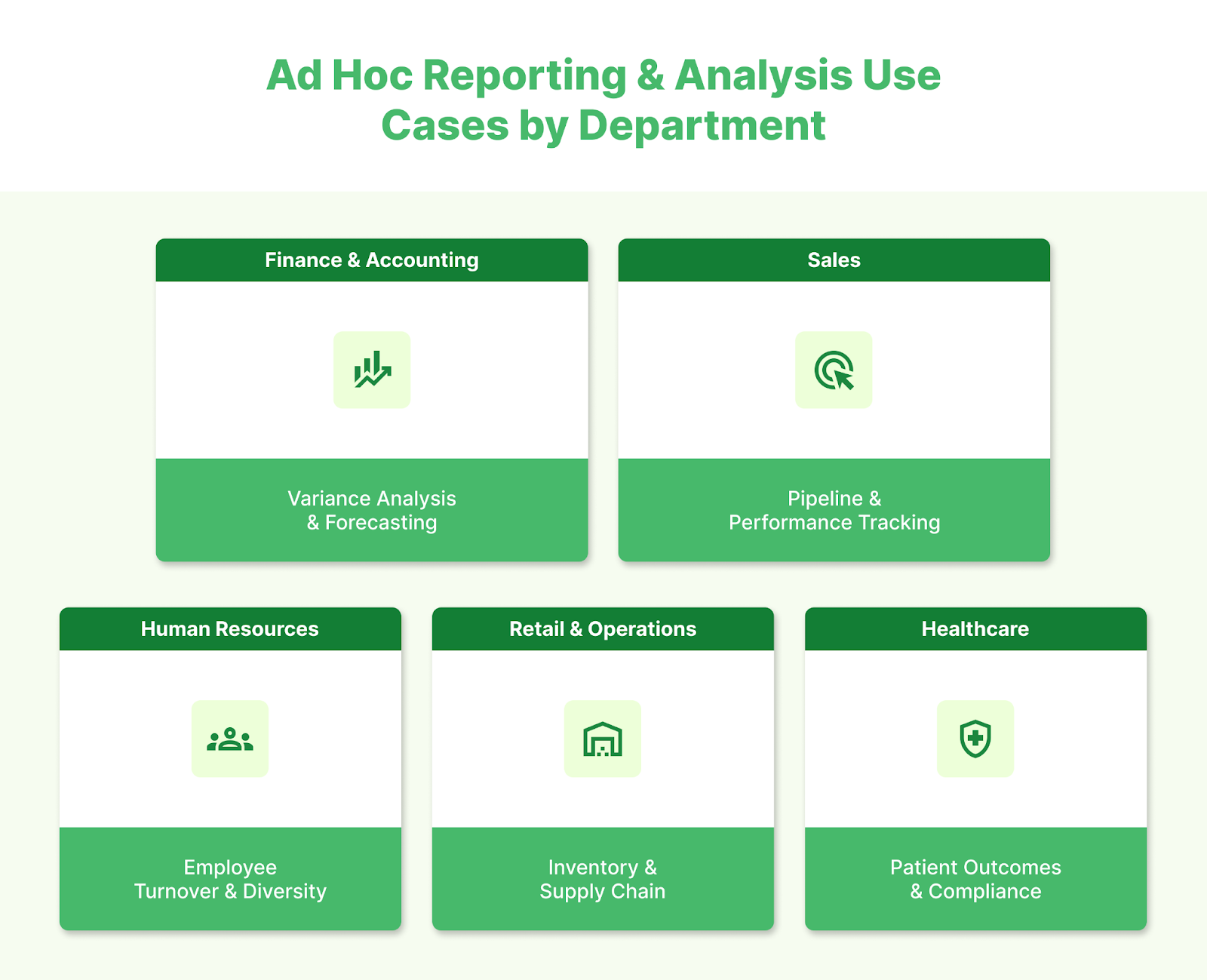
Below, we’ll explore how ad hoc reporting is used across five key departments: Finance & Accounting, Sales, Human Resources, Retail & Operations, and Healthcare.
In Finance & Accounting, ad hoc reporting is critical for real-time financial analysis, forecasting, and budgeting. For instance, teams can quickly adjust forecasts based on changing revenue streams or new expenses, such as unanticipated costs in a project or supply chain disruptions.
Ad hoc financial analysis also helps CFOs create immediate variance reports, allowing them to compare actual performance against the budget and identify discrepancies.
A major advantage for teams is the ability to drill down into complex data sets without waiting for a scheduled report. This flexibility supports urgent needs such as preparing for board meetings, responding to audits, or ensuring compliance with regulations like Generally Accepted Accounting Principles (GAAP) or International Financial Reporting Standards (IFRS).
With ad hoc reporting tools, finance teams can explore different scenarios (e.g., "What happens if expenses increase by 10%?") to better manage cash flow and working capital.
For Sales, ad hoc reporting enhances performance tracking, forecasting, and pipeline management. Sales managers can instantly access custom reports that break down sales by region, product, or even individual team members. These reports provide insights into which accounts are most profitable, which sales reps are underperforming, and which territories may need more focus.
Moreover, ad hoc analysis allows sales teams to react quickly to emerging trends. For example, if a new competitor enters the market or a product unexpectedly drops in sales, ad hoc reporting tools allow sales leadership to dive deep into the metrics and adjust their strategy in real-time.
Sales leaders can also use ad hoc reporting for lead scoring, ensuring they prioritize the most lucrative opportunities. By quickly accessing this business data, sales teams can make smarter, quicker decisions and improve conversion rates.
In HR, ad hoc reporting is used for workforce analytics, talent management, and compliance reporting. HR departments can instantly create reports to assess turnover rates, track employee engagement, or analyze compensation across departments.
This data enables HR teams to respond proactively to trends like high employee attrition, helping to implement retention strategies before turnover becomes a bigger issue.
HR departments also use ad hoc reports for diversity and inclusion tracking, ensuring they stay on top of company diversity metrics in real-time. Additionally, performing ad hoc analysis allows HR to better manage recruitment by analyzing hiring patterns, identifying bottlenecks in the hiring process, or assessing which recruitment channels are most effective. By customizing these reports, HR can more effectively align staffing strategies with company goals.
For Retail & Operations, ad hoc reporting is used to track inventory, analyze customer behavior, and optimize supply chain processes. Retail managers can generate real-time reports that show product sales performance across different stores or regions, helping them quickly identify slow-moving inventory and adjust pricing or promotions. This flexibility supports fast decision-making on stock levels and product assortments.
Operations teams also use ad hoc reports to evaluate the efficiency of logistics and fulfillment processes.
For example, they can quickly assess the impact of delivery delays or supply shortages on customer satisfaction and make adjustments to avoid operational disruptions.
Ad hoc reporting helps retailers and operators react in real-time to customer demands, product availability, or even competitor actions, ensuring that they stay competitive and agile.
In Healthcare, ad hoc reporting is essential for improving patient care, managing compliance, and tracking financial performance. Healthcare providers can use ad hoc analysis to pull real-time data on patient outcomes, treatment costs, or hospital occupancy rates. This enables healthcare administrators to make quick, informed decisions about staffing levels, resource allocation, or addressing patient care bottlenecks.
Ad hoc reporting is also key for compliance tracking, such as ensuring adherence to HIPAA or OSHA regulations. With the flexibility to customize reports, healthcare managers can quickly evaluate the effectiveness of safety programs, audits, and certifications.
In terms of financial analysis, healthcare organizations can monitor reimbursements, track claims processing, and forecast budget changes based on fluctuating patient volumes or unexpected healthcare costs.
Ad hoc reporting offers significant advantages, but like any tool, it comes with its own set of challenges. Let’s explore some common obstacles businesses face when implementing ad hoc reporting, and how to overcome them.
Challenge: When data is siloed in different systems or departments, users often struggle to access all the relevant information they need to make informed decisions. This fragmented view makes it difficult to analyze trends, identify discrepancies, or perform cross-departmental analysis.
Solution: The key is a unified data platform that integrates all data sources into a single repository. This eliminates silos and ensures users have access to the full scope of data, creating a comprehensive view of financials, operations, and performance metrics in one place. Modern platforms enable teams to access data from various sources, ensuring seamless reporting across departments and better decision-making.
Challenge: Different departments often work with different sets of data, leading to conflicting insights. For example, sales might have one view of customer performance, while finance might be working off another. This inconsistency can confuse decision-makers and hinder collaboration.
Solution: A single source of truth is the solution. When all teams access the same, consistent data, whether it’s financial, operational, or sales, everyone is aligned on the insights that drive decisions.
Limelight’s integration capabilities, for example, consolidate data from multiple systems (ERP, CRM, payroll, etc.), ensuring everyone in the entire organization is using the same data to guide strategy and execution. This reduces errors, enhances collaboration, and ensures that decisions are based on the same set of facts.
Challenge: Many employees struggle with new ad hoc reporting tools due to complexity or insufficient training. This leads to underutilization and user frustration. If users don’t understand how to leverage ad hoc capabilities, they may revert to old methods or fail to gain needed insights.
Solution: An intuitive, Excel-like user friendly interface drastically reduces the learning curve. When tools mimic familiar software, users can immediately start generating reports without extensive training.
Features like drag-and-drop functionality and interactive dashboards empower business users to harness the full potential of ad hoc reporting with minimal training, ensuring the tool is fully utilized across the organization.
Challenge: While ad hoc reporting is incredibly valuable, relying too heavily on self-service reporting can cause companies to miss out on the benefits of structured, scheduled reports. Key metrics and KPIs need to be regularly monitored, and ad hoc reporting alone isn’t enough to ensure ongoing visibility into the health of the business.
Solution: The solution lies in balancing ad hoc reports with scheduled reports. Ad hoc reporting is ideal for answering specific, time-sensitive questions, but scheduled reports ensure that critical metrics are consistently tracked over time. A combination of both provides the best of both worlds, enabling teams to remain agile while still keeping an eye on long-term performance indicators. The ability to automate both ad hoc and scheduled report generation ensures teams can explore data on-demand while benefiting from the consistency of ongoing reports.
Choosing ad hoc reporting software: five key criteria
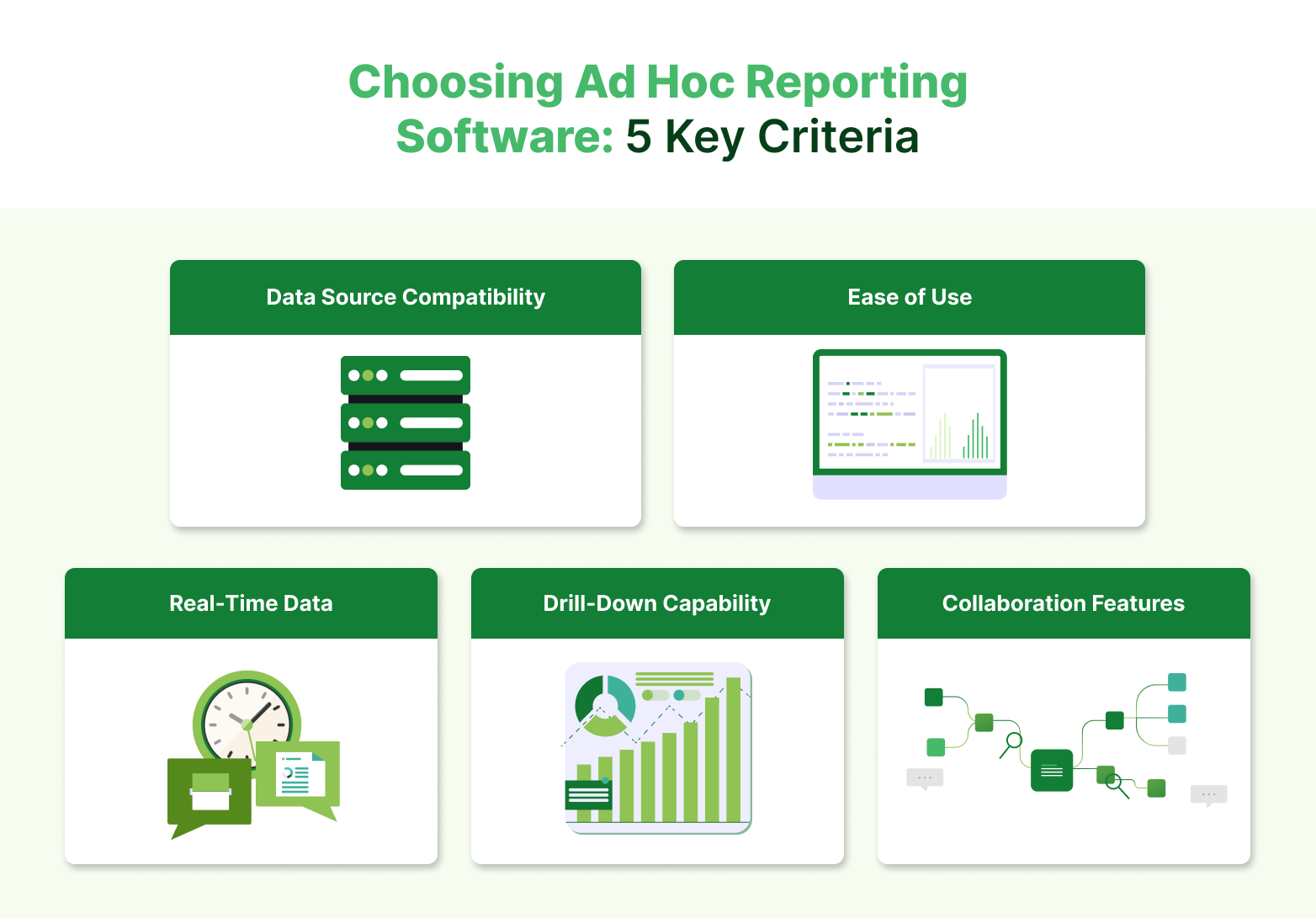
Selecting the right ad hoc reporting tool can make all the difference in improving financial analysis, decision-making, and team collaboration. With so many options available, it’s essential to consider the following key criteria to ensure you’re selecting the best solution for your team.
The first and most crucial factor is whether the tool can easily connect to your existing data sources, such as your ERP software, CRM tool, spreadsheets, and other systems. A reporting tool that integrates seamlessly with all your data platforms ensures that you can access up-to-date and accurate information without manual data imports.
Look for tools that support wide integration capabilities, enabling smooth data consolidation across systems like NetSuite, SAP, Microsoft Dynamics, and other major platforms, ensuring that all your financial data is in one unified space.
Ad hoc reporting should be accessible to non-technical users, meaning the interface should be intuitive and easy to navigate. The ability to quickly create reports without the need for specialized technical skills is a must.
Look for tools that feature a drag-and-drop interface or pre-built templates, allowing users to customize reports with minimal effort. Solutions with Excel-like familiarity ensure that business teams can generate complex reports without needing advanced IT knowledge, enabling faster, more efficient decision-making.
Ad hoc reporting should provide real-time insights so your team can act on the most up-to-date information. Some tools require manual data refreshes, leading to delays in accessing relevant information.
To ensure that your team always works with the latest data, choose a tool that automatically updates and reflects any changes in real-time. Leading solutions offer automatic data updates, ensuring that teams can access the latest insights without waiting for manual processes to catch up.
A powerful ad hoc reporting tool should enable users to drill down from high-level summaries to more granular data. This allows teams to uncover deeper insights and track down specific transactions or trends without jumping between different reports.
Look for tools that allow for seamless navigation from summary reports to transaction-level data. Limelight, for example, provides excellent drill-down capabilities, letting users dive deep into their data, helping teams uncover valuable insights that inform strategic decisions.
Since ad hoc reporting often involves multiple stakeholders, collaboration features are essential. Ensure that your chosen tool allows for easy sharing of reports, adding comments, and collaborating in real-time. This ensures that teams can work together efficiently, discussing findings and making data-driven business decisions.
Modern platforms enable seamless collaboration, allowing teams to share reports, annotate findings, and communicate directly within the platform, fostering alignment and transparency.
|
Tool |
Pros |
Cons |
|
Spreadsheets (Excel, Google Sheets) |
Free and familiar to users |
Manual, error-prone, not real-time, time-consuming to update reports |
|
Business intelligence tools (Power BI, Tableau) |
Powerful data visualization and analysis capabilities |
Require technical expertise, overkill for adhoc reporting needs |
|
Purpose-built financial analysis & planning (FP&A) software (e.g., Limelight) |
Finance-friendly, purpose-built for ad hoc analysis, real-time insights, seamless data integration, easy to use |
Typically involves a subscription cost, but the benefits far outweigh the limitations for finance teams |
Limelight offers ad hoc reporting capabilities
Picture this: it’s Friday afternoon, and your CFO needs a quick report, something like revenue by product line, margins by region, or a variance breakdown for Monday’s board meeting. In the old spreadsheet days, you’d be spending hours hunting down data, tweaking formulas, and double-checking versions. It’s the kind of chaos that makes you wish for a better way.
The ad hoc nightmare (sound familiar?):
How Limelight solves each one:
Limelight pulls real-time data directly from systems like Sage Intacct and your ERP. No more manual exports or copy-paste errors. When your CFO needs variance analysis, the data is already consolidated and ready for you to slice and dice however needed.
Alyssa Morrison, Executive Analyst at Triple Crown Sports, said they went from spending a whole day building reports to creating them in just 15 minutes. That's over 90% time savings per request.
Cresa customer testimonial for Limelight’s capabilities
For instance, GSW Manufacturing used Limelight’s version control to make sure every report was traceable and defensible, giving them confidence in their analysis.
Ready to turn ad hoc chaos into strategic clarity? See how Limelight enables real-time ad hoc analysis for your teams. Request a demo.
An example of ad hoc analysis could be a finance team tasked with determining the impact of a sudden market change on monthly sales projections. Using ad hoc analysis, the team would generate a custom report that evaluates sales by region, product line, and customer segment in real-time, providing the CFO with insights to adjust forecasts and make informed decisions immediately.
The term "ad hoc" comes from Latin, meaning "to this" or "as needed." In business, it refers to actions or reports that are created to address specific, one-time questions or needs, without being part of a regular reporting cycle. Ad hoc solutions are typically flexible and customizable, designed to provide targeted insights for immediate decision-making.
In accounting, adhoc reporting refers to the ability to create custom financial reports on demand, rather than relying on standard, scheduled reports. This type of reporting allows accountants to quickly respond to specific queries, such as analyzing revenue fluctuations, identifying unexpected expenses, or evaluating budget variances, based on the most up-to-date data available.
Yes, Excel can be used for adhoc reporting, but it comes with limitations. While Excel allows users to manipulate data and create custom reports, it requires manual data consolidation and is prone to errors. Additionally, it lacks real-time updates and version control, making it less efficient for ongoing, high-volume reporting. Analysis tools like Limelight offer more streamlined, real-time, and error-free adhoc reporting with automated data integration.
Ad hoc analysis differs from regular reporting in that it is dynamic and on-demand, designed to answer specific questions or address immediate business needs. Regular reports, on the other hand, are pre-scheduled, often static, and designed for routine tracking of KPIs or financial metrics. While regular reports follow a fixed structure, ad hoc analysis is flexible, offering the ability to drill down into data and customize reports as necessary.
When selecting ad hoc reporting software, look for the following features:
Subscribe to our newsletter