
%20(1).svg)
How to Prepare for a Nonprofit Financial Statement Audit
By Laks Satchi |
Last Updated: July 31, 2026
To prepare for a nonprofit financial statement audit, confirm which assurance engagement you actually need, engage the auditor before fiscal year end, assign every prepared-by-client request to a named owner, complete all account reconciliations, document grants and donor restrictions, and resolve prior-year findings. Organizations subject to a single audit must also prepare the Schedule of Expenditures of Federal Awards and federal compliance records.
Your engagement letter is signed, fieldwork starts in eleven weeks, and the prepared-by-client list arrived last Thursday.
This guide is written for finance leaders at mid-sized and large US nonprofits, particularly nonprofit finance teams managing multiple funds, grants, entities, or reporting dimensions across systems such as Sage Intacct, NetSuite, Blackbaud Financial Edge NXT, and Microsoft Dynamics. Complexity is what drives audit effort at these organizations, and one variable drives most of it: whether financial information can be reproduced, reconciled, and explained on demand. Before any of that matters, confirm which engagement you are actually buying.
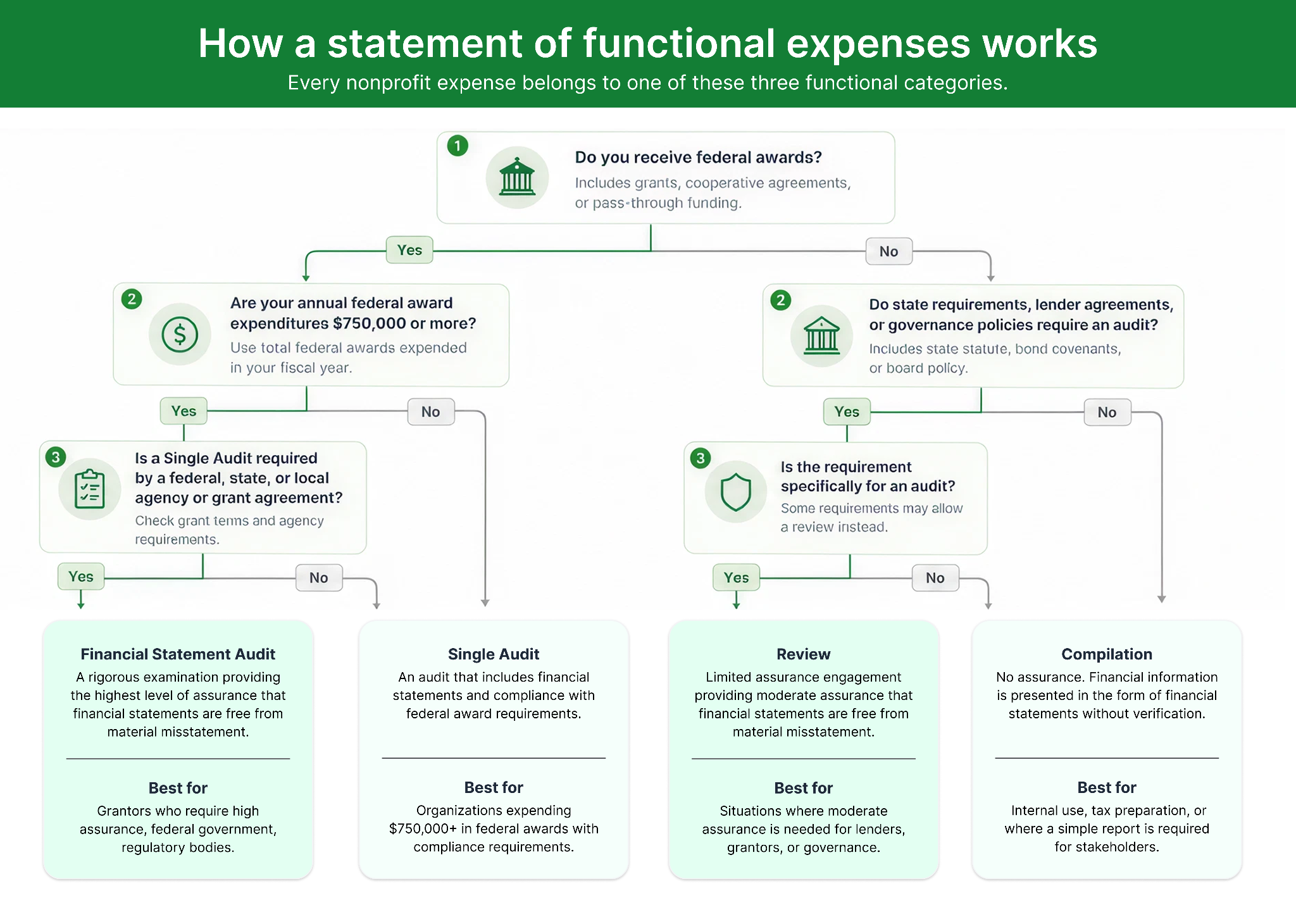
Start by separating two things that often get merged. A financial statement audit examines whether your organization’s financial statements are fairly presented under GAAP. Organizations that meet the federal expenditure threshold may also need a single audit, which incorporates the financial statement audit and adds testing of federal award programs and compliance requirements. They are related, not interchangeable. If your organization has no federal awards, nothing in this guide about the SEFA, major program determination, or Clearinghouse filing applies to you. For a refresher on the statements themselves, see our breakdown of the four required financial statements.
The second question is whether a full audit is required at all. Four assurance engagements exist at materially different price points, and organizations sometimes commission the most expensive one because a funder used the word "audited" without specifying what it meant.
|
Engagement |
Assurance |
What the CPA does |
Typically satisfies |
Relative cost |
|---|---|---|---|---|
|
Audit |
Reasonable |
Obtains an understanding of relevant internal controls, tests selected transactions and balances, may obtain third-party confirmations, and issues an opinion on the financial statements |
Federal single audit requirements, many state registration thresholds, most lender covenants |
Baseline |
|
Review |
Limited |
Analytical procedures and inquiry, without the testing and confirmation work an audit requires |
Lower state thresholds and many smaller funder conditions |
Materially less than an audit |
|
Compilation |
None |
Presents management data in financial statement format |
Rarely a statutory trigger. Internal or lender comfort |
Well below a review |
|
Preparation |
None, no report |
Prepares statements from management records |
Internal use |
Lowest |
|
A note on internal controls In a financial statement audit the auditor obtains an understanding of relevant internal controls in order to design audit procedures. That is not the same as testing controls for operating effectiveness, and the auditor does not ordinarily issue an opinion on internal controls. Control testing does occur in some engagements, including single audits, but it is not what defines a financial statement audit. |
Read the funder agreement and the applicable statute in the exact words they use before you commission anything. A review sometimes clears the bar, and that check has saved organizations a five-figure line item. Once you know which engagement applies, the next question is what obliges you to commission it.
Four categories account for most nonprofit audit requirements. They are common categories rather than a complete legal taxonomy, and they operate independently, so clearing one does not clear the others.
|
Category |
The test |
Authority |
If missed |
|---|---|---|---|
|
Federal awards |
Generally $1 million or more in federal awards expended in the fiscal year for awards issued on or after October 1, 2024. Earlier awards may carry the prior $750,000 threshold |
2 CFR 200.501 |
Noncompliance and funding risk. Findings are reported through the Federal Audit Clearinghouse |
|
State registration |
Gross revenue or contributions above a state-set threshold, usually tied to charitable solicitation registration |
State charitable solicitation statutes |
Registration lapse and loss of the right to solicit in that state |
|
Funder or lender |
Written into the grant agreement, bond documents, or debt covenant |
Contract |
Breach of covenant or grant condition |
|
Governance |
Bylaws or board policy require an annual audit |
Your own governing documents |
Governance failure and board exposure |
Other requirements sit outside these four and are easy to miss. Local government contracts, parent or affiliated entity policies, bond and financing agreements, licensing arrangements, and individual program rules can each carry their own audit or reporting obligation. Check every funding stream, not just the largest.
OMB’s 2024 revision to the Uniform Guidance raised the single audit threshold from $750,000 to $1 million, codified at 2 CFR 200.501. The revised threshold applies to federal awards issued on or after October 1, 2024. Because many organizations expend funds from awards issued across multiple years, the transition cannot always be determined from fiscal year end alone. Three details cause most of the confusion.
Falling below the threshold removes the federal single audit requirement for that year and nothing else. Procurement standards, subrecipient monitoring, and cost principles still apply, and a state, funder, or governance trigger may still require an audit.
Most states require charitable nonprofits to register before soliciting, and many attach an audit obligation above a revenue or contribution threshold. Those thresholds differ widely by jurisdiction and change through legislation, and secondary sources frequently contradict each other on the specific figures.
Grant agreements, bond documents, and debt covenants can require an audit independently of any statute, and so can bylaws, which are rarely consulted at year end. Pull the largest grant agreements, the financing documents, and the bylaws before drawing any conclusion about your obligation.
|
Before budgeting for the audit Run all of these tests in the same week each year and record the conclusion in the board packet. A requirement discovered in month ten costs more than the audit itself, because you will be buying scarce audit capacity at short notice. |
With the requirement confirmed and the engagement scoped, the remaining variable is time, and it is the one finance teams most often underestimate.
Preparation time varies substantially with close maturity, audit type, entity count, federal program volume, and auditor availability. The table below is a recommended planning framework rather than a universal standard: a practical audit preparation calendar can span roughly twenty weeks around fiscal year end (FYE). Adjust the spans to your own close cycle.
|
Timing |
Owner |
Milestone |
What tends to break if it slips |
|---|---|---|---|
|
FYE minus 16 to 20 weeks |
CFO |
Auditor selected or re-engaged. Engagement letter signed with fee and timeline agreed. |
Firms book out. Late selection pushes fieldwork and the board presentation. |
|
FYE minus 12 to 16 weeks |
Controller |
Planning meeting held. PBC list received and assigned line by line to named owners with dates. |
An unassigned PBC list quietly becomes one person’s problem in week two. |
|
FYE minus 8 to 12 weeks |
Controller |
Interim procedures, where the engagement includes them. |
Issues surface at year end instead, with less time to address them. |
|
FYE minus 4 to 8 weeks |
Accounting |
Known discrepancies resolved and documented. Restricted fund balances reviewed against gift instruments. |
Unresolved or undocumented items at fieldwork can lead to additional testing, proposed adjustments, or reported control deficiencies. |
|
FYE minus 0 to 4 weeks |
Grants |
Draft SEFA built from award-level records. Subrecipient monitoring files assembled. |
A SEFA started during fieldwork can expand scope and surface questioned costs. |
|
FYE plus 2 to 4 weeks |
Accounting |
Hard close. Accounts reconciled. Trial balance locked. |
Downstream schedules get built on figures that keep moving. |
|
FYE plus 4 to 6 weeks |
Controller |
PBC package delivered complete. Schedules tie to the final trial balance. |
Partial delivery interrupts the auditor’s workflow and consumes budgeted hours. |
|
FYE plus 6 to 10 weeks |
Auditor |
Fieldwork. Open-item list managed daily rather than weekly. |
Slow responses extend fieldwork, and extended fieldwork is billed. |
|
FYE plus 10 to 14 weeks |
CFO |
Draft statements and management letter reviewed. Responses drafted with named owners. |
The board sees comments management has not yet answered. |
|
FYE plus 14 to 16 weeks |
Board |
Audit committee presentation. Report issued. Reporting package submitted where a single audit applies. |
Late federal submission is itself a compliance finding. |
If a single audit applies, note the filing deadline precisely. Under 2 CFR 200.512, the audit, the data collection form, and the reporting package must be submitted to the Federal Audit Clearinghouse within 30 calendar days after the auditee receives the auditor’s report, or nine months after the end of the audit period, whichever is earlier. For a December 31 year end, the outside date is September 30. For a June 30 year end, it is March 31. The milestone that generates the most work is the PBC package, so it is worth breaking down what your auditor expects to receive.
The prepared-by-client list names documents. It rarely specifies the format the auditor expects, which is where delay originates. A bank reconciliation delivered as a screenshot is not the same deliverable as a reconciliation that ties to the locked trial balance with supporting detail. Group the list into five buckets, assign each an owner, and note that where fund accounting is handled through year-end journal entries rather than transaction-level coding, every schedule has to be rebuilt by hand.
Four of those five buckets stand or fall on reconciliations that agree to the trial balance, which is where preparation either holds together or comes apart.
This is the checklist that does the most to keep last year’s comment off this year’s management letter. Work through each area, confirm it agrees to the locked trial balance, and retain the supporting detail in the same place you will deliver it from.
|
Area |
What to reconcile |
Where it commonly goes wrong |
|---|---|---|
|
Cash |
All operating, payroll, and restricted accounts to bank statements, with outstanding items aged |
Stale outstanding checks carried forward year over year |
|
Investments |
Statements to the ledger, including realized and unrealized activity and fee treatment |
Fair value adjustments posted annually rather than at each reporting date |
|
Receivables and pledges |
Aging to the ledger, with allowance and present-value discount calculations documented |
Multi-year pledges recorded at face value with no discount support |
|
Payables and accruals |
Aging to the ledger, plus a search for unrecorded liabilities after year end |
Invoices received after close that belong in the audited period |
|
Fixed assets |
Rollforward with additions, disposals, and depreciation tying to the ledger |
Capitalization policy applied inconsistently across departments |
|
Net assets with donor restrictions |
Balances by restriction to gift instruments, with releases supported |
Releases posted in one year-end entry rather than as conditions are met |
|
Contributions and grant revenue |
Revenue by funding source to award documents, with the contribution or exchange conclusion documented |
Conditional grants recognized before the barrier is overcome |
|
Leases |
Lease inventory to right-of-use assets and liabilities under ASC 842 |
Embedded leases inside service contracts never inventoried |
|
Payroll and benefits |
Payroll registers to the ledger, with accrued leave and benefit liabilities supported |
Reimbursements run through payroll, which muddies the expense trail |
|
SEFA, where applicable |
Federal expenditures by Assistance Listing number and award year to the ledger and to award documents |
Pass-through federal funds treated as state revenue |
Two of these areas generate a disproportionate share of comments, and both depend on how transactions are coded at entry rather than reconstructed at year end. Our guides to functional expense allocation and nonprofit accounting standards go deeper on both. These reconciliations exist because of what tends to go wrong without them.
Six issues appear repeatedly in nonprofit audit findings and management letters. Each maps to a specific control that reduces the chance of recurrence, which is why the third column matters more than the first. A repeat comment is generally read as a control weakness regardless of the dollar amount attached.
|
Issue |
Why it recurs |
What reduces the risk |
|---|---|---|
|
Functional expense allocation unsupported |
The methodology sits with one person and the driver data is not retained by period |
A written allocation methodology reviewed annually, with square footage, FTE, or time-study data saved each period |
|
Net asset release timing |
Releases posted in bulk at year end rather than as donor conditions are satisfied |
Release restrictions monthly against the gift instrument, with a schedule maintained per restricted gift |
|
SEFA incomplete or built late |
Federal awards tracked by department in the ledger rather than by Assistance Listing number and award year |
Tag federal awards at transaction level and build the SEFA through the year |
|
Contribution and exchange revenue misclassified |
Agreements containing barriers and rights of return recorded as unconditional contributions |
Assess each material agreement under ASC 958-605 and document the conclusion in a memo |
|
In-kind contributions undervalued or undisclosed |
Donated goods and services captured informally and valued at year end |
An intake process that records the valuation basis at the point of receipt |
|
Leases missing from the balance sheet |
ASC 842 adoption incomplete for embedded leases inside service contracts |
An annual lease inventory that examines service agreements for embedded arrangements |
These issues are not only a fee and timeline problem. Where a single audit applies, they also become part of the public record.
Yes, where a single audit applies. Reporting packages submitted to the Federal Audit Clearinghouse are public records, and that data is republished. ProPublica’s Nonprofit Explorer has carried audit documents alongside Form 990 data since 2017, with filters for organizations where auditors flagged serious financial issues or a significant theft was reported.
That is worth carrying into the boardroom. If board reporting frames the audit as a finance department chore, the audit committee will keep funding it as one. The practical response is to work on the two things management controls, the fee drivers and the close itself.
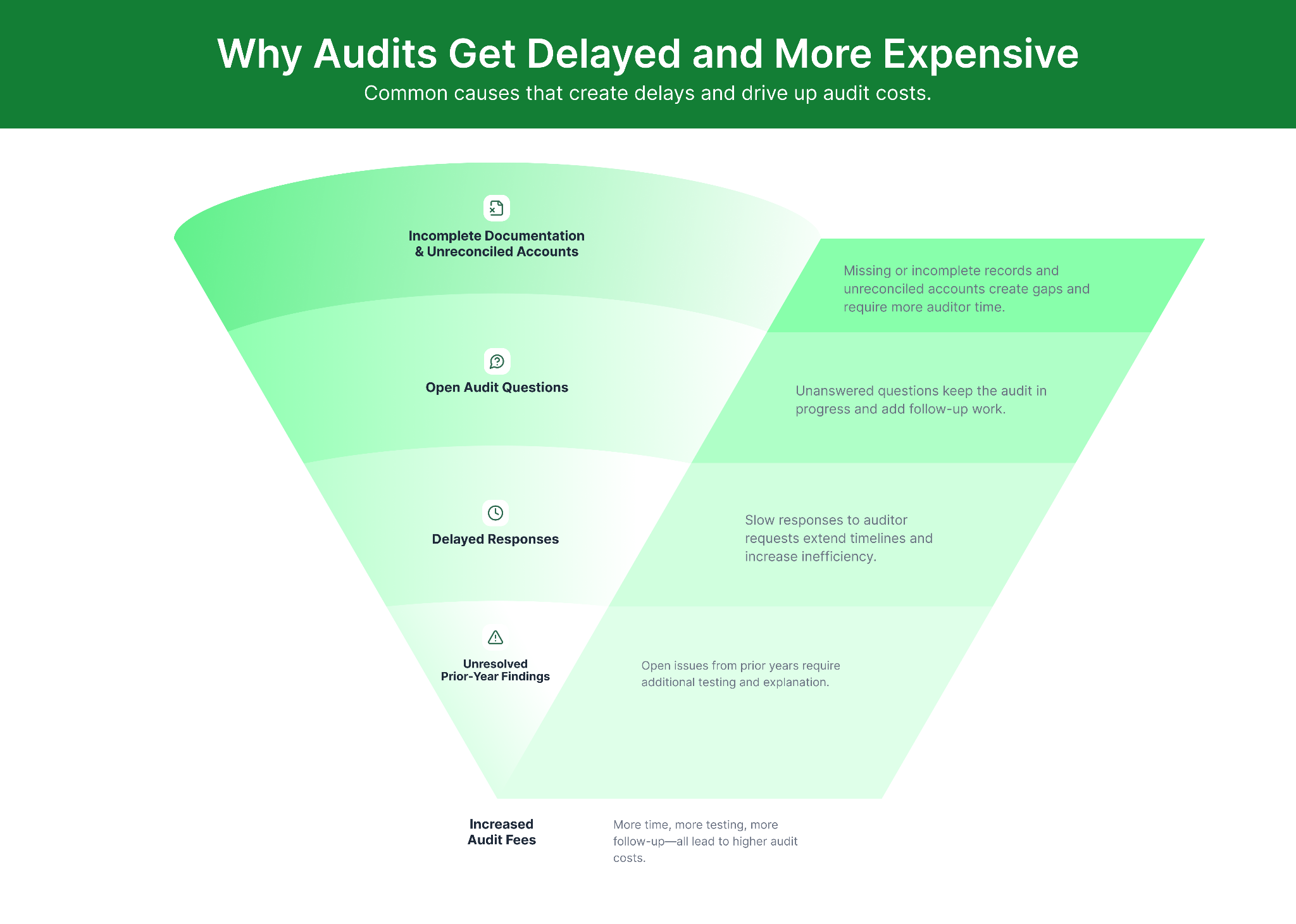
Published fee ranges vary so widely across sources that quoting a single band would mislead more than it helps. Size, entity count, scope, federal programs, locations, transaction volume, accounting complexity, prior findings, deadlines, and the local auditor market all move the number. One of the largest controllable drivers of audit effort is how easily the organization can reconstruct and support its balances. Ask three firms for a scoped quote against your actual structure, then work the levers below.
Auditor capacity is worth planning around as a scheduling constraint. The US Bureau of Labor Statistics projects about 124,200 openings for accountants and auditors each year on average over the 2024 to 2034 decade, and the AICPA has described a constrained talent pipeline, though its 2025 Trends Report also indicates that most public accounting firms that hired in 2024 expected to hold or increase hiring. The practical takeaway is not that the profession is collapsing. It is that good firms book early, so selecting your auditor several months before year end is how you secure a workable slot. Those levers reduce the cost of the audit you are about to have. Changing the close changes the cost of every audit after it.
Teams that treat audit preparation as an annual six-week project tend to pay for it twice, in fees and in staff time. Teams whose monthly close already produces reconciled, dimensioned data start from a stronger position. A good close will not eliminate audit preparation, because confirmations, minutes, subsequent-events work, and auditor-selected samples still have to be handled. It does remove the reconstruction work that consumes most of the calendar.
Most organizations can begin these improvements without adding headcount, although teams with material capacity or expertise gaps may still need additional support. What it does require is a financial reporting layer that holds dimensional data continuously instead of a folder of exports rebuilt each year. That is the practical case for putting a planning and reporting layer above the ledger.
Limelight is FP&A software that sits above the ledger rather than replacing it, pulling actuals from Sage Intacct, NetSuite, QuickBooks, Microsoft Dynamics, or Blackbaud Financial Edge NXT. Four mechanisms are relevant to audit preparation, stated with their boundaries.
On evidence, Communication Service for the Deaf cut budget cycle times in half after moving off spreadsheets. That case study concerns budgeting rather than audit preparation, so it does not prove an audit outcome. What it indicates is that the organization was able to replace fragmented spreadsheet work with a faster, more controlled reporting process. Review-platform evidence points the same direction, with the caveat that several of the underlying reviews are several years old.
|
Benefit |
Evidence |
Relevance to audit prep |
Limitation |
|---|---|---|---|
|
Faster close |
A Manager of FP&A reported closing time down 30 percent after implementation (G2, November 2020) |
A shorter hard close moves the FYE plus 2 to 4 week milestone forward |
Single reviewer, dated 2020, and not measured against an audit cycle |
|
Fewer competing spreadsheets |
A senior accountant reported the implementation team translated existing Excel files into working budget templates (Capterra, March 2024) |
Schedules stop living in personal workbooks, which supports reconstructability |
Describes implementation, not audit outcomes |
|
ERP-connected reporting |
A reviewer reported integration with their Sage Intacct instance and more controlled consolidation than the prior manual approach (G2, September 2020) |
Actuals pulled from the ledger reduce the stale-export problem |
Dated 2020. Integration scope varies by ERP and configuration |
|
Implementation cost |
Reviewers describe a real learning curve before the report builder becomes flexible (Capterra, July 2023) and limited help documentation (G2, November 2020) |
Works against you in year one |
Budget implementation time before the audit cycle you are trying to improve |
G2 Rating: 4.7/5
Capterra: 4.5/5.
A Gartner Peer Insights profile is also available.
|
Limitation to keep in mind An FP&A platform does not repair a general ledger that is coded incorrectly at source. If your chart of accounts carries no fund or functional expense dimension, adding a planning layer gives you faster access to the same underlying data. Fix the coding first, then add the reporting layer. |
Tooling aside, the preparation work itself compresses into a short list you can run each year.
Use this as the short form. Each line maps to a section above.
Working formats for several of these schedules, along with budgeting and forecasting models, are available in the Limelight template library, and our guide to nonprofit budgeting covers the planning side of the same data. Work the list in order and the audit becomes a review of work already done rather than a deadline that consumes a quarter.
The audit is scored largely on data your organization already owns. Your auditor is not the main variable, the fee schedule is not the main variable, and the calendar only becomes one if you ignore it until the books are closed. What matters most is whether a given schedule can be produced on request or has to be rebuilt from exports and recollection.
|
Your next step At the next monthly close, identify one schedule that is still reconstructed manually. Assign an owner, document its source data, and make it reproducible before year end. Repeat with a second schedule the following month. |
|
See how nonprofit finance teams shorten audit preparation by making schedules reproducible from the close. Book a Limelight demo |
An independent CPA’s examination of your financial statements and supporting records. The auditor obtains an understanding of relevant internal controls, tests selected balances and transactions, and issues an opinion on whether the statements are fairly presented under GAAP.
A financial statement audit addresses whether the statements are fairly presented under GAAP. A single audit incorporates that work and adds testing of federal award programs and compliance requirements, plus a Schedule of Expenditures of Federal Awards and a federal filing.
Four common categories apply: federal award expenditure, state charitable registration thresholds, funder or lender agreements, and your own bylaws. Local contracts, bond documents, and program rules can also require one. Any single requirement creates the obligation.
For federal awards issued on or after October 1, 2024, the threshold is generally $1 million in federal awards expended during the fiscal year, up from $750,000. Awards issued earlier may remain subject to the prior threshold.
Under 2 CFR 200.512, the earlier of 30 calendar days after the auditee receives the auditor’s report or nine months after the end of the audit period. For a December 31 year end, the outside date is September 30.
A practical planning calendar spans roughly twenty weeks around fiscal year end, though actual time varies with close maturity, entity count, and federal program volume. Auditor selection should begin several months before year end rather than after it.
The prepared-by-client list is the document request your auditor issues after engagement. It covers governance records, trial balance support, reconciliations, revenue documentation, and federal award files. Assign every line to a named owner with a due date.
A review provides limited assurance through analytical procedures and inquiry, without the testing and confirmation work an audit requires, and costs materially less. Some state thresholds and funder conditions accept a review, so confirm the requirement first.
Subscribe to our newsletter