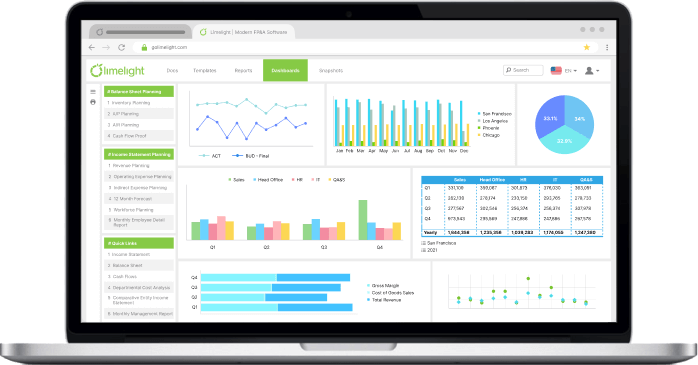

%20(1).svg)
AI Financial Forecasting: How It Works, Benefits & Best Practices for 2026
By Laks Satchi |
Last Updated: September 15, 2026
For many finance teams, financial forecasting still means pulling data from multiple spreadsheets, reconciling numbers across departments, and spending weeks building models that may already be outdated by the time they reach the board. When market conditions change or new revenue data arrives, updating those models often requires another round of manual revisions. Running real-time scenarios or testing alternative assumptions becomes difficult when the underlying process relies on static spreadsheets and disconnected systems.
This challenge is driving interest in AI financial forecasting, which uses machine learning and data analysis to help finance teams generate forecasts faster and respond to changing business conditions.
According to a June 2024 Gartner survey of 121 finance leaders, 58% of finance functions were using AI in 2024, up from 37% the year prior, a jump of 21 percentage points in just one year. The shift reflects a broader move toward more dynamic financial planning processes.
AI financial forecasting analyzes historical financial data alongside operational and external inputs to produce forecasts that update as new information becomes available. Unlike traditional models that rely heavily on manual updates, AI tools can identify patterns in large datasets, detect anomalies, and support scenario modeling across multiple business drivers.
This guide explains how AI is used in financial forecasting, the benefits it offers finance teams, and the best practices for adopting it successfully. It also explores real-world applications across industries, including SaaS, manufacturing, retail, and higher education, and how purpose-built FP&A platforms make AI forecasting accessible to finance teams without requiring data science expertise.
AI financial forecasting refers to the use of machine learning (ML), natural language processing (NLP), and predictive analytics to estimate future financial performance. These technologies analyze large volumes of historical and real-time data to generate projections for revenue, expenses, cash flow, and other financial metrics.
Traditional financial forecasting usually relies on manual models built in spreadsheets. Analysts consolidate data from multiple sources, apply assumptions, and update forecasts periodically during budgeting or quarterly planning cycles. These models are often static and heavily dependent on historical data, which makes them harder to adjust quickly when business conditions change.
AI financial forecasting approaches the process differently. Instead of relying only on manual updates, AI models analyze patterns across financial and operational data and automatically adjust forecasts when new information becomes available. This enables more continuous and responsive forecasting compared to traditional methods.
While implementations vary, most AI forecasting systems generally follow three core stages.
AI forecasting platforms first gather data from multiple internal and external sources. Structured financial data such as transaction records, budgets, and ERP data are combined with operational data like sales pipelines or production metrics. Many systems also incorporate external signals such as macroeconomic indicators, industry benchmarks, or market reports.
Machine learning models then analyze relationships within the data. These algorithms can detect correlations that may be difficult for analysts to identify manually, such as connections between market conditions, operational drivers, and financial performance. By processing large datasets, AI systems can identify subtle trends that influence revenue or cost patterns.
Unlike static forecasting models, AI systems update forecasts as new data becomes available. This allows finance teams to run rolling forecasts, test different scenarios, and detect unusual financial patterns earlier. Many AI systems learn from updated inputs, improving forecasting reliability over time.
Today, these capabilities are increasingly built into financial planning and analysis platforms rather than requiring separate data science tools. Platforms such as Limelight integrate AI forecasting features directly into planning workflows, allowing finance teams to apply predictive analytics without specialized machine learning expertise.
Finance teams rarely struggle with forecasting because they lack formulas. The real challenge is keeping forecasts current while the business keeps changing. Deals close earlier than expected, hiring plans shift, costs move, and market conditions rarely wait for the next planning cycle.
AI adoption in financial forecasting helps solve this problem by continuously analyzing new data and updating projections automatically. Instead of rebuilding models every quarter, finance teams can rely on systems that adjust forecasts as the business evolves.
Below are five common ways AI is being applied in financial forecasting today.
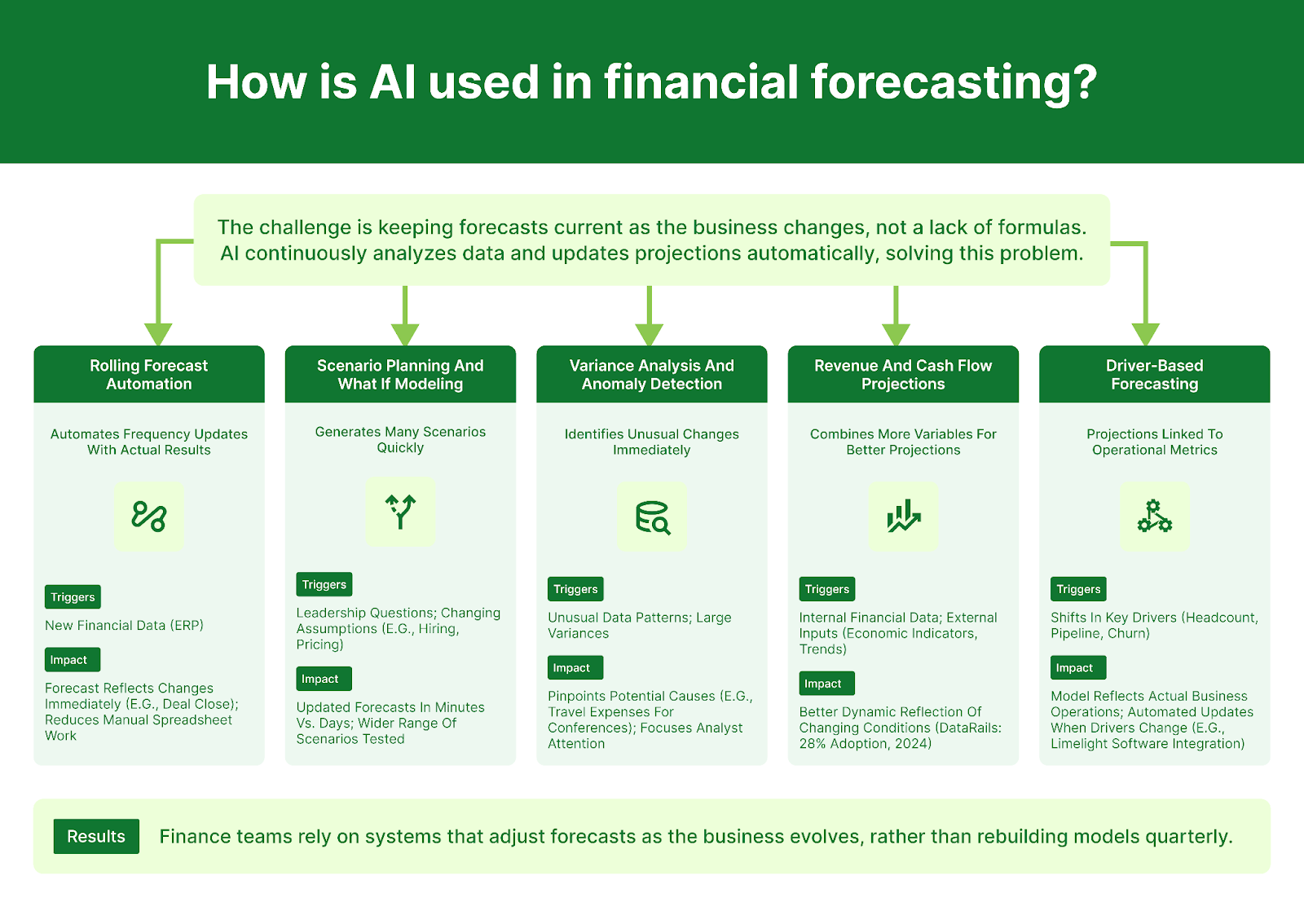
Five ways in which AI is being applied in financial forecasting
Rolling forecasts require frequent updates as actual financial results come in. In many organizations, this still means exporting data from ERP systems, updating spreadsheets manually, and recalculating projections line by line.
AI simplifies this process. When new financial data appears in connected systems, the forecasting model updates automatically. If a major deal closes ahead of schedule or operating costs increase unexpectedly, the forecast reflects the change immediately.
For finance teams, this keeps forecasts current without waiting for the next planning cycle and reduces the manual work required to maintain planning models.
Scenario planning is critical for strategic decisions, but building multiple forecast versions manually can be time-consuming. As a result, many teams limit themselves to just a few scenarios.
AI-powered forecasting platforms can generate many more scenarios quickly. Finance teams can test different assumptions at once, such as changes in hiring plans, pricing strategies, or sales growth projections.
When leadership asks questions like “What happens if we reduce hiring by 10%?” or “How would slower sales impact cash flow?”AI tools can generate updated forecasts in minutes rather than days.
Variance analysis often requires finance teams to review reports line by line to understand why results differ from the plan. In large organizations, this investigation can take days.
AI speeds up this process by identifying unusual changes as soon as new data appears. Instead of simply showing that expenses increased, the system can analyze patterns and explain potential causes.
For example, it might highlight that travel expenses exceeded the forecast due to additional industry conferences during a specific quarter. This allows analysts to focus on understanding the business impact rather than searching for the source of the variance.
Forecasting revenue and cash flow typically requires evaluating multiple inputs, including sales performance, pricing changes, customer behavior, and broader economic trends. Traditional models often rely on a limited set of these variables.
AI forecasting models can analyze many more signals simultaneously. They combine internal financial data with external inputs such as economic indicators, industry trends, and behavioral data to produce projections that better reflect changing conditions.
According to recent research, 28% of finance teams were already using AI-driven advanced analytics within their planning processes as of 2025, highlighting the growing adoption of AI-driven forecasting approaches.
Many traditional financial models rely heavily on historical averages. While useful, those models can struggle to adjust when key business drivers shift.
Driver-based forecasting links financial outcomes to operational metrics such as headcount levels, deal pipeline activity, churn rates, or production volumes.
AI strengthens this approach by continuously monitoring these drivers and updating forecasts automatically when they change. The result is a planning model that stays connected to how the business actually operates.
Modern FP&A platforms integrate these capabilities directly into forecasting workflows, allowing finance teams to apply AI-driven insights without building complex models from scratch.
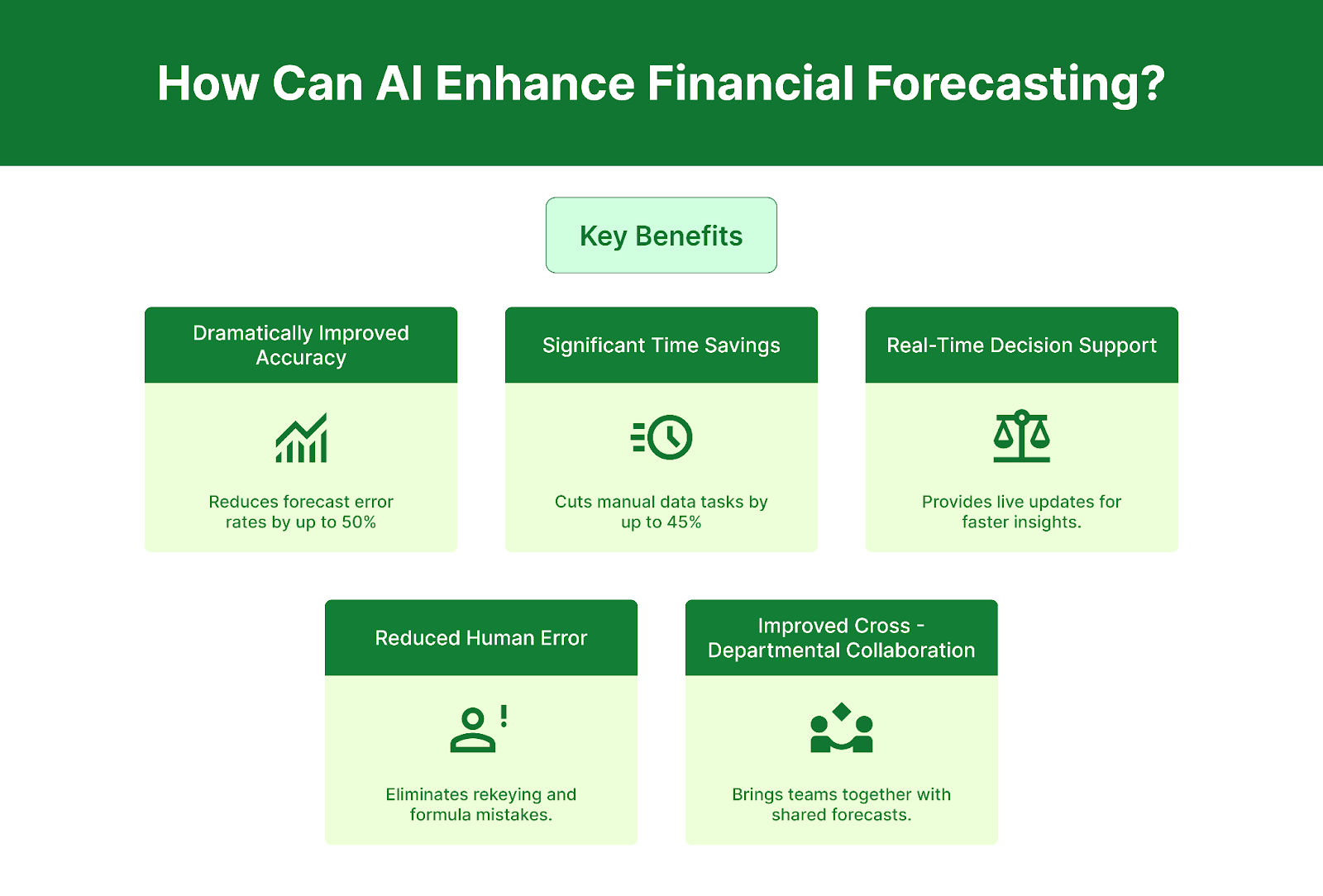
5 key benefits of AI in financial planning
AI financial forecasting doesn’t just make existing workflows faster, it expands what finance teams can actually do. From improving forecast accuracy to supporting faster decisions, finance leaders report several tangible benefits after adopting AI-powered planning tools.
One of the most measurable advantages of AI forecasting is a reduction in forecast error. Studies from multinational companies show that AI-based forecasting models can cut forecast error rates by as much as 50% compared with traditional forecasting approaches.
This improvement comes from how AI models evaluate data. Instead of relying mainly on historical averages, they analyze a wider range of variables, including operational drivers and external signals. By factoring in more context, forecasts are better aligned with current business conditions rather than assumptions made months earlier.
Manual data collection and preparation still consume a large portion of finance teams’ time. The 2024 FP&A Trends Survey found that finance professionals spend up to 45% of their time on manual data preparation tasks.
AI addresses this directly. Instead of spending hours reconciling spreadsheets, analysts can focus on higher-value work such as interpreting results, identifying trends, and supporting business decisions.
Traditional static budgets often lock organizations into assumptions that may already be outdated by the time leadership acts on them.
AI forecasting works differently. As new data flows in, from sales pipelines, ERP systems, and external market indicators, projections update automatically. Finance leaders gain a real-time view of performance and future expectations.
This makes it easier to respond to changes as they happen rather than adjusting plans only after results have already drifted from expectations.
Manual forecasting processes introduce many opportunities for mistakes. A broken spreadsheet formula, a mislinked cell, or conflicting file versions can quietly distort projections before they reach leadership.
AI reduces these risks by recalculating models automatically whenever new data enters connected systems. Because calculations update centrally, there are no formulas to audit across multiple spreadsheets and no duplicate versions of files circulating between teams.
The result is a forecasting process that is more consistent, reliable, and easier for finance leaders to trust.
Financial forecasting has traditionally been handled primarily within finance, with other departments submitting inputs and waiting for reports.
Cloud-based AI forecasting platforms change that dynamic. Teams across finance, operations, sales, and HR can access live projections and contribute to planning in real-time.
Instead of relying on periodic reporting cycles, business leaders can review current forecasts whenever they need them. This helps reduce approval bottlenecks, keeps assumptions aligned across departments, and allows organizations to respond more quickly when conditions change.
Financial forecasting challenges look very different from one industry to another. The variables that drive revenue in a SaaS business are completely different from those shaping a university budget or a manufacturing cost structure.
This is where AI forecasting tools become particularly valuable. Instead of relying on rigid models, they adapt to the specific drivers, data sources, and planning constraints of each sector.
Now we dive into how AI financial forecasting is being applied across four industries where modern, cloud-based FP&A solutions work.
Higher education finance teams operate in a forecasting environment unlike most other sectors. Enrollment cycles can span multiple years, tuition revenue fluctuates with demographic trends and competitive pressures, and state funding often changes alongside political and economic cycles. Endowment performance adds another layer of variability that static spreadsheets struggle to capture.
There are also strict reporting requirements. Grant-restricted funds must be tracked separately from operating budgets, with spending tied to specific compliance timelines.
AI forecasting helps CFOs model enrollment scenarios under different assumptions, such as demographic shifts, tuition pricing changes, or financial aid adjustments. These models then translate those scenarios into projected tuition revenue. At the same time, restricted fund compliance can be monitored automatically as spending data flows into the system, reducing the manual oversight required during reporting cycles.
Rolling forecasts that incorporate grant pipelines and endowment performance provide academic leadership with timely financial insights. This allows institutions to make more informed decisions about program investments, capital projects, and long-term infrastructure planning.
SaaS revenue is rarely a single straightforward number. It is shaped by a set of interconnected metrics, including monthly recurring revenue (MRR), churn rate, net revenue retention, and expansion revenue. When one of these variables changes, the entire revenue forecast shifts. Tying those metrics together is the job of a saas revenue forecast model.
Traditional forecasting models often struggle to capture these interdependencies in real-time, which means projections can quickly fall behind the business’s actual performance.
AI addresses this by analyzing signals such as usage data, billing history, and customer support interactions to predict churn at the individual account level before it appears in financial results. Those churn predictions feed directly into revenue forecasts, giving finance teams a clearer picture of future MRR.
This also makes it easier to evaluate pricing changes, model expansion revenue scenarios, and understand how customer behavior may impact growth.
Manufacturing finance teams operate in an environment shaped by supply chain volatility, commodity price fluctuations, and production capacity limits. A cost forecast built early in the year can quickly become outdated if raw material prices change or a supplier disruption occurs.
Traditional planning models are often too rigid to reflect these shifts quickly enough to support operational decisions.
AI forecasting integrates production data, supplier pricing feeds, and external demand signals into a unified model that continuously updates as conditions change. When commodity prices increase or lead times extend, the system can flag the potential P&L impact before it materializes.
This gives finance and operations teams time to adjust procurement strategies, revise pricing assumptions, or update production schedules. The result is a cost forecast that stays aligned with real operational conditions.
Nonprofit finance teams manage a revenue structure that can be highly unpredictable. Grants arrive according to funder timelines, individual donations fluctuate with economic conditions and campaign results, and program fees vary depending on service demand.
Building reliable forecasts from these inputs using traditional spreadsheet models can be challenging. In addition, errors in restricted fund tracking can create compliance risks with serious consequences.
AI forecasting helps nonprofits model fundraising scenarios using historical giving patterns, seasonal trends, and campaign data. Instead of relying on a single projection, finance teams can evaluate a range of possible revenue outcomes.
At the same time, restricted and unrestricted cash balances can be tracked automatically as funds are received and spent, with grant spending compliance projected well ahead of reporting deadlines.
For nonprofit CFOs and boards, this provides the financial visibility needed to plan program delivery with greater confidence.
Adopting AI forecasting involves more than adding a new piece of software. Finance teams that achieve the best outcomes treat implementation as an operational shift. They prioritize integrating reliable data sources, establishing disciplined planning processes, and keeping experienced analysts involved to review and interpret model outputs.
Here are six best practices finance leaders should consider when implementing or strengthening AI financial forecasting.
AI forecasting models are only as reliable as the data they use. Before introducing any AI forecasting tool, ensure your ERP, CRM, and HR systems are properly integrated and feeding consistent data into a single planning environment.
Purpose-built FP&A platforms help address this challenge by pulling actuals directly from source systems. This reduces manual data consolidation and lowers the risk of forecast errors caused by outdated or inconsistent inputs.
Using a general AI chatbot to analyze spreadsheets is very different from deploying a true artificial intelligence financial forecasting solution.
Dedicated FP&A platforms embed artificial intelligence directly into financial planning workflows and train models using your organization’s historical data and planning logic. When forecasts are built on your own operational data, the results are more relevant and easier to interpret.
For a comparison of the leading platforms, see our guide to the best financial forecasting software.
Equally important, your financial data remains within a secure and governed planning environment rather than being processed through external consumer AI tools.
Artificial intelligence can analyze large datasets quickly, but finance professionals remain responsible for interpreting the results.
Teams should review AI-generated forecasts carefully and apply context the model may not fully capture. For example, a strategic pivot, a major client relationship at risk, or a market shift that has not yet appeared in the data.
Finance leaders should also be able to clearly explain AI-generated projections to boards and stakeholders. If a forecast cannot be explained, it will be difficult to trust.
AI forecasting tools deliver the greatest value when paired with rolling monthly or quarterly forecast cycles rather than static annual budgets.
A rolling cadence keeps the planning horizon consistent and encourages teams to reassess assumptions regularly as new data becomes available. This approach shifts finance away from calendar-driven budgeting, where forecasts are already aging midway through the year, toward continuous planning that reflects how the business is actually performing.
Effective AI forecasting should not sit with only the FP&A lead. Everyone working with financial projections should understand how AI-generated forecasts are created, how to question the outputs, and when deeper analysis is needed.
Investing in training helps the broader finance team interpret AI-driven insights and communicate them confidently to non-finance stakeholders such as department leaders, operations teams, and executives.
Forecast error rate—the difference between forecasted and actual results—should be treated as a core KPI for the finance planning process.
Tracking this metric consistently creates a feedback loop. It reveals recurring forecasting biases, highlights which drivers are hardest to predict, and helps teams refine models over time.
The longer an AI forecasting model is used with consistent measurement and feedback, the more accurate and reliable it becomes.
AI financial forecasting can deliver meaningful improvements for finance teams, but adoption is rarely frictionless. Like any major shift in planning technology, there are a few practical hurdles organizations often encounter along the way. The good news is that most of these challenges are predictable and manageable with the right preparation.
AI forecasting models are only as reliable as the data they are built on. For organizations where financial data lives across multiple ERP systems, spreadsheets, and department-level tools, inconsistencies tend to surface quickly once AI is introduced.
Rather than treating this as a failure of the technology, teams typically see it as a signal that data consolidation needs attention. Connecting source systems and establishing consistent data definitions across the organization helps ensure forecasting models receive clean, reliable inputs.
When those foundations are in place, AI models can produce far more accurate and dependable projections.
Historically, implementing AI required specialized data science skills that most finance teams did not have internally. This created a barrier for organizations interested in AI forecasting but lacking technical resources.
Purpose-built FP&A platforms have helped lower that barrier significantly. Many now embed AI capabilities directly into familiar planning workflows, allowing finance professionals to interact with forecasting models using natural language prompts rather than technical tools like SQL queries or Python scripts.
This makes AI forecasting accessible to finance teams without requiring a full data science function.
For any forecast to be useful, leadership needs to understand where the numbers come from. Boards and executive teams are unlikely to act on projections they cannot clearly interpret.
Modern AI forecasting tools address this by providing natural language explanations for variance drivers and emerging trends. Instead of presenting only the output, the system can also explain what factors are influencing the forecast.
This makes it easier for teams to communicate AI-generated insights to leadership, and confidently defend those numbers when questions arise.
Moving from spreadsheet-based forecasting to an AI-powered platform represents a meaningful shift in how finance teams work. Resistance often appears when the new system feels unfamiliar or difficult to use.
Platforms designed with an Excel-like interface help reduce that friction. By maintaining a familiar environment while introducing new forecasting capabilities, these tools make the transition smoother and speed up adoption across the finance team and other departments involved in planning.
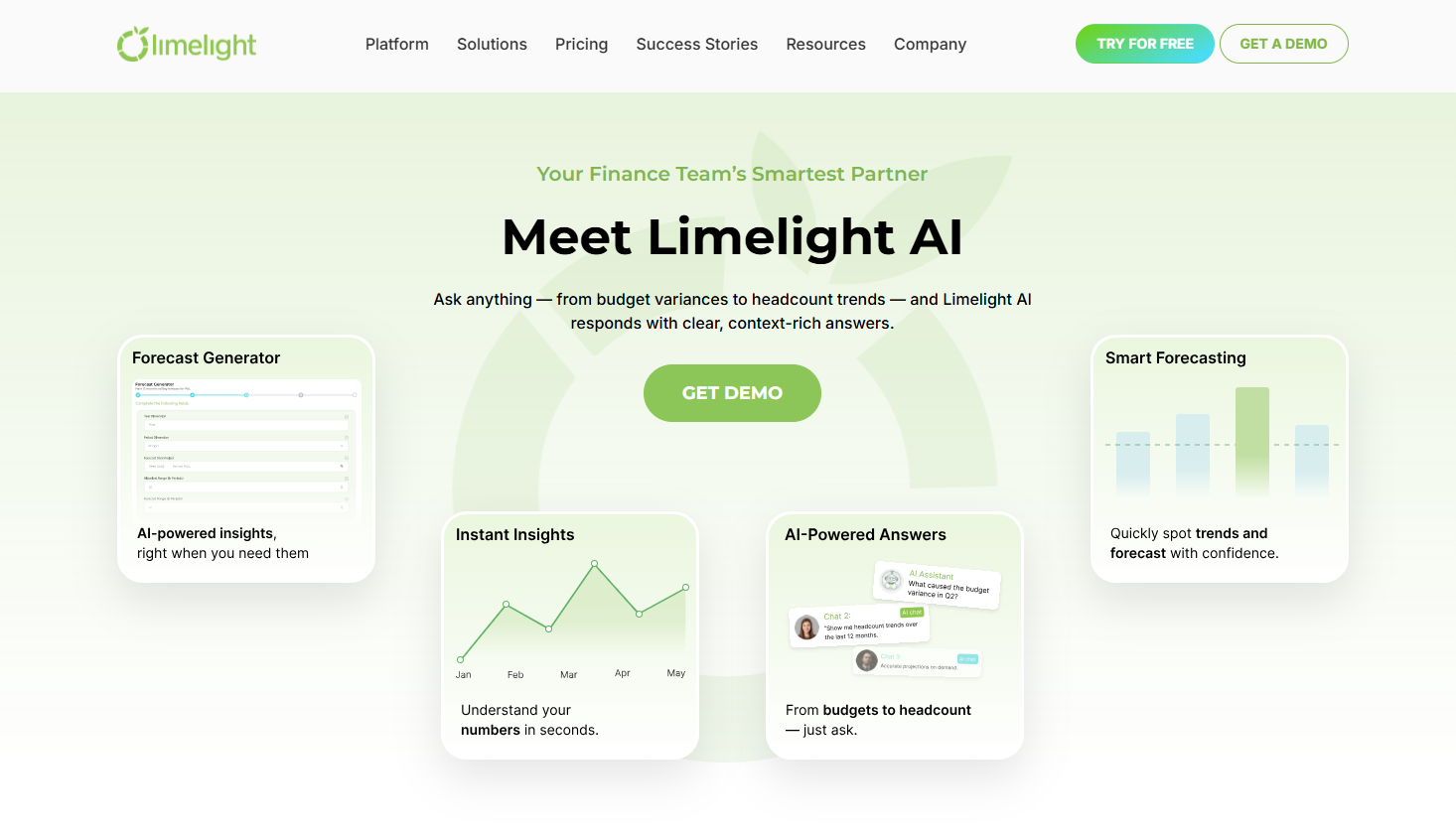
Limelight offers AI-powered forecasting and insights
Across this guide, several familiar challenges have surfaced: forecasts that become outdated between planning cycles, finance teams spending too much time preparing data, difficulty explaining variance to leadership, and disconnected systems that slow collaboration. Limelight is designed to address these issues directly.
Limelight AI brings three core capabilities together within a single platform.
Driver-based planning and forecasting connects operational variables such as headcount, pipeline activity, churn rates, and production volumes directly to financial outcomes. When those drivers change, rolling forecasts update automatically rather than waiting for manual adjustments.
ERP integrations with Oracle NetSuite, Sage Intacct, Microsoft Dynamics, QuickBooks Online, and Blackbaud remove the manual data consolidation step that consumes so much finance team time. Actual financial data flows directly from source systems into the forecasting model.
Interactive dashboards replace static spreadsheet outputs with real-time, filterable views that stakeholders across the business can explore independently. This reduces the constant back-and-forth between finance teams and department leaders when questions arise.
Workforce planning integrates HR and payroll data directly into financial models, ensuring headcount cost forecasts stay connected to revenue and expense projections instead of living in separate spreadsheets.
Teams that have adopted Limelight report meaningful improvements. Triple Crown Sports reduced report preparation time by 98%, while also improving forecast accuracy and cross-functional collaboration. Communication Services for the Deaf (CSD) cut its budget cycle time in half.

As forecasting becomes more data-driven, finance teams need tools that combine accuracy, speed, and collaboration.
See how Limelight helps finance teams forecast faster, collaborate more effectively, and move from spreadsheets to strategy.
AI is used in financial forecasting to automate data collection and cleaning, identify patterns across historical and real-time financial data, and generate driver-based predictions that update as business conditions change. AI-powered platforms can run multiple scenario models simultaneously and explain variances in natural language, eliminating the manual analysis that traditionally consumed most of a finance team's planning time.
AI enhances financial forecasting across five key areas: accuracy, time savings, real-time decision support, reduced human error, and cross-departmental collaboration. On accuracy alone, IBM's Institute of Business Value found that 57% of CFOs report fewer sales forecast errors after implementing AI. By automating data ingestion and model updates, AI also reclaims the time finance teams currently spend on manual preparation, freeing analysts for strategic work.
The six core best practices are: start with clean, connected data across ERP, CRM, and HR systems; choose purpose-built FP&A software over general AI tools; maintain human oversight and apply qualitative judgment AI cannot capture; adopt rolling forecast cadences instead of static annual budgets; build AI literacy across the full finance team; and track forecast error rate over time as a core KPI to drive continuous model improvement.
The key benefits include improved forecast accuracy, significant time savings on data preparation, real-time scenario modeling, automated anomaly detection, and reduced human error from manual data entry and formula mistakes. Together, these capabilities shift the finance function from backward-looking reporting, explaining what already happened, to forward-looking strategic analysis that helps leadership make faster, better-informed decisions.
Higher education CFOs use AI forecasting to model enrollment scenarios under varying demographic and pricing assumptions, predict tuition revenue, and track restricted fund compliance automatically as grant spending occurs. Rolling forecasts that incorporate grant pipelines and endowment performance replace static annual budgets that quickly go out of date. The result is timely, accurate financial data that gives academic leadership the confidence to make program investment and infrastructure decisions.
Yes. Purpose-built FP&A software resolves the core limitations of Excel—version control issues, formula errors, manual data consolidation, and the inability to generate real-time forecasts. Platforms like Limelight connect directly to ERP and HR systems, embed AI forecasting into familiar planning workflows, and update projections automatically as new data arrives. Finance teams that make the switch consistently report shorter planning cycles, higher forecast accuracy, and more time available for strategic analysis.
Subscribe to our newsletter